
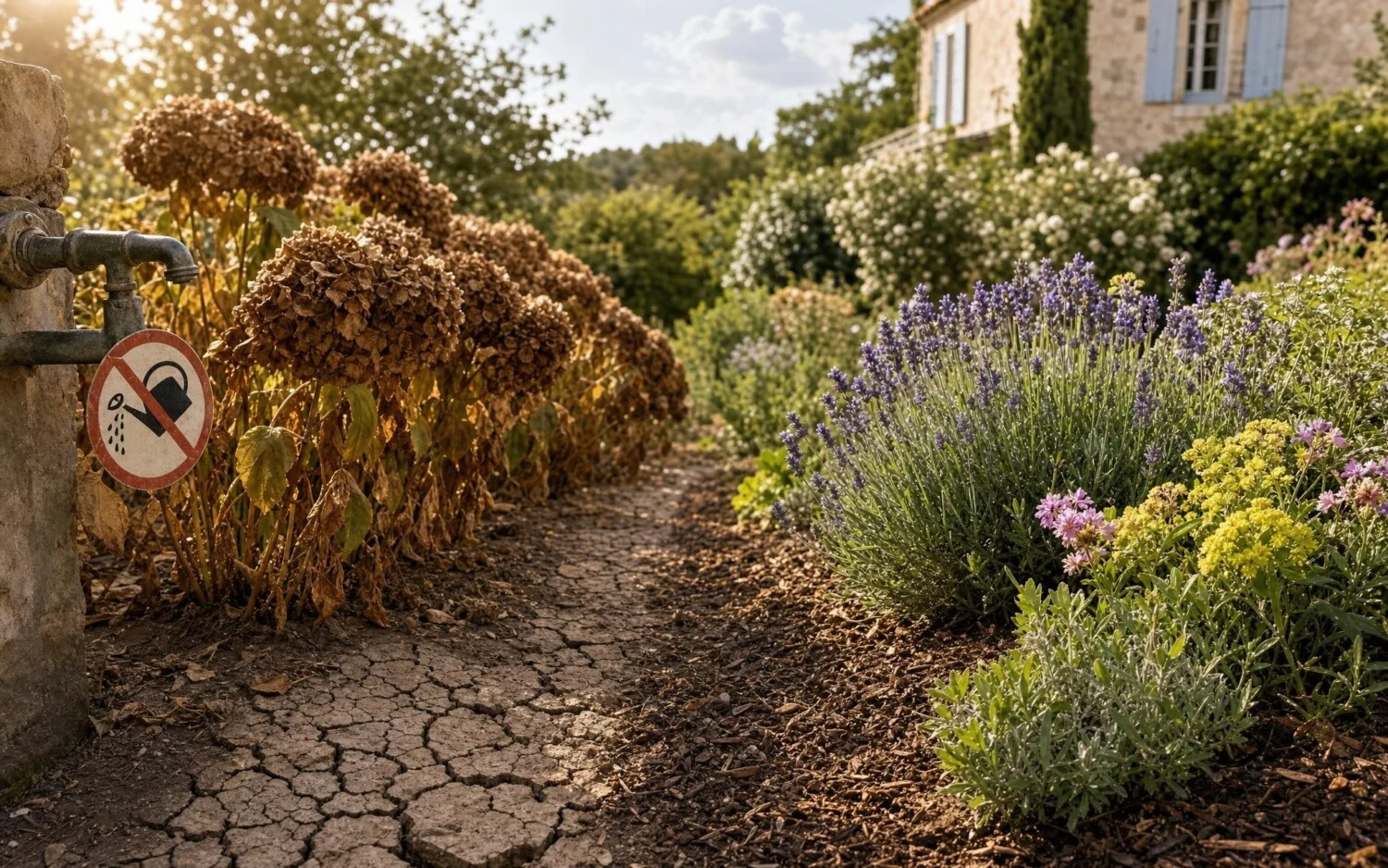
As the new season begins this autumn, many gardeners are already preparing the planting holes, dreaming of lush borders for the coming spring. One habit could disappear: planting a large flowering shrub, a symbol for decades of family gardens. Several experts warn it will become a poor choice in a large part of the country.
This plant is the hydrangea, or Hydrangea, with its spheres of flowers in white, pink, or blue. Articles from Pleine Vie, Modes et Travaux, or Mon Jardin Ma Maison report the same observation: since the major heatwaves of 2022, it has been wilting more and more often, despite watering. By autumn, many gardeners wonder whether it’s better to stop planting them. The answer isn’t simple.
Hydrangea: why this garden star is set to become rare
Since the 1950s, the Hydrangea macrophylla has established itself as an icon of Western and Northern gardens. It favors deep, rich soils that stay cool all summer, and a climate without extremes, neither too cold nor too hot. For a long time, the Atlantic façade and regions like Brittany offered these ideal conditions. The problem is that this climatic frame is receding year after year.
Over the summers, the testimonies repeat: flowers scorched in July, colors turning brown within a few days, leaves hanging and then drying out completely. Pleine Vie reports that even in Brittany, entire shrubs withered after several weeks of heat waves. In Germany or England, specialists like Isabelle Van Groeningen describe the same thing, even in shade, where air that has become too dry burns the inflorescences.
Heat and drought: when it’s best not to plant hydrangeas anymore
Hydrangeas love a humid atmosphere and soil that remains consistently cool. Yet heat waves keep coming one after another, with peaks frequently exceeding 35 °C and weeks without rain. Articles citing the ADEME explain that these shrubs, with relatively shallow roots, quickly go into water stress. When the soil dries deeply, even generous watering no longer suffices to rehydrate them properly between two heat waves.
Many gardeners then move their hydrangeas into shade, hoping to save them. Experts remind that this does not solve the air dryness affecting the entire garden. Near a large tree, the powerful roots take a good portion of the watered water and the soil still remains dry. Mon Jardin Ma Maison also mentions successive drought ordinances: in some municipalities, professionals have lost up to 70 % of their plants due to insufficient watering.
Which plants to choose in place of the hydrangea this autumn
Disappearing from gardens does not mean forbidden. Reference articles emphasize: nothing prevents keeping or planting hydrangeas in zones that remain cool and humid, near the Atlantic façade or in a sheltered corner to the north of a house. Some types, such as Hydrangea paniculata, Hydrangea arborescens, or Hydrangea quercifolia, tolerate heat a bit better.
For drier gardens, many landscape designers now recommend foregoing planting new hydrangeas and composing borders of the dry-garden type. These plants bloom for a long time, attract insects, and use very little water:
- ornamental lavenders and salvias;
- ceanothus and rockroses;
- gauras, echinaceas and fine grasses;
- some compact eucalyptus suited for gardens.
Sources
- Pleine Vie
“This pretty flower will disappear from our gardens: here is why it is (unfortunately) no longer worth planting it as of next autumn”
