
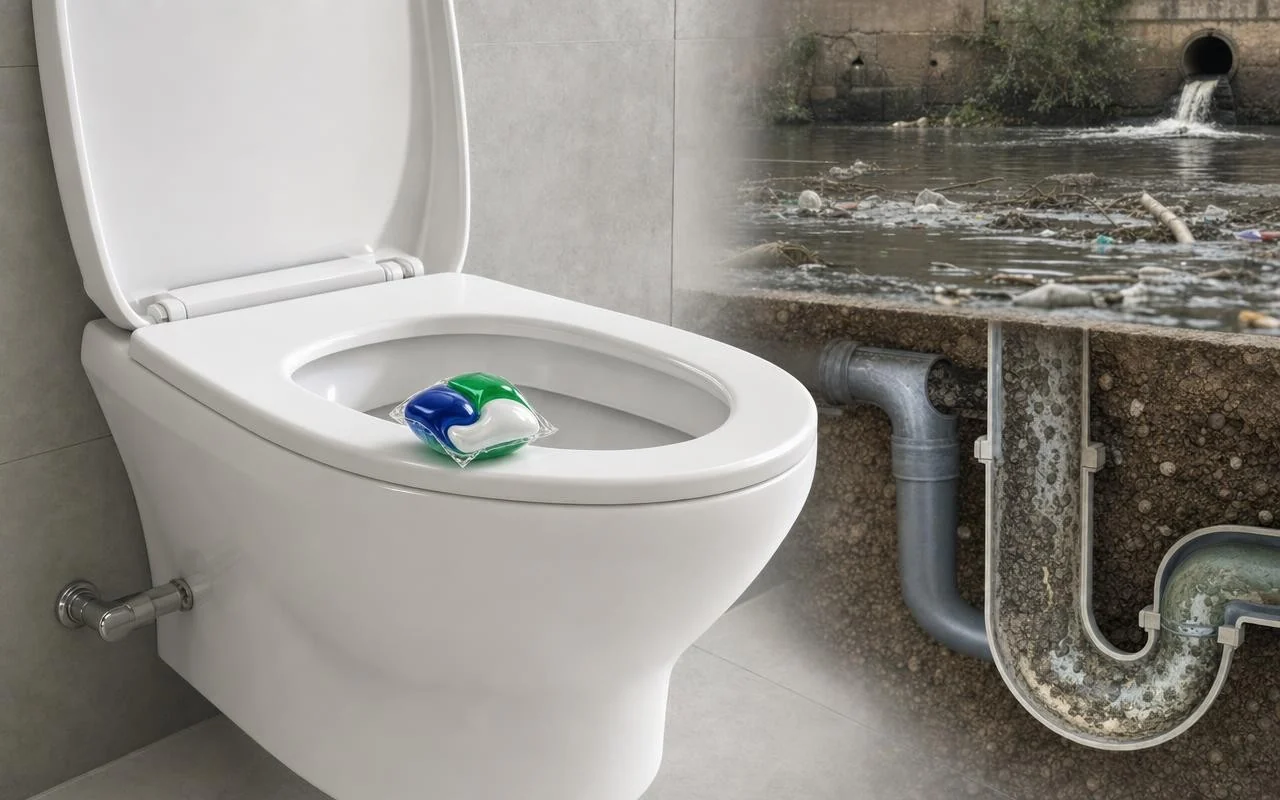
A laundry capsule falls to the floor, we hesitate to put it back in the box, and the idea quickly comes to mind: throwing it into the toilet, where it will dissolve “as in the machine.” The gesture seems harmless, almost clever, especially when you want to use it to “deodorize” the toilet bowl.
In reality, this small reflex touches an entire hidden system: your pipes, the sewer network, or the septic tank, then the treatment plant. The United States Environmental Protection Agency (US EPA) notes that one in five homes in the United States uses a septic tank, and that a poorly maintained system threatens health, the environment, and can cost thousands of dollars, i.e. several thousand euros. Behind a simple capsule, the stakes are therefore much larger.
Toilets and Laundry Capsule: The Simple Rule to Remember
The basic rule given by the US EPA is unequivocal: “Flush only human waste and toilet paper,” the agency states. Put differently, the general answer to the question “Can you flush an unused capsule down the toilet?” is no, whether the capsule is intact, opened, or slightly punctured. Cities like Montreal or sanitation unions in France broadcast the same message: toilets must not serve as a trash can for household products.
A laundry capsule remains an object, with a water-soluble shell that can stick and then swell in the traps, especially if it gets snagged by hair or other residues. It also contains a cocktail of concentrated detergents. Just because it dissolves well in a washing machine does not mean it disappears instantly in your pipes. In case of a clog or drainage failure, the intervention of a professional can be very costly, exactly what authorities aim to prevent.
Why an Unused Capsule Threatens the Septic Tank and Sewer Network
In a house equipped with a septic tank, wastewater first enters the tank, then distributes into a drainage field. Everything relies on “useful” bacteria that break down organic matter. The US EPA stresses that many chemical products disrupt these bacteria and promote blockages. An unused laundry capsule injects at once a large dose of surfactants and enzymes, which goes against this delicate balance.
For a dwelling connected to the sewer network, the problem shifts to the collective pipes and the wastewater treatment plant. Municipalities like Montreal detail how non-soluble or fatty wastes clump together to form blockages and can lead to sewer backups into basements or overflows of wastewater into waterways. Prevention flyers also classify cleaning products and disinfectants among the things never to flush down toilets.
What to Do with an Unused Capsule Without Damaging Toilets and Pipes
The best option remains to use the laundry capsule as intended, possibly adjusting the laundry quantity or washing temperature. If that isn’t possible (changing machines, moving, product no longer suitable), the important thing is to treat the capsule as household waste, not as mere dirt to be rinsed away. Some municipalities provide dedicated channels for household chemicals.
- Use the capsule in the device intended for it, adjusting the amount of laundry or the wash temperature.
- If you no longer want to use it, keep it in its airtight packaging and drop it off with the hazardous household waste during a dedicated collection, when such service exists.
- If that isn’t available, carefully wrap the capsule and dispose of it in the residual waste bin, never in the sink or the toilets.
There is a special case: some products are formulated to be flushed down the toilet, for example treatment capsules of the type “WC NET Septic Tanks” that indicate on the packaging direct use in the bowl. In this specific case, the label provides dissolution in the septic tank and takes bacteria into account. For all other capsule detergents, the rule recalled by the US EPA remains the safest: “Flush only human waste and toilet paper.”
