
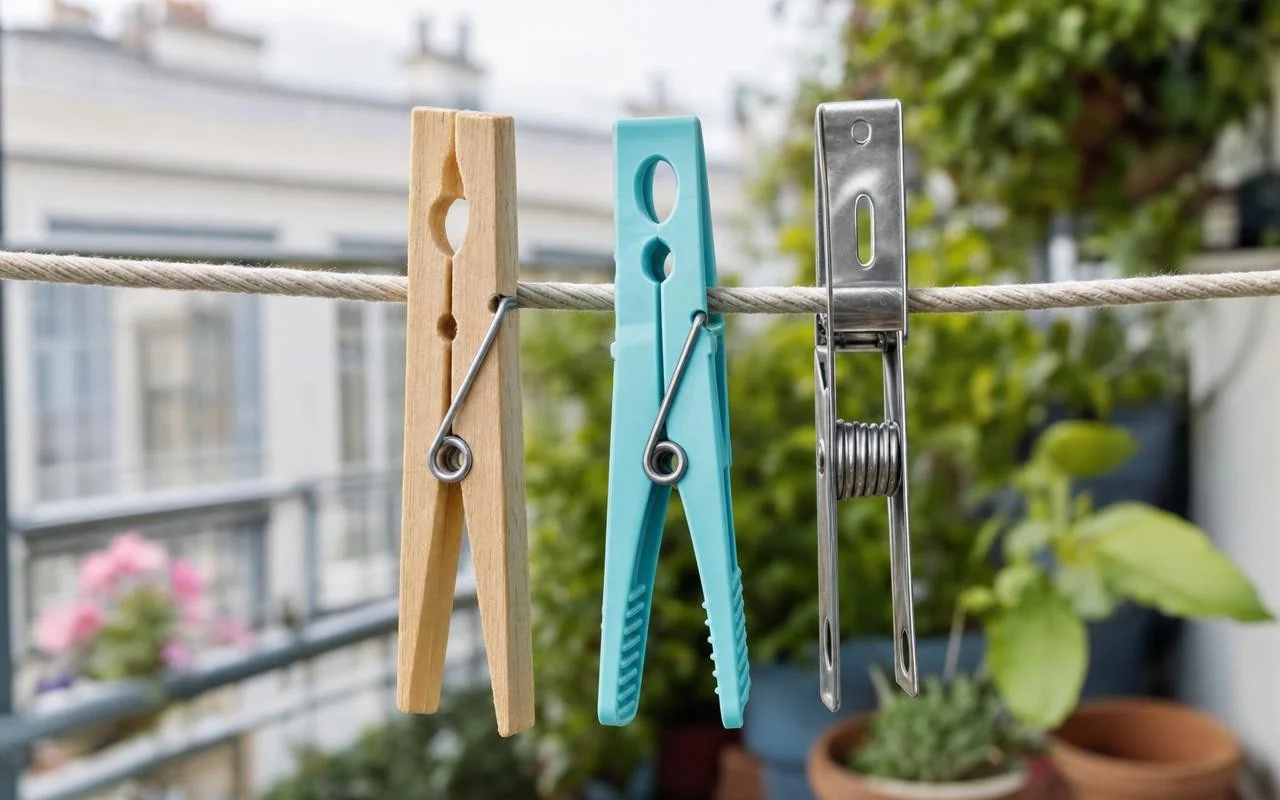
On a balcony line or at the bottom of a laundry basket, clothespins often go unnoticed. Until the day when one snaps cleanly, stains a white T-shirt, or becomes rusty. Between wooden clips, colorful plastic ones, or gleaming stainless steel varieties, many wonder which are truly worth the investment without having to replace them every spring.
The ADEME reminds us that to consume more wisely, you should choose objects that last to reduce waste and wastefulness. Clothespins used outdoors, under sun and rain, make a good case study: some deteriorate within a few months, others last for years. And yet, the material is not the sole criterion that changes everything.
Clothespins’ Lifespan: Wood, Plastic or Stainless Steel at the Forefront?
User feedback aligns: left outdoors year-round, wooden clothespins generally hold up for about six months before they crack or lose their grip, according to Maison et Travaux and Speed Queen. Plastic models last a little longer, between one and two years depending on exposure. When stainless steel is of high quality, it endures the seasons without breaking or rusting; these are then the longest-lasting clothespins.
Behind these differences lies how each material reacts to outdoor conditions. Wood is hygroscopic: it swells with moisture, dries, contracts, and eventually cracks, as detailed by an AREC Île-de-France guide on wood behavior. Plastics, often polypropylene, weaken under UV rays that cause microcracks and breakage, recalls the Canadian Conservation Institute. Stainless steel, meanwhile, resists corrosion very well, but a poor-quality spring can still fail.
What Really Wears Out Clothespins: Sun, Rain, Springs, and Storage
The leading aging factor remains leaving the pins hooked on the line year-round. Maison et Travaux notes wooden pins turning black, bending, or cracking after only a few months due to the rain-sun cycles. The tannins in the wood can also migrate and leave brown halos on light fabrics. For plastic, the same conditions accelerate discoloration and sharp breakage with the slightest handling.
Laundry specialists remind us that a simple habit changes everything: bringing the clothespins in after each wash. Speed Queen estimates that this practice can nearly double their lifespan, as they are no longer baked by the sun or drenched by rain. Some plastic-pin manuals explicitly advise not to store them outdoors and to avoid prolonged sun exposure, where they overheat, deform, and become fragile.
How to Choose Clothespins So They Last Really Long
For mainly indoor use or on a sheltered balcony, good-quality plastic clothespins may be sufficient. Prefer a thick body, a rust‑proof stainless steel spring if possible, and a wide gripping area that marks the laundry less. Wooden clothespins keep a natural charm and a good grip, but they tolerate permanent exposure poorly; with white or delicate fabrics, it’s better not to leave them damp for too long.
For maximum durability, stainless steel pins stand out. The French brand Pincinox, manufactured in Vitrolles since 1970, for example advertises a warranty valid for the product’s entire life against rust and breakage, illustrating the material’s potential when quality is ensured. The initial investment is higher, but the ADEME reminds that choosing a durable object helps avoid repeated replacements and extra waste.
