
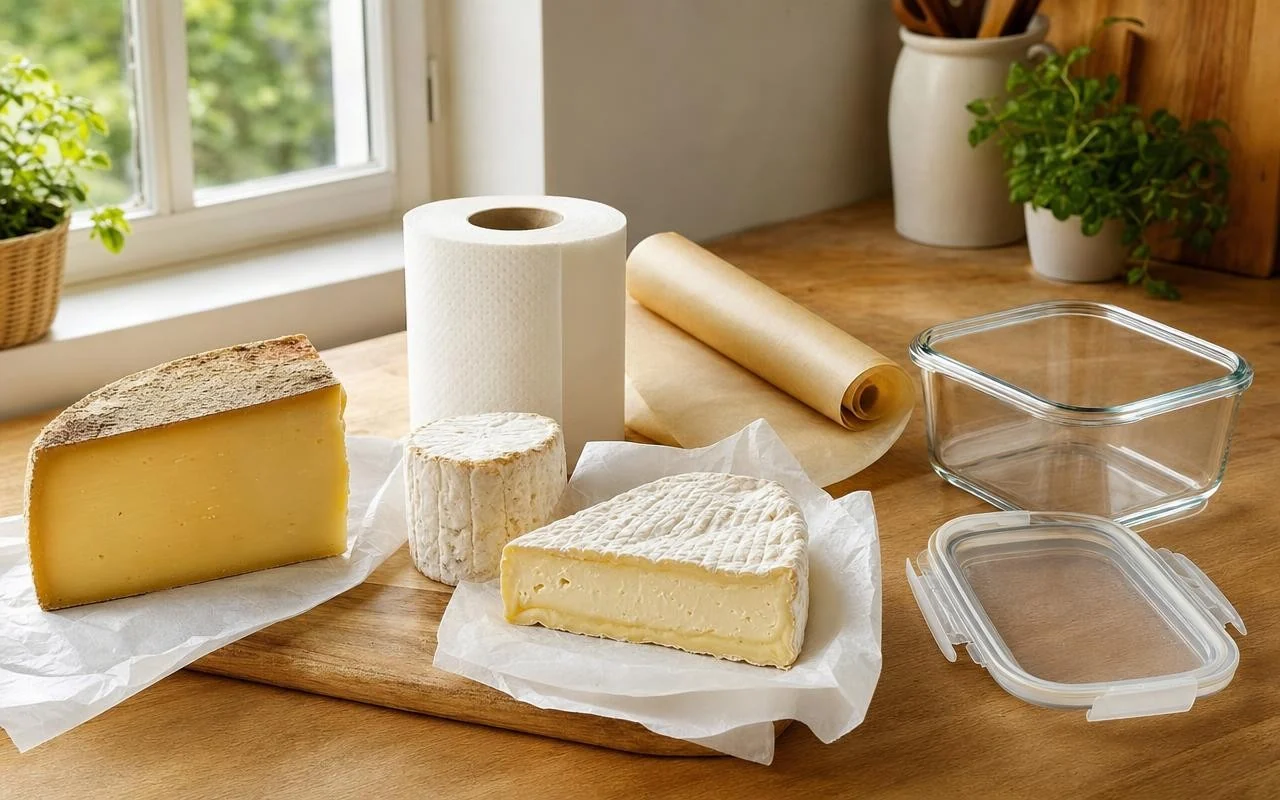
A piece of Comté that becomes coated with greenish spots in a few days, a log of goat cheese that dries out to the point of hardening… Many French people face the same puzzle: does cheese really keep well in the refrigerator, or is it our way of wrapping it that poses the problem?
A tip that circulates everywhere: wrapping cheese in paper towel before storing it in the fridge. Some swear this slows down mold, while others find that their cheese becomes crumbly. The real question then becomes: Should you wrap cheese in paper towel? The answer depends on the type of cheese and how you use this absorbing paper.
Paper towels and cheese: understanding the role of moisture
The real enemy of cheese in the fridge isn’t just the cold, it’s poorly managed moisture. In a sealed plastic bag without precautions, water vapor condenses into droplets: the surface stays wet, which fosters bacteria and unwanted molds. The FDA notes that “foods that require refrigeration should be placed in the cold as soon as you get home,” in a refrigerator set at 4 °C or lower, and well covered.
That’s where the paper towel comes in as a buffer. Tests reported by foreign press show that a sheet of absorbent paper placed in a resealable bag limits this condensation. The same logic applies to the Save Your Food association, which recommends a bottom layer of absorbent paper in an airtight box: the cheese benefits from a slightly humid environment, but excess water is trapped by the paper.
How to wrap cheese in paper towels in the fridge
The paper towel should not become the main packaging glued to the cheese for days. Cheesemongers interviewed by Martha Stewart favor cheese paper or, if unavailable, parchment paper, which allows the rind to “breathe” while retaining moisture. The paper towel then serves as an accessory, especially for hard or semi-hard cheeses.
- Wrap the cheese in cheese paper or parchment paper.
- Place a dry, folded paper towel at the bottom of a box or a resealable bag.
- Put the cheese on top, then close without squeezing out all the air.
- Store the whole thing in the vegetable drawer, a slightly more humid and less cold area.
As a temporary option, some experts mention a very slightly damp paper towel around a cheese, tucked into a bag to prevent drying out. This technique is sporadic and requires close monitoring. As soon as the paper becomes damp or stained, it should be replaced to limit microbial risk.
Cheese, paper towel and mold: when not to
For fresh cheeses (mozzarella, brined feta, fromage blanc, very young goat cheeses), paper towel is not suitable: it draws out the liquid that protects them and makes them age too quickly. It is better to keep these products in their original packaging or in a closed box, at a constant 4 °C, as the FDA recommends. If an unexpected mold appears on this type of cheese, USDA guidelines advise discarding it.
Another delicate case: grated or pre-sliced industrial cheeses. Absorbent paper does not provide enough security for a product already highly exposed to air; in the presence of mold, it should be thrown in the trash. For a piece of Comté or Gruyère, the USDA recommends cutting at least 2.5 cm around and beneath the affected area, then rewrapping properly. After that, a suitable paper wrapping, complemented by a paper towel at the bottom of a box in the crisper drawer, helps extend the life of the cheese without drying it out or flooding it.
