
Familiar scene: someone leaves the living room, the light stays on, and a voice immediately comes from the hallway, “Turn off the light!”. This reflex has become a symbol of ecological common sense, almost an educational reflex passed down from generation to generation, just as turning off the tap or not wasting food.
Energy specialists, however, nuance this gesture: turning off the light every time does not always yield as much savings as one might imagine, and sometimes it mainly wears out certain bulbs. It all depends on the type of lamp, the duration for which the room remains empty, and the household’s equipment. The habit remains useful, but the real rule is a little different.
Why turning off the light when leaving a room doesn’t always pay off as much
For a long time, a myth circulated: turning a lamp back on would consume more than leaving it on for a few minutes, due to a supposed power surge. Energy comparators and specialized agencies remind us that this extra consumption lasts only a fraction of a second and weighs very little on the bill. The real issue lies more with the lifespan of certain bulbs subjected to repeated on/off cycles.
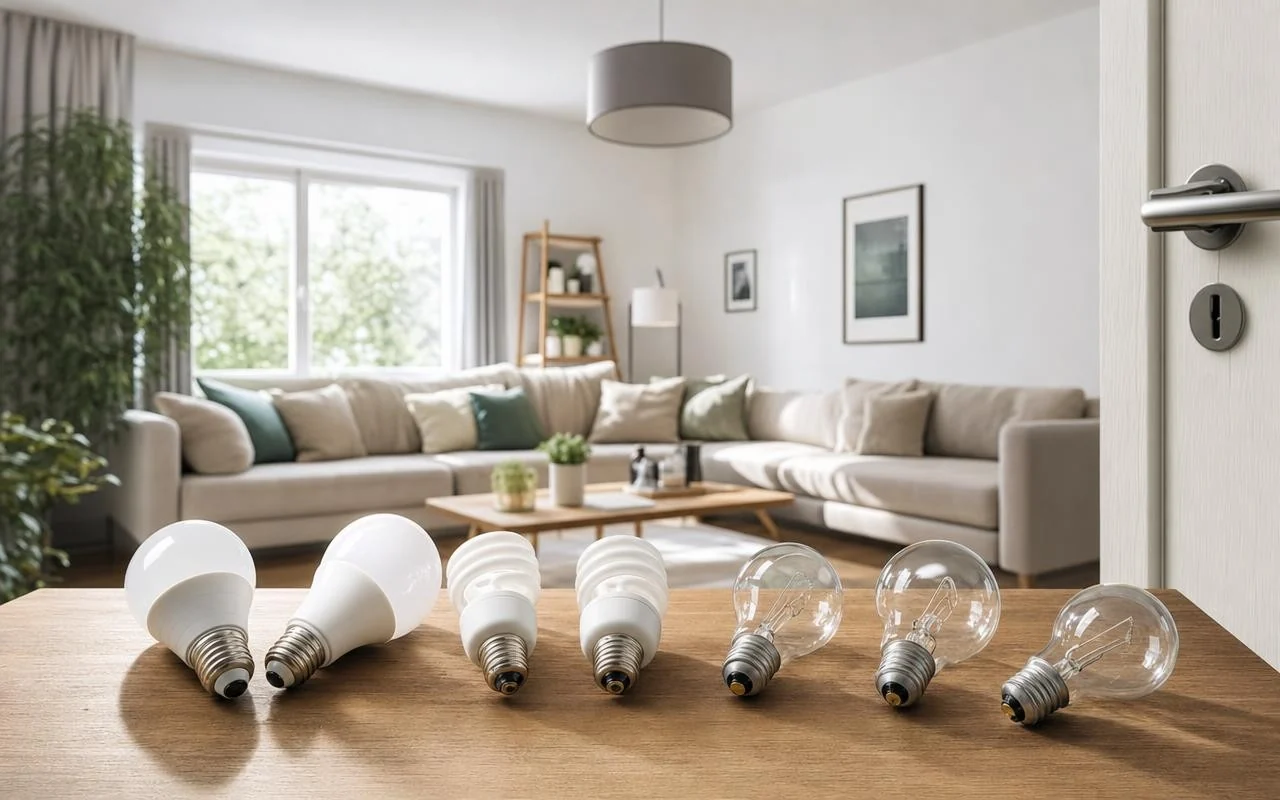
The old incandescent bulbs remain the least efficient: only about 10% of the energy becomes light, the rest becomes heat, for a lifespan of 750 to 1,000 hours. Halogens do a bit better, but 80–90% of the energy still turns into heat, with 1,000 to 2,000 hours of service. Compact fluorescent lamps, meanwhile, show about 85% efficiency and run around 8,000 hours, but they cope poorly with very frequent switching. As for LED bulbs, they can use up to 90% less energy than incandescent ones and last about 25,000 hours.
Turning off the light when leaving a room: the simple rule according to bulb type
For experts, the right way to turn off the light when leaving a room comes down to a simple rule that is easy to remember. LED bulbs can be switched off as soon as the room is empty, even for a few seconds. Compact fluorescents benefit from remaining on if the absence is very short, because it is mainly the repeated cycling that reduces their lifespan.
- With a LED bulb: turn off as soon as you leave the room, even for a minute.
- With a compact fluorescent lamp (CFL): switch off only if the room remains empty for more than 15 minutes.
- With a halogen bulb: switch off systematically when leaving, as it consumes a lot.
- With an incandescent bulb: turn off at every departure and replace as soon as possible with an LED, which can represent about €72 in savings over the bulb’s lifetime.
In a hallway or toilets still equipped with CFLs, constant back-and-forth trips end up wearing out the bulb for only limited energy savings if each passage lasts only a few seconds. In an office or a bedroom where one steps away for a quarter of an hour to make a call or cook, turning off the light remains worthwhile, even for these more sensitive models.
Turning off the light when leaving a room: automate and aim for the real saving points
Once the right reflex is adopted for each technology, other levers can further reduce the bill without requiring thought. Motion sensors, presence detectors, and timers automatically switch off lights in transitional areas. Zone lighting, lighting only a few LED lamps rather than a single energy-hungry ceiling fixture, further limits consumption.
Calculations published by a comparison site show that a small 6 W LED costs about 0.12 euro per hour when lit, which remains modest taken in isolation. Heating, however, weighs far more heavily: more than 60% of a dwelling’s energy consumption. “Just with our daily lives, I think we can change things on our scale!” testifies a private individual questioned by EDF. In this logic, choosing LEDs, applying the 15-minute rule to CFLs, and prioritizing heating are three avenues frequently highlighted.
