
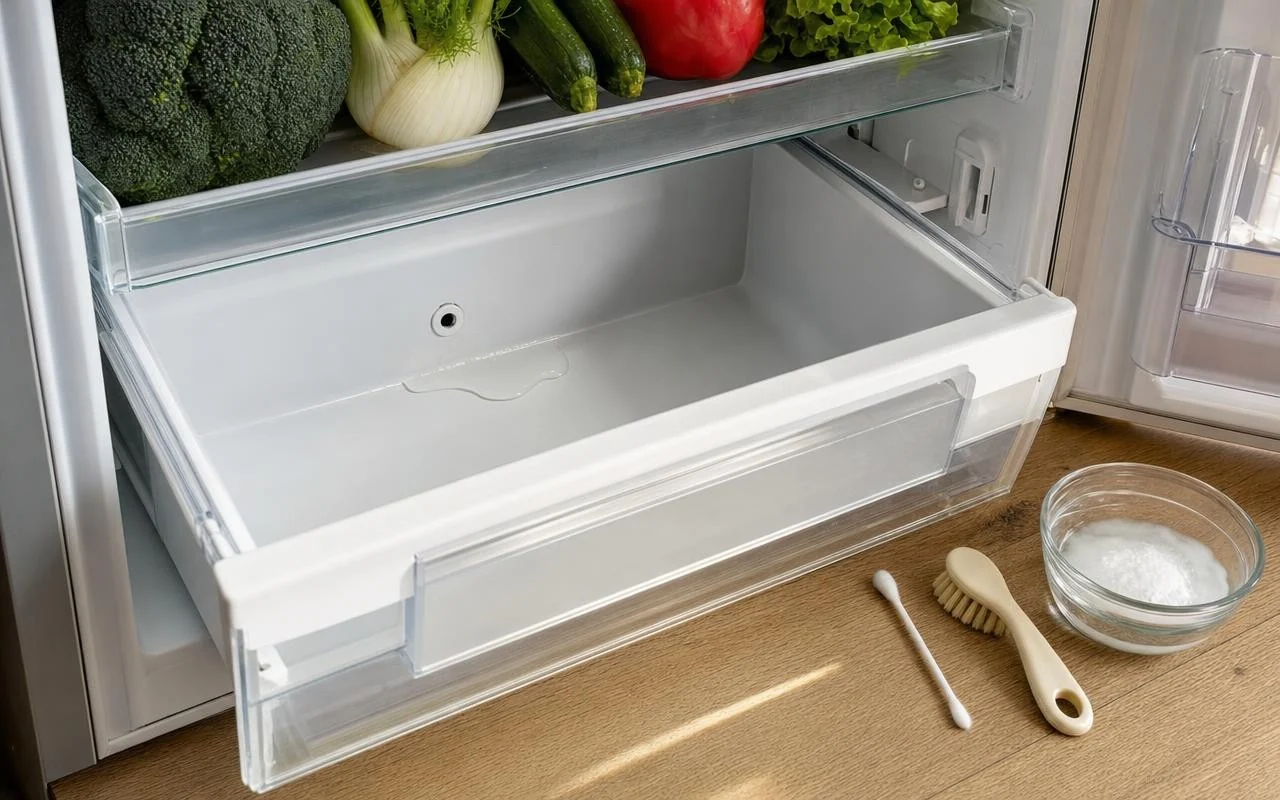
One morning you open the fridge and notice a small puddle under the last vegetable drawer. You wipe it up, blame the tomatoes that are a bit damaged, maybe you nudge the thermostat a notch… until the water returns, again and again. Some people call a repair technician directly, while cleaning experts remind us that a simple gesture is often enough to fix the problem.
Because this water under the vegetable bin often reveals a clogged fridge drainage hole. A tiny opening, discreet at the bottom of the appliance, that manages condensation and defrost water. When it gets blocked, the lower drawer becomes a small pool, bringing humidity, odors and microbes. And this little forgotten hole can create more trouble than you might think.
Water Under the Vegetable Bin: the Fridge Drain Hole’s Crucial Role
In a fridge that is in good condition, the water formed by condensation on the back wall flows along a gutter or defrost channel toward a(n) evacuation opening. This water then travels through a small conduit to a recovery tray or evaporation tray located at the back, near the compressor, as explained by Liebherr and Miele support services. This system also regulates humidity to keep the vegetable bin in proper conditions.
When this opening becomes encrusted with food remnants, dirt or mold, the water no longer drains away. It stagnates beneath the lower drawer, causing accelerated dirt build-up, odors and the proliferation of bacteria. The Anses notes that “a temperature below +4 °C indeed slows down the growth of micro-organisms such as the bacterium Listeria monocytogenes, and stops the growth of most pathogenic germs such as Salmonella enterica.” A refrigerator that is well-regulated thus limits risks, but a warm puddle loaded with residues provides an ideal field for microbes and molds.
A Fridge Drain Blocked: The Right Steps Experts Recommend to Clean It
Maintenance specialists first emphasize safety: before any intervention, unplug the appliance. The experts cited by OkDiario then advise removing the vegetable drawer to access the gutter and the opening. Some manufacturers, such as Electro Dépôt in their troubleshooting guides, also recommend checking the manual, since each model has a somewhat different maintenance system.
Once access is cleared, the method remains straightforward:
- Manually remove the large visible debris from the defrost gutter.
- Carefully insert a flexible tool (a thin brush, a pipe cleaner, a plastic cotton swab, or a small nylon brush) into the drain hole, never forcing it.
- Pour a little warm water mixed with white vinegar to help dissolve deposits and verify that the flow reaches the evaporation tray.
- Wipe the gutter, the vegetable bin and the area around the opening thoroughly.
- Reconnect the fridge only when everything is completely dry.
Manufacturers discourage any metal or sharp object, which could perforate the conduit or push the clog further along. The Anses also warns against using concentrated bleach directly on the walls, as it risks “aggressing the surface and creating crevices that favor microorganism settlement,” so it is preferable to stick to soapy water and vinegar for this area.
Preventing the Return of Water and Microbes to the Vegetable Bin
To prevent the opening from clogging again, brand manuals such as Liebherr advise regularly checking that nothing sticks to the back walls and not overloading the lower drawer. A monthly check of the gutter and the drain hole, a simple cotton swab pass and a little water with vinegar already reduce the risks. The door seal also deserves a look: if it doesn’t seal properly, condensation increases and water returns faster.
On the hygiene side, the Ministry of Agriculture reminds us that “you must immediately clean up any spilled food and thoroughly wash the inside of the refrigerator, disinfect it, rinse it and, above all, dry it well with a clean cloth.” Keeping the fridge at 0 to 4 °C, removing dusty excess packaging, drying the gutter after each major spill, and keeping a clean sponge reserved solely for this purpose constitute a simple set of reflexes. If despite these measures the water comes back quickly, if thick frost forms or if water leaks outside, Electro Dépôt guides recommend contacting after-sales service or an authorized technician rather than attempting to dismantle the hidden defrost circuit yourself.
Sources
- Top Santé
“Fridge: this area that everyone forgets to wash becomes a bacteria nest and ends up in your drinks this summer” - Marie France
“This simple act with this natural mixture blocks microbes in your fridge, but few people do it”
