
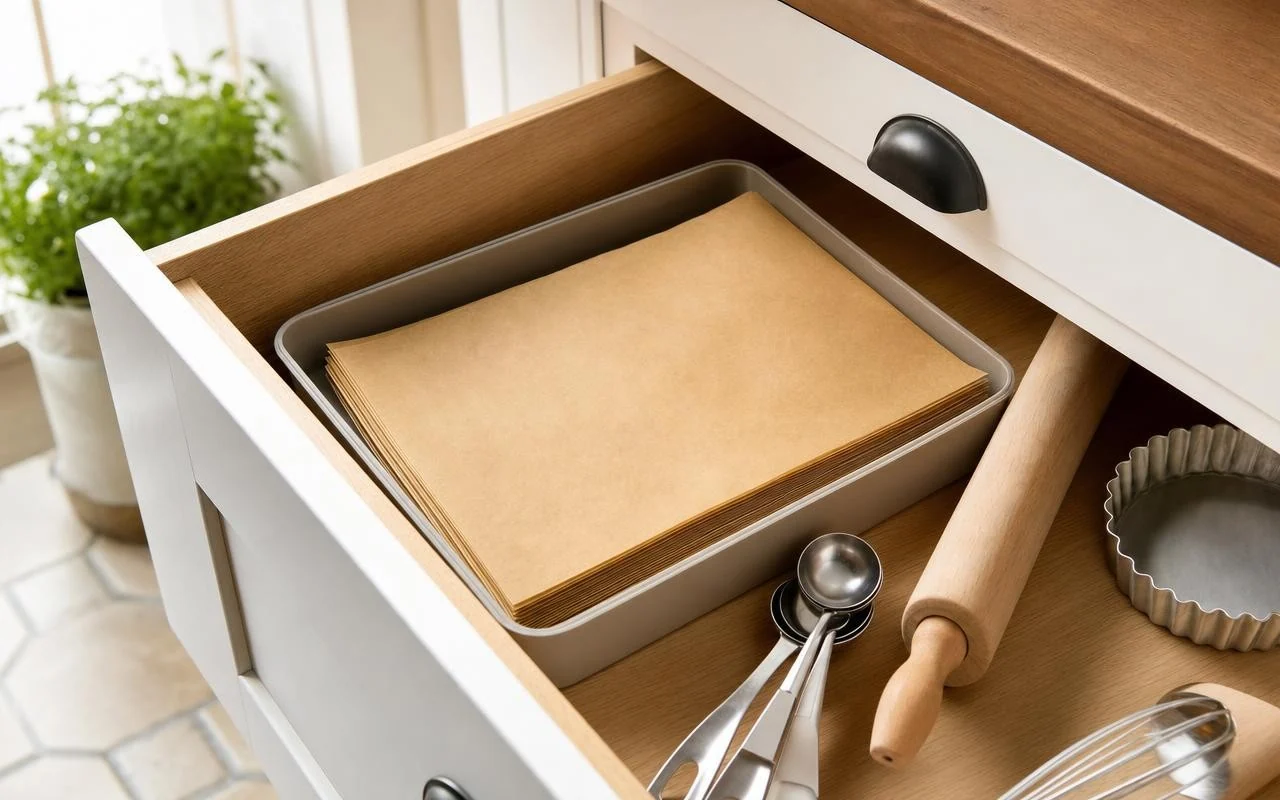
You have carefully cut your parchment sheets to match the size of your baking trays, and once the batch is finished, everything ends up rolled into a ball in a drawer. When you go to reuse them, the edges kink, the paper tears easily, and nothing stays flat. It wastes time, wastes material, and the dough ends up slotted exactly into the folds.
Sites such as King Arthur Baking, Maison-Travaux, or Selunohome-france show that a few simple gestures are enough to stow pre-cut parchment without crumpling. The principle is to respect the paper’s fragility, control moisture, and pick suitable storage supports. The difference is made at the moment of storage.
Why parchment paper crinkles: folds, moisture, and odors
When you dump sheets that are already cut loose into a drawer, they endure irregular pressures: pots slide, cutlery presses down, doors slam. The paper retains every crease, which explains those annoying undulations. King Arthur Baking also notes that reused sheets, at room temperature, can become sticky, wrinkled, and sometimes odorous if they’ve absorbed a lot of fat.
The kitchen environment plays a big role. Near a kettle, dishwasher, or a still-warm burner, steam relaxes then re-wrinkles parchment. Selunohome-france emphasizes this humidity factor as the number-one enemy of flat parchment sheets. Maison-Travaux adds that parchment that’s still greasy or damp, stored without drying, deforms much faster.
The golden rule for storing pre-cut parchment: keep it flat
The simplest advice comes from King Arthur Baking: lay the sheets flat, well spaced, on top of a stack of baking trays. Pastry chef PJ Hamel explains that she places her used parchment on the top of her stack of rectangular trays, which gives her a flat surface with good air exposure. The paper stays flat, dries quietly, and remains within reach for the next batch.
For fresh, pre-cut sheets, you can keep the original packaging if it’s designed to prevent curling, as highlighted by Toppits with their optimized packaging. Ideally, store the pack horizontally on a shelf, with nothing heavy on top. In a humid kitchen, Selunohome-france recommends, once the sheets are thoroughly dry, sliding them flat into a zipped pouch or a large plastic folder, leaving a bit of air space.
Used sheets: freezer, zip bag, and a gentle defolding
For parchment that has already been used but is still relatively clean, King Arthur Baking offers a surprisingly practical method: let the sheet cool completely, remove crumbs and bits of dough, then carefully fold it into four and slip it into a large zipped bag. The bag goes into the freezer. The cold locks in fats, neutralizes odors, and prevents the parchment from crumpling in a crowded drawer. Some cooks even keep two separate bags, one for sweet applications and one for savory ones.
One last tip to truly prevent parchment from curling: fix small defects before use. Selunohome-france suggests running a metal ruler from the center toward the edges, applying light pressure to smooth out beginning creases. To keep your sheets in good shape, a few practical habits really help:
- do not store them near steam sources or direct heat;
- never trap them under heavy or sharp objects;
- always let freshly used parchment dry slightly before storing;
- avoid tightly rolled packages that leave lasting marks on the paper.
With these simple habits, storing parchment sheets becomes quick, and your baking surfaces are ready in moments, with not a single crease to worry about.
