
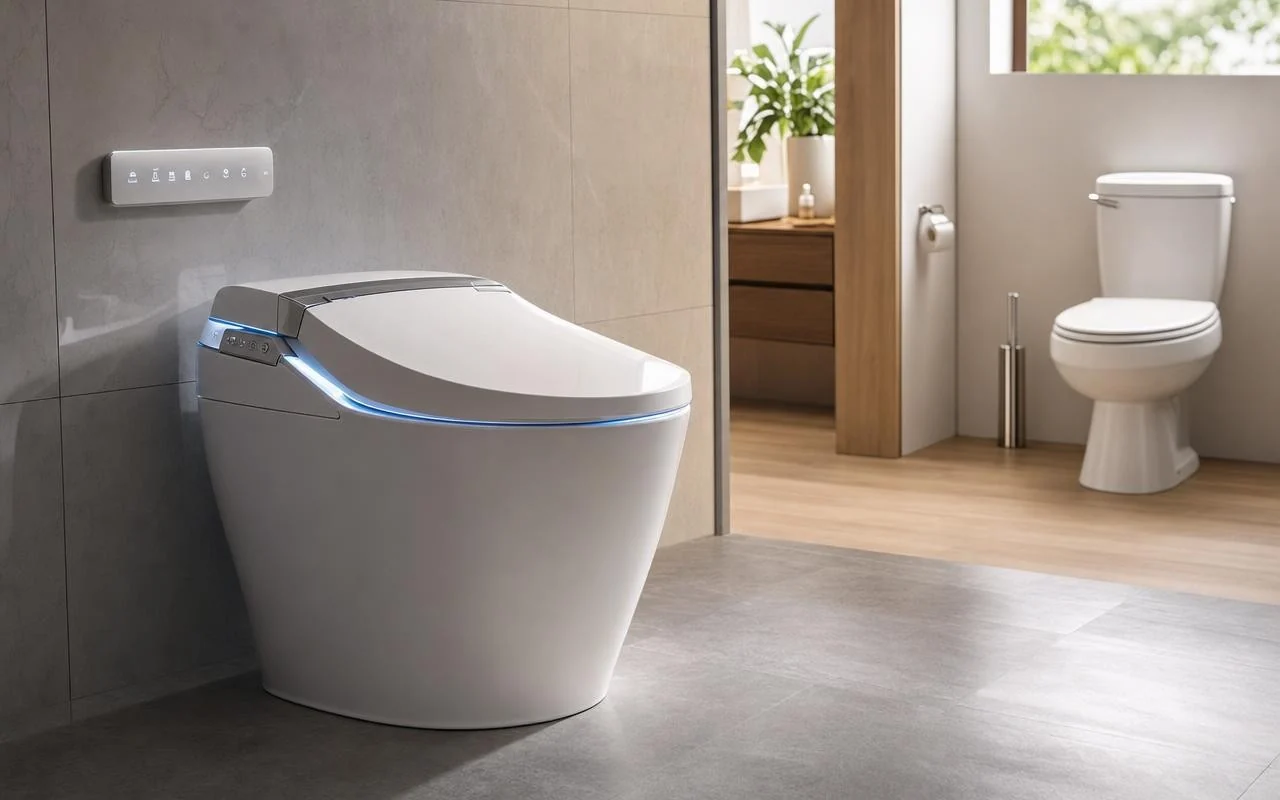
For decades, the classic bathroom fixture remained the same: a white ceramic toilet, a flush, and toilet paper. Simple, effective in appearance, almost invisible in the décor. In Spain, this backdrop is changing: in hardware stores and showrooms, a new type of sanitary ware is beginning to take the place of this historic model.
After the kitchen and home automation, the world of toilets is entering the high-tech era. Spaniards are discovering equipment that washes, dries, lights up, and cleans itself, with the aim of being more modern, cleaner, and more functional than the standard white toilet. What lies beneath this bowl has little in common with our old porcelain throne.
Japanese toilets: the smart sanitary that upends the white toilet
This announced replacement is the Japanese toilets, also known as smart toilets. In practice, they are toilets equipped with electronics and automated systems: a bidet nozzle with adjustable positions, water pressure and temperature that can be customized, sometimes warm-air drying, heated seat, nocturnal LED lighting, or even automatic lid opening. The idea is to integrate the bidet’s functions directly into the bowl.
The concept originates from Japan. The Toto brand launched its first Washlet seat in 1980, inspired by warm-water models used in Japanese hospitals since the 1960s. The Japanese government estimates today that more than 80% of households with two or more people have a toilet with an electronic bidet. Long confined to Asia, this technology is now reaching Spain, where manufacturers like Roca offer complete smart toilets.
Functions of Japanese toilets: hygiene, comfort and less toilet paper
The flagship function remains washing with water. A retractable nozzle emerges under the lid and projects a precise water jet onto the intimate area. The user selects the position, temperature, and intensity; some models even provide a gentler jet adapted to female anatomy. This philosophy aligns with the Nordic countries, where water is already preferred over paper, as illustrated by the rise of bidet attachments described in Scandinavia.
More advanced models add hot-air drying, with several temperature levels. In this scenario, the use of toilet paper is significantly reduced, though not necessarily eliminated. Self-cleaning systems rinse the nozzle after each use, some integrate an ultraviolet disinfection light or a stain-resistant glaze inside the bowl. There are sometimes integrated deodorization, presence sensors, and a heated seat, delivering an experience very different from the traditional white toilet.
How much does a Japanese toilet cost in Spain and what options exist for outfitting?
The market isn’t limited to full smart toilets. Specialized articles distinguish three major families. At the entry level, non-electrically powered bidet accessories that attach under the existing seat. This is the principle behind the small spray nozzles popularized in Nordic countries: a flat box, one or two jets, a simple connection to the water supply. The cost remains modest, typically between 40 and 90 euros, with installation advertised at about ten minutes.
Next come the electronically washing seats, which replace the seat on a compatible bowl. They provide water washing, fine adjustments, and a heated seat, sometimes with basic drying. The entry price frequently exceeds 1,000 euros. At the top of the range, complete smart toilets, such as the In-Wash Ona or In-Wash Inspira models from Roca, start around 1,900 euros and can exceed 2,600 euros, excluding installation, depending on options for drying, deodorization, or UV light.
Water supply, electricity, maintenance: what Spaniards check before leaving the white toilet
Before adopting a Japanese toilet, Spanish guides remind of a few basic checks. For a complete toilet or an electronic seat, you need a grounded power outlet in close proximity to the bowl, a suitable water supply, and adequate pressure. The dimensions of the bathroom also matter, as does space on the side for the remote control or control panel. When only an electronic seat is involved, compatibility with the shape of the bowl (round, oval) remains essential.
Maintenance is another factor to watch. The self-cleaning nozzle and non-stick coatings simplify life, but do not substitute for regular cleaning or descaling in limestone-rich regions. In practice, many Spanish tenants start with a non-electrical bidet accessory or a handheld spray, which is easier to install and portable. Property owners undergoing renovations, meanwhile, lean more toward full smart toilets to permanently replace their standard white toilet.
Sources
- Maison & Travaux
“Farewell to your old toilet brush: this much more hygienic version is taking over in toilets by 2026”
