
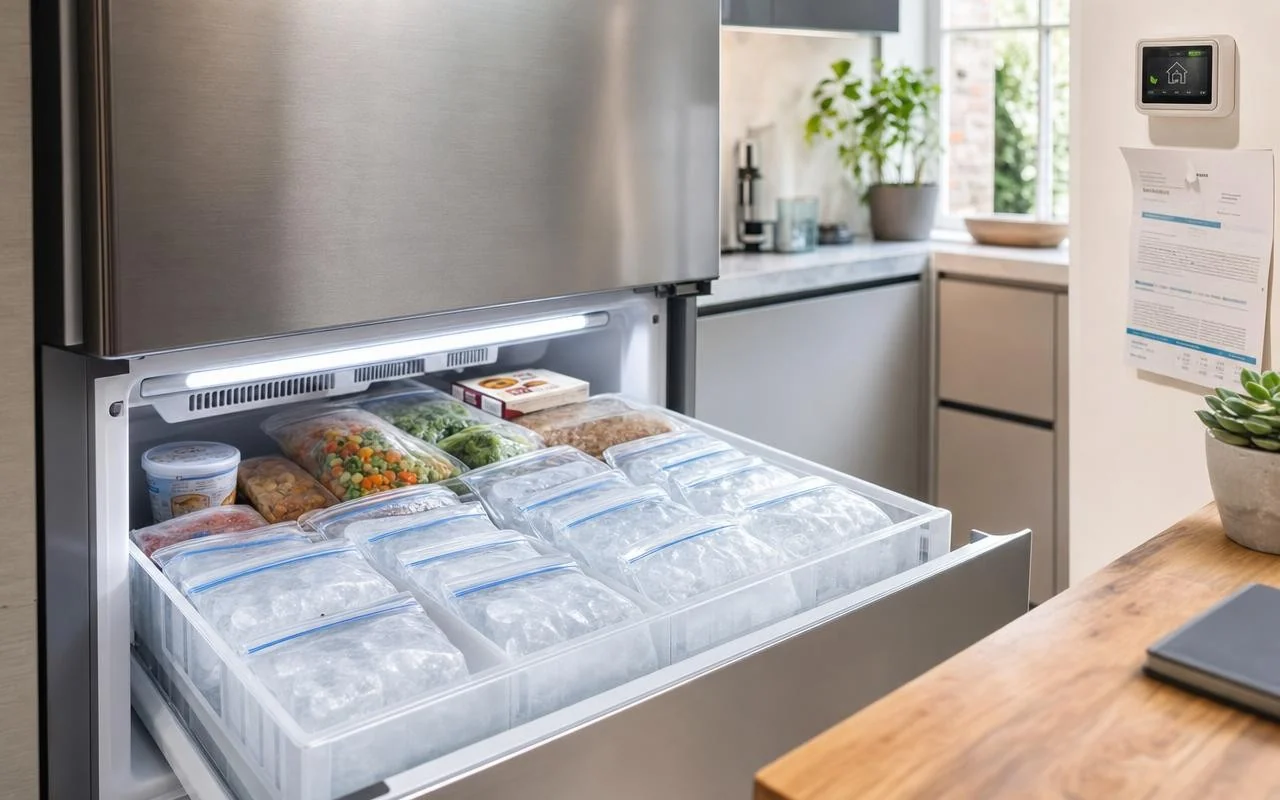
In Spain, a habit is taking hold as October approaches: filling the freezer with water bags. Originating in the United Kingdom and then relayed by media outlets such as OKDIARIO, this tip is reaching households anxious about their electricity bill. At first glance, the idea seems anecdotal, almost gadget-like, especially when the freezer already appears to be energy-efficient.
In Spain, media outlets recommend that all households keep these water bags in the freezer precisely in October, and it’s no accident: the cold season is coming, appliances run more, and everyone looks for the smallest gesture to ease their budget. The water-bag-in-the-freezer trick promises a more stable appliance, a less-strained compressor, and, ultimately, a few euros saved over the year. It remains to understand how a few litres of water can help a freezer.
Why water bags in the freezer in October in Spain
The principle, explained by OKDIARIO, is summed up in one sentence: “Replace empty space with ice.” In other words, when you open the door, the less empty space there is in the drawers, the less hot kitchen air can enter. That air must then be cooled, so the compressor starts up more often. With blocks of ice, the amount of free air decreases and the interior temperature fluctuates less.
By filling the empty spaces with frozen water, you create a reserve of cold that takes longer to warm up than air. Spanish media remind that well-filled drawers leave less room for room air to slip in each time the door is opened. The motor works less, heats less, and, in the long run, its lifespan increases, according to advocates of this method.
How to fill your freezer with water bags safely
Before filling your freezer with water, you must choose the right bag. The DGCCRF has reminded since February 18, 2026 that only a material intended for contact with food is acceptable. These containers are identifiable by the glass-and-fork pictogram or by the label “suitable for foods.” It sums up: “Whether you are a professional or a consumer, use only utensils and containers designed for cooking or storing foodstuffs,” to avoid exposing consumers to danger. For freezing, a specific indication is also required, for example a snowflake or a temperature range including -18 °C.
For this trick, Spanish recommendations talk about hermetically sealed freezer bags or clean plastic bottles, avoiding glass. When filling, you must not fill all the way to the top: OKDIARIO advises about three-quarters full, because water expands when freezing and can burst the container. On No Frost models, specialists also emphasize one point: never block the air outlets at the bottom of the freezer, to avoid disrupting the circulation of cold air.
Electricity savings: what do water bags really achieve
The figures cited by OKDIARIO for this method are modest. The outlet talks about a reduction of between 5 and 10 % of the freezer’s own consumption, i.e., only 3 to 8 euros per year on the electricity bill. It adds that “the economic impact is very small, because modern freezers are efficient.” The main benefit would therefore be primarily to protect the appliance and its motor.
Some French media outlets, such as Maison et Travaux or Pleine Vie, remind that filling your freezer with water can remain a useful addition, provided you do not block ventilation and you remove the bags as soon as you store food. They emphasize that a freezer properly set to around -18 °C, with gaskets sealing properly and with the door kept open as little as possible, will have a far larger effect on the bill than this simple water-bag trick.
Sources
- Maison & Travaux
“How to recognize a bag truly suited for freezing”
