
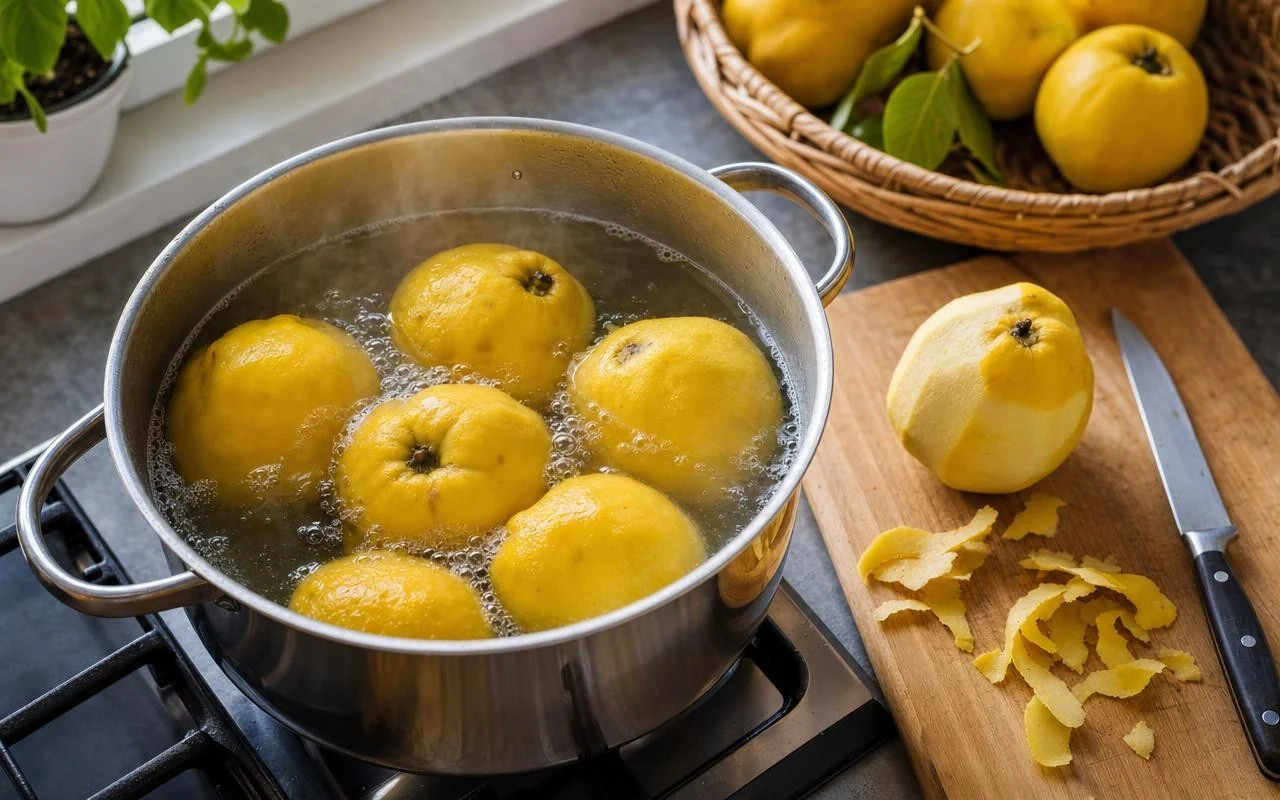
Facing a basket of quinces that are a vivid yellow, many cooks hesitate. An autumn fruit par excellence, the quince is fragrant, generous… and dreaded for its hardness. Between the tough skin, the stone-like core, and the irregular shape, peeling raw quickly turns into a weightlifting session, with a knife that presses and a real risk of slipping.
Food experts, but also passionate hobbyists, nevertheless repeat the same trick: to peel a quince easily, you simply pass it through boiling water before pulling out the peeler. A simple method, validated by experience, that requires just a bit of control to avoid wholly softening the flesh nor depriving the skin when it is useful for certain recipes.
Why raw quince is so hard to peel
In a TF1 report, the journalists remind us that “the quince has the peculiarity of never being eaten raw.” Its very firm flesh, almost woody when fresh, explains this rule. The channel also notes that “the quince saves us the drudgery of peeling, but beware, the cutting is delicate.” Between the hard seed and the bumpy shape, keeping the fruit steady on the cutting board becomes tricky.
This dense structure makes the skin very adherent, especially on large fruits that are still a little green. Trying to slide the blade between the two requires strength and precision. Yet the quince always ends up cooked: in compote, in paste, poached or roasted. Heating the fruit before peeling therefore seems coherent. For jellies and jams, some even cook it with the skin, rich in pectin, which further reduces the need to peel raw.
Boiling quinces before peeling: the step-by-step method
According to an article from the Spanish media Okdiario, the heat of the water helps soften the outer layers of the fruit and loosens the skin, which detaches much more easily. An Argentine cook, on her Instagram account, sums up the trick as follows: “The thing is to plunge the quinces into boiling water for a few minutes and remove them when the skin becomes softer. Then, let them cool enough to handle safely. Once you can hold them safely, you can remove the skin with a peeler or a suitable knife,” she explains.
Concretely, one can proceed as follows:
- Thoroughly wash the fruit and rub the fuzz with a towel or a brush.
- Fill a large pot with water and bring to a boil; the quinces should be fully covered.
- Immerse the whole quinces; for small ripe fruits, about ten minutes, up to 15–20 minutes for larger quinces, while monitoring.
- Test with the tip of a knife: the flesh should barely yield on the surface, without being mushy at the core.
- Remove them with a slotted spoon, let them cool slightly, then peel with a knife or a peeler: the skin will come off much more easily.
Cooking time, quince texture and when to keep the skin
Okdiario warns that extended cooking in boiling water can over-soften the pulp and complicate cutting into neat quarters, especially if aiming for firm pieces. For a recipe like Nicole Fagegaltier’s, where the pan-fried quince should stay “both firm and melting” after about twenty minutes of gentle cooking, it’s better to retain a flesh that remains well-held after the water treatment, adjusting by one or two minutes rather than forcing with the knife later if the skin resists.
Not everything requires peeling the fruit. For jellies and certain jams, cooking sites remind us that the skin concentrates a lot of pectin, valuable for achieving a good set texture: one simply washes the quinces carefully and removes the fuzz. Conversely, for desserts with neatly defined quarters, roasted quinces, a very smooth purée, or refined savory preparations, boiling the quinces before peeling offers an effective compromise between safety, ease of peeling, and a consistent result on the plate; each cook should adjust the poaching time according to the recipe and the ripeness of the fruit.
