
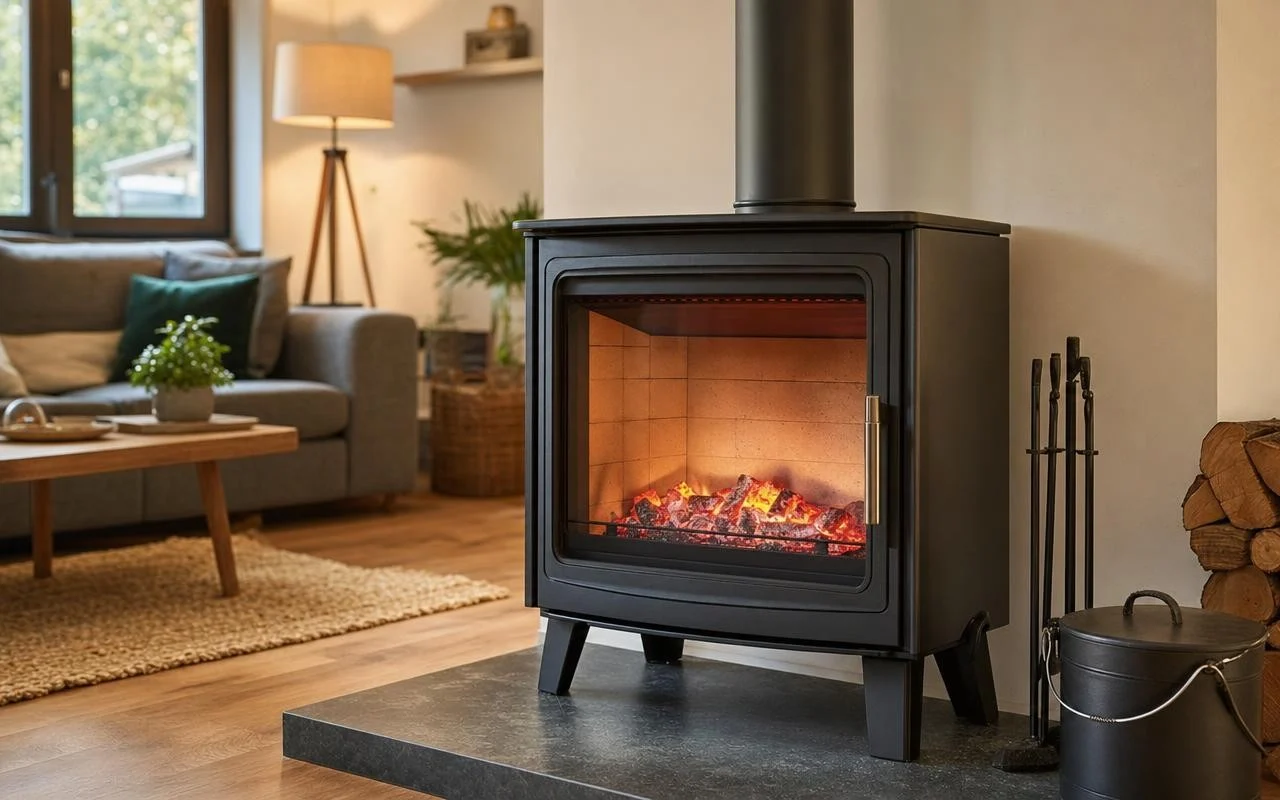
The scene is familiar: a few red embers remain in the wood stove, you want to sleep soundly, so you grab a pot of cold water and pour it into the firebox before closing the door. The hiss of steam is reassuring, the flame disappears, the house seems safe. It’s only upon waking, when reopening the stove, that doubt arises: what if this apparently prudent gesture had actually endangered the appliance?
This reflex is widespread among households that use a wood stove as their main heating source. The idea is simple: you snuff out the fire before nightfall or before a weekend departure. Yet manufacturer manuals and the ADEME guide How to heat with wood? tell a very different story. When several manufacturers state in black and white that you must “never pour water on the fire to extinguish it,” the evening’s pot suddenly takes on a new face.
Pouring water on the embers of a wood stove: why the risk is real
Two manufacturers, including the Godin Rosnay model and Totem Fire’s Technika multi-face fireplaces, give the same strict instruction: “never pour water to extinguish the fire.” At a campsite, water that falls on a few scattered embers does not pose any particular problem. In a closed fireplace, the situation is very different: the internal bricks and the vitreous ceramic glass have endured high temperatures for hours. The sudden arrival of cold water creates a thermal shock that these materials do not tolerate well.
The Totem Fire manual details the risk: water can cause the bricks and the vitreous ceramic glass of the firebox to explode. The word used is indeed “explosion,” not a simple crack of comfort. The bricks that line the interior and retain the heat, like the glass that seals and secures the firebox, are nonetheless central components of the appliance. When they undergo this brutal cooling, the manufacturer judges the threat sufficient to ban this gesture entirely, with no nuance or exception.
You’ve already poured water on the embers: how to react
Manuals do not describe in detail what one finds in the stove the day after a pot of water; they focus on the moment of impact. One point clearly stands out: if water has already been poured, it is better to avoid relighting immediately “to see if it holds.” The article relayed by Le Journal des Seniors recommends having the hearth, bricks and glass checked by the installer or the manufacturer before any new blaze. The appliance is considered potentially weakened until a professional has examined it.
Your model’s manual remains the baseline for knowing which parts to monitor, since each stove has its own design. Once the firebox has cooled completely, you can open the door, inspect bricks and glass from all angles, and report to the specialist any crack or suspicious defect. A customer service accustomed to thermal shocks will know whether the glass should be replaced or if the bricks have suffered. Until this doubt clears, it is better to refrain from relighting rather than risk a sudden rupture in the middle of heating.
Extinguishing a wood stove properly at night or before a departure
For the desired extinguishing, the Totem Fire manual proposes a simple method: close the combustion air inlets to let the fire go out by lack of oxygen. This requires a bit of foresight: avoid refueling the stove very late, as a log placed at 11 p.m. extends the duration of the embers. The safest approach is to make a final modest loading early in the evening, then let the hearth burn down normally before reducing and closing the air, if the device’s manual allows for stopping in this way.
ADEME, in its September 2024 guide, recommends the opposite: never close the air completely when the fire is burning. It advises opening wide at ignition and at each reload, then reducing the air supply after 30 to 40 minutes if the hearth was cold, or after about 10 minutes if it was already hot. The agency also notes that a house is comfortable at 19 °C during the day and 17 °C at night, which avoids pushing the stove to a near-idle burn until the early morning. It remains then to consult the manual, often available as a PDF from the manufacturer, to align these general references with the specific instructions for your model.
Sources
- Modes & Travaux
“Beech, Oak or Ash? Here is the ONF’s official ranking of the best types of firewood for heating your home efficiently and without polluting”
