
You come home from the market with beautiful green asparagus, standing tall with tight tips. Two days later, as you’re about to prepare dinner, you find them soft and wilting at the bottom of the vegetable drawer in the refrigerator. This scene repeats every spring as the asparagus season is short and the bundle is often pricey.
Producer sheets and cooking specialists remind us that asparagus ranks among the most delicate vegetables: it continues to “breathe” after harvest and loses water very quickly if stored improperly. Without precautions, it will soften in 48 hours, whereas a simple change in method can keep it crisp for 5 to 7 days. The secret lies in a very simple gesture, inspired… by the flower vase.
Why Green Asparagus Softens So Quickly in the Refrigerator
Asparagus is cut by hand, then rapidly cooled: between harvest and chilling, producers aim for a maximum four-hour window to preserve its freshness. Once at home, everything hinges on humidity. Lying flat in the vegetable drawer, without protection, the stalks lose water through evaporation, their cells empty, and the firm texture disappears. Classic methods, such as a damp cloth or newspaper in the drawer, limit the damage for only 3 to 4 days.
Green asparagus, which grows entirely in the open air and isn’t peeled, has a more pronounced flavor but also tips more exposed to dehydration. It even starts at the market: a good bunch should be very straight, with a closed bud, a slightly glossy heel, and a stem that yields under the fingers. If it bends without resistance, no storage trick will truly keep it crunchy.
The Flower Bouquet Method to Keep Green Asparagus Longer
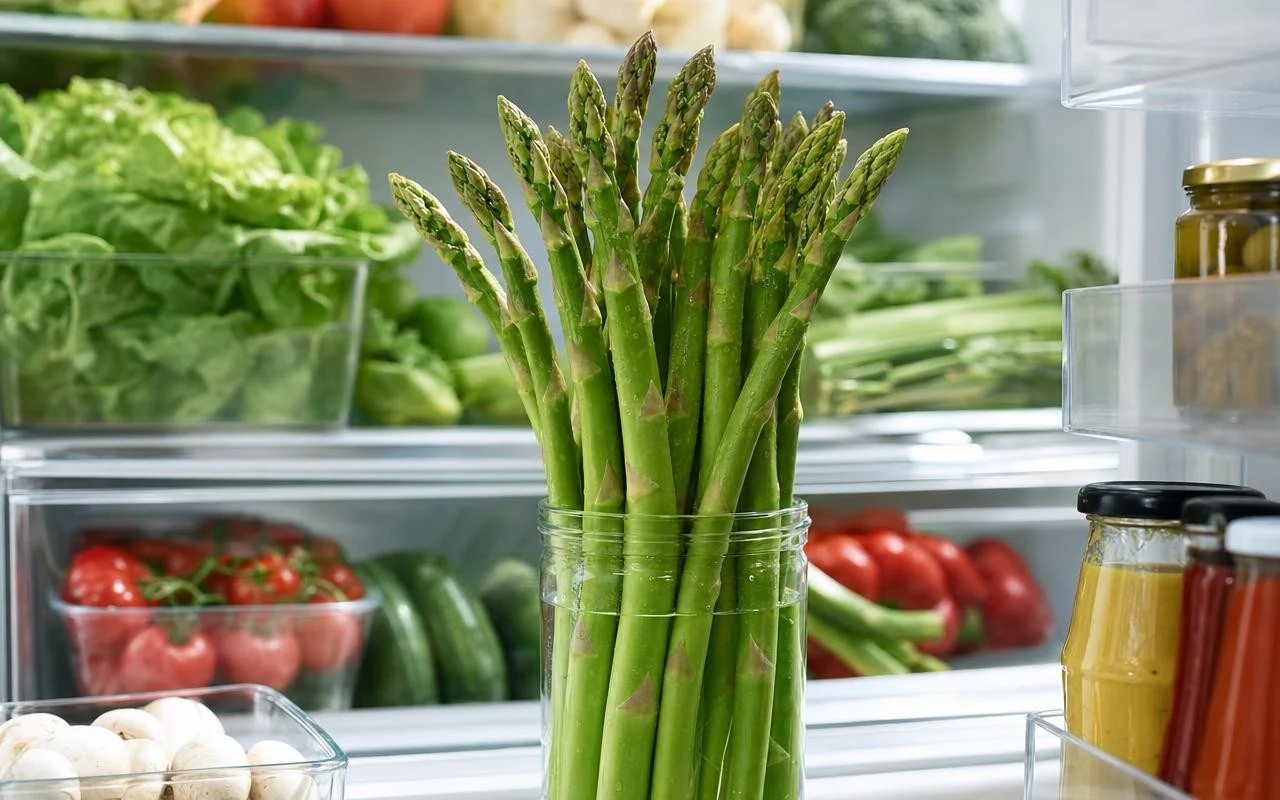
Experts agree: to extend the life of your asparagus, treat them like a bouquet of flowers. After trimming, the bases of the stalks continue to absorb water. The idea is to rehydrate that base while keeping the tips dry to avoid soaking them with moisture. Used by many cooks, this method can take you from 2 days of freshness to 5 or even 7 days.
The setup is very simple. All you need is a jar or a sturdy tall glass and a little cold water.
- First, recut the bottom of each stalk by about 1 cm to “refresh” the base.
- Then pour 2 to 3 cm of water into the bottom of the container, no more.
- Stand the bunch upright, base in the water, keeping the elastic band so it stays tight.
- Finally slide a light plastic bag, ideally perforated, around the stems without crushing the tips.
The jar goes into the refrigerator; the stalks drink just enough water to stay firm, while the tips breathe in the air. Change the water at the bottom after a few days and cover with a bag to also protect against cheese or deli meat odors that easily permeate this vegetable.
Damp Cloth Method, Pitfalls to Avoid, and Actual Shelf Life
If your fridge cannot accommodate a tall jar, the damp towel method remains a solid alternative. Simply wrap the bunch in a clean cloth that is lightly dampened and place it in the vegetable drawer. Producers report a storage life of 3 to 4 days, with some cooks noting that a very fresh bundle can stay firm for almost a week if the cloth is merely damp, never soggy.
A few mistakes ruin all these efforts. A water level that is too high and covers the tips promotes mold. A cloth saturated with water creates condensation and speeds spoilage, as the asparagus leaflets explain. A plastic bag that isn’t perforated traps moisture, and a fridge filled with strongly scented foods can perfume your stalks if they’re not protected. Without these precautions, your asparagus can go mushy in 48 hours; with the water jar method, they stay neat and crisp for several days. And if you really bought too many, there’s always the option to blanch them for 2 to 4 minutes, cool them in ice water, then freeze at -18 °C to enjoy them again for 4 to 6 months.
