
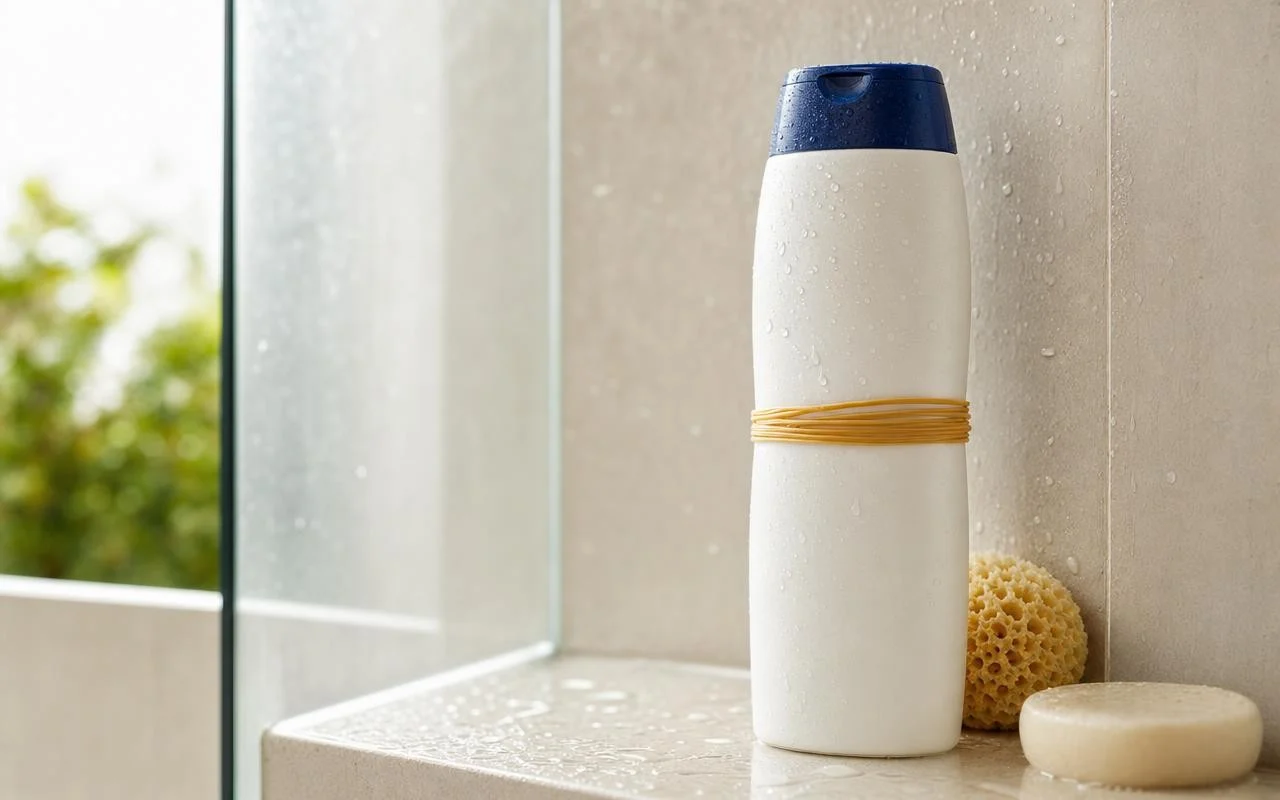
The slippery shampoo bottle that slips from your hands during rinsing, bounces off the shower base, and bangs into your toes: a scene familiar in many bathrooms. To fix it, a trick has circulated widely: wrap the bottle with a simple elastic to make it non-slip under the shower. But does this idea really hold up?
In this small daily gesture, there is both a promise of comfort, a safety concern, and the desire to limit damage in the shower cubicle or tub. Internet users share their tests, practical guides detail the method, while packaging specialists explain why some bottles become real soap bars. The answer is not entirely black or white.
Why Shampoo Bottles Slip Under the Shower
A standard shampoo bottle is molded in smooth plastic. In contact with water and the surfactant-rich formulas of shampoos and conditioners, the surface loses almost all grip. A spa product article describes this trio—smooth plastic, water, and care—as a combination that makes the bottle nearly frictionless, especially when hands are already foamy.
When the bottle has already had some conditioner or shower gel left on it, a fine greasy film adds, further increasing slipperiness. The slightest abrupt movement, a tilted shower tray, or a child grabbing the bottle in a hurry is enough for it to slip away and fall. Impact on ceramic, cap breaking, product spilling: the small tumble can quickly become annoying.
Rubber Band around the Shower Bottle: Does It Really Work?
Everyday advice sites and forums report a simple idea: place one or more elastic bands around the bottle to create some relief. The rubber grips the skin well, even when wet, and the thick bands used to hold vegetable sacks offer a much firmer grip than the bare plastic surface. On a clean bottle, the improvement is felt immediately between the fingers.
A French-translated practical guide even advises wrapping the elastic several times to form a real non-slip zone that remains effective under the shower. The principle works, but it has its limits. If the elastic is too thin, worn, or placed on a very rounded area, the hand doesn’t settle well and the difference remains small. The size of your hands and the bottle’s shape also matter a lot.
Bien utiliser un élastique sur un flacon de shampoing, et les alternatives possibles
To get the most out of this trick, it’s best to choose a wide, thick elastic in good condition. Place it where you naturally hold the bottle, often in the middle, and don’t hesitate to stack two or three to obtain a taller band. On large, heavy formats, placing a second elastic near the cap also helps when opening, especially with wet and soapy hands.
There are a few hygiene rules to follow. Regularly rinse the bottle and the elastic to remove the film of shampoo or gel, otherwise the surface becomes slippery again and the rubber may stain. Replace it as soon as it loosens or cracks. For a more durable result, some manufacturers offer bottles with rubberized zones overmolded, or silicone non-slip sleeves, or fixed supports that prevent handling the bottle under water.
