
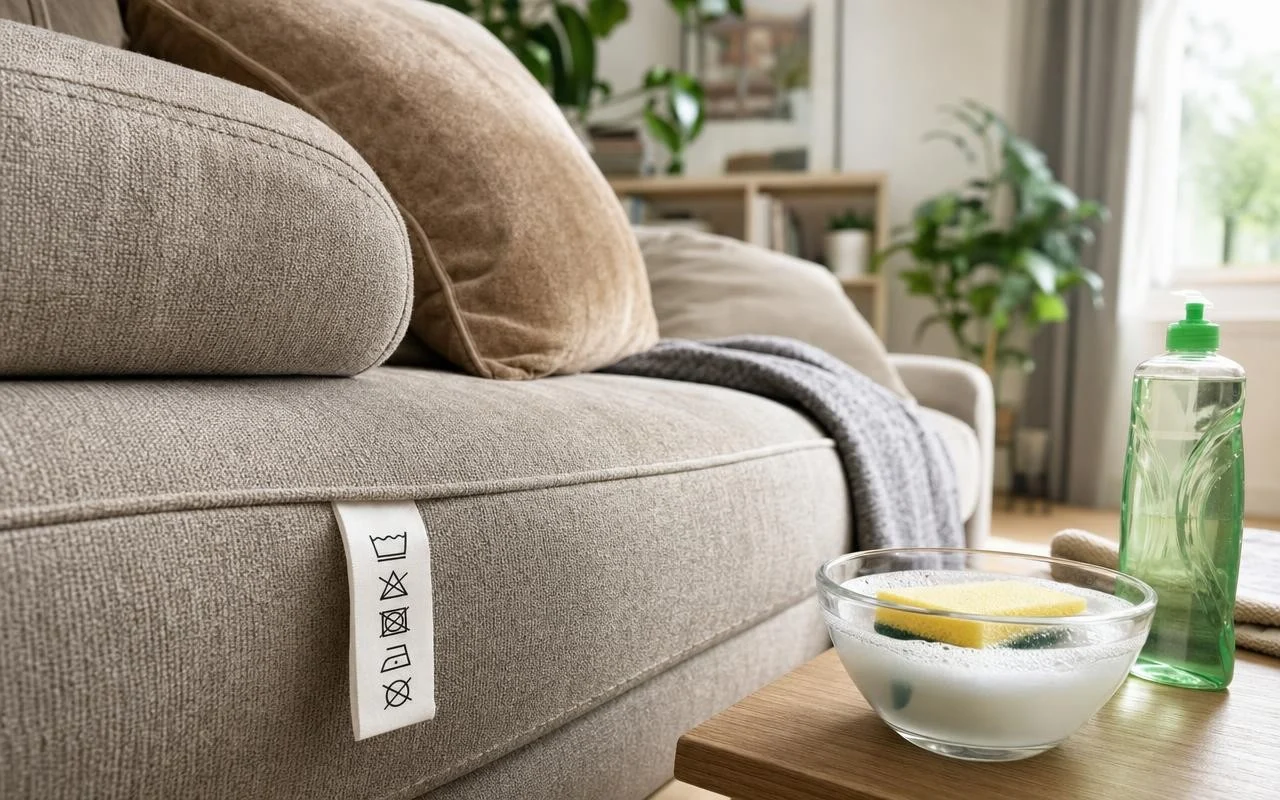
A small stain on the sofa, a bowl of water, a few drops of
dish soap: the scene speaks to everyone. This gesture
appears gentle, almost risk-free. Yet some fabrics react very poorly to
water and foam, resulting in light or dark halos that are impossible to
retrieve. Everything actually hinges well before the first wipe of a cloth.
For each sofa, the manufacturer provides a precise cleaning mode, often
ignored at the moment the stain appears. Cleaning professionals remind
us that checking this instruction only takes about thirty seconds, while
a mistake can permanently damage the upholstery. This verification rests
on a simple letter code and guides the use of water-based products like
dish soap. It is this little code that should guide your decision.
Code W, S, WS or X: the baseline before cleaning your sofa
The first step is to locate the care code. It is most often
hidden on a label sewn under the seat, behind a cushion, or inside a
removable cover. On some models, it may also appear in the manual provided
with the sofa. Once the label is spotted, a few letters indicate the type
of cleaning the fabric can support.
The code W means the fabric accepts water-based cleaning, in
the form of foam or a shampoo. The code S indicates, conversely,
cleaning with a specific solvent, without water. The code WS (or SW)
gives the choice between water and an appropriate solvent, depending on the
stain and the method. The code X, on the other hand, allows only
vacuuming and gentle brushing, with no liquid whatsoever. Since dish soap is a
water-based cleaner, it is mainly feasible on sofas labeled W or,
with caution, WS.
The test on a hidden area: the true indispensable verification
Even when the code allows water, manufacturers’ and professionals’ guides stress one point:
always perform a test on a hidden area before treating the visible stain.
Some dyes bleed, other fabrics mark as soon as they become too wet. This pre-test
exists precisely to detect any possible color transfer, halo, or a change in
feel without endangering the entire seat.
Practically, prepare a very diluted solution of dish soap in warm water, until you obtain a light foam.
Then choose a completely discreet spot, for example under a cushion or at the back of the sofa.
Dab the area with a clean cloth barely damp with the solution, without rubbing and without soaking the fabric,
then blot with a second dry cloth. Once the test area is completely dry, check for discoloration, halo, or
fiber stiffening: at the slightest doubt, it is better to forgo the dish soap.
When dish soap is possible… and when you should refrain
If the code indicates W or WS and the discreet test reveals neither color transfer nor halo, a localized cleaning with dish soap remains feasible.
Again, the rule is to limit moisture: light foam, gentle blotting of the stain from the outside toward the center,
then careful absorption with a dry cloth. The objective is to never saturate the padding, because water that penetrates
deep often creates the famous halos that reappear as it dries.
Conversely, a sofa labeled S or X must not receive soapy water, even for a small stain, and a test that leaves a halo or a color change requires stopping immediately.
Professional documents also remind not to improvise with harsh household solvents on upholstered fabrics. If the label is missing or illegible,
the most prudent approach is to treat the sofa as water-sensitive and stick to suction or to seek a specialist’s advice.
In doubt, better a sofa with a light stain than a covering irreparably damaged.
