
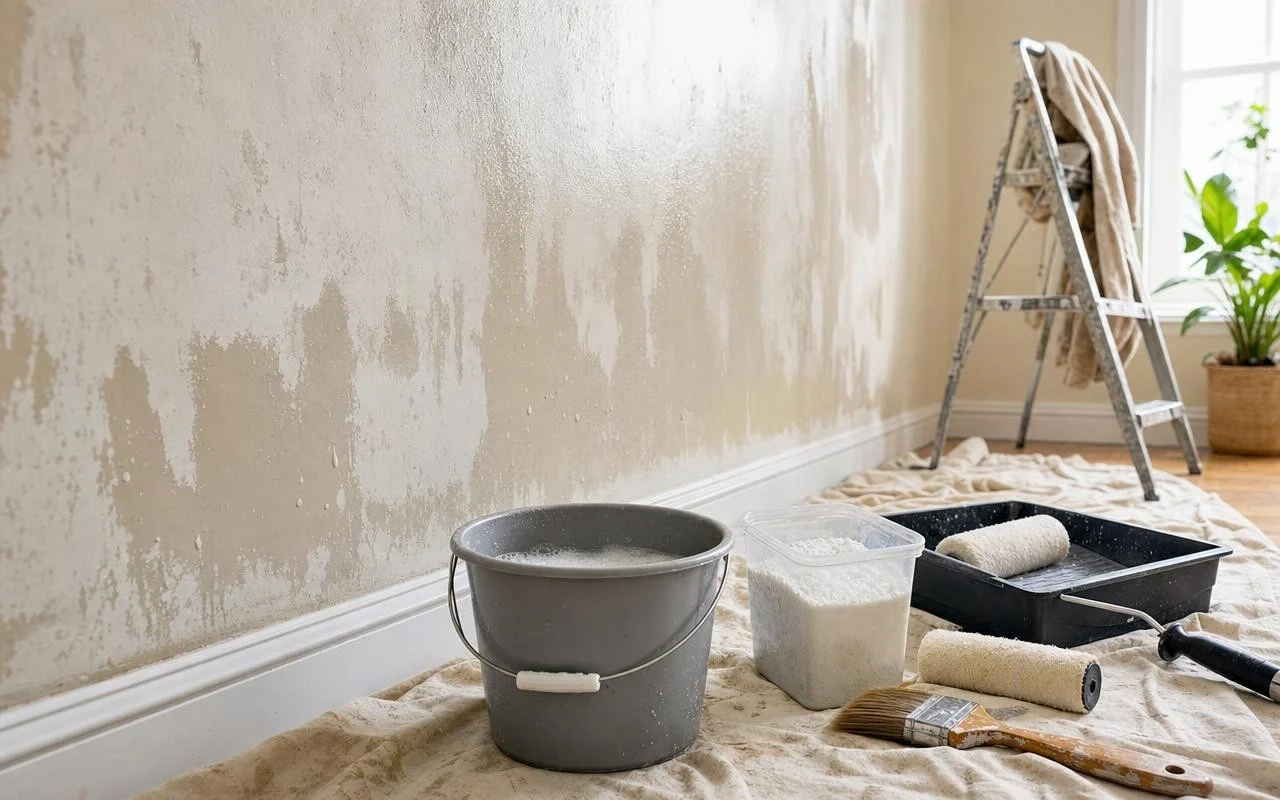
The walls were carefully scrubbed with washing soda, the primer appeared flawless… then, after a few months, the paint began to blister and peel in patches. In many renovation projects, the culprit isn’t the paint or the substrate, but a preparation step that was completed too quickly.
Widely used for washing before repainting, the washing-soda-based mixture, such as Pin Starwax’s Oil Work Laundry, which “does not foam, rinses easily,” deeply degreases kitchen walls, yellowed ceilings, or varnished woodwork. Yet many people settle for a simple wipe with a damp sponge, or even forget to rinse with clear water: that’s where everything hinges.
Why rinsing with washing-soda crystals before painting makes all the difference
Washing-soda crystals are a powerful alkaline cleaning agent: they lift grease, nicotine, and old wax films, but they also leave a deposit if not removed. The Chort Bâtiment site notes that detergent residues form “a film that blocks adhesion,” comparable to a wall that has remained greasy. Visually, the surface may look clean, yet the new layer of paint struggles to grip properly.
Manufacturers emphasize this point in their directions. For Pin Starwax’s Oil Work Laundry, the recommended dosage is 20 g per liter for routine cleaning, 50 to 100 g per liter for heavy scrubbing, and 60 g per liter for washing walls before renovation, with the obligation to rinse thoroughly and then allow to dry before any finishing. Professional guidelines, such as the DTU 59.1 standard for painting work, require a clean, dry surface free of any preparatory products.
Correct dosage and handling of washing-soda crystals before painting
An overly strong dosage makes the rinsing of washing-soda crystals before painting almost endless. Starwax recommends 20 g per liter for maintenance washing, 50 to 100 g per liter when walls are heavily soiled, and 60 g per liter specifically before a repaint. For its “heavy-duty” washing-soda crystals, the manufacturer indicates 40 g per liter for intensive cleaning and up to 500 g per liter, left for ten minutes, to strip old paints, followed by generous rinsing.
Experts, such as Ravoyard, remind that washing-soda crystals are not caustic soda, which is much more aggressive. For an interior wash before painting, stay with the crystals, carefully following dosages and avoiding excessive dwell time, especially on bare plaster or old matte paint. On a varnished surface, Liberon recommends washing with washing-soda crystals, rinsing with clear water repeatedly, then abrading with 240-grit sandpaper to promote adhesion.
Rinsing and drying protocol for maximum paint adhesion
For effective rinsing, guides like ClubTidy and Chort Bâtiment advise preparing two buckets: one with the washing-soda solution, the other filled with clear water. We wash the wall from bottom to top, frequently rinsing the sponge in the washing-soda bucket, then switch to the clear-water rinse from top to bottom, wringing out the sponge regularly. On a sealed surface such as varnish, Liberon recommends rinsing two to three times with clear water before continuing with the preparation.
To verify the outcome, a few simple benchmarks apply after a drying period of 24 to 48 hours, as recommended by Chort Bâtiment and as noted in Starwax data sheets.
- The rinse water remains clear.
- The surface is no longer slick at all.
- No white haze or dry streaks.
- The wall or piece of furniture is perfectly dry to the touch.
