
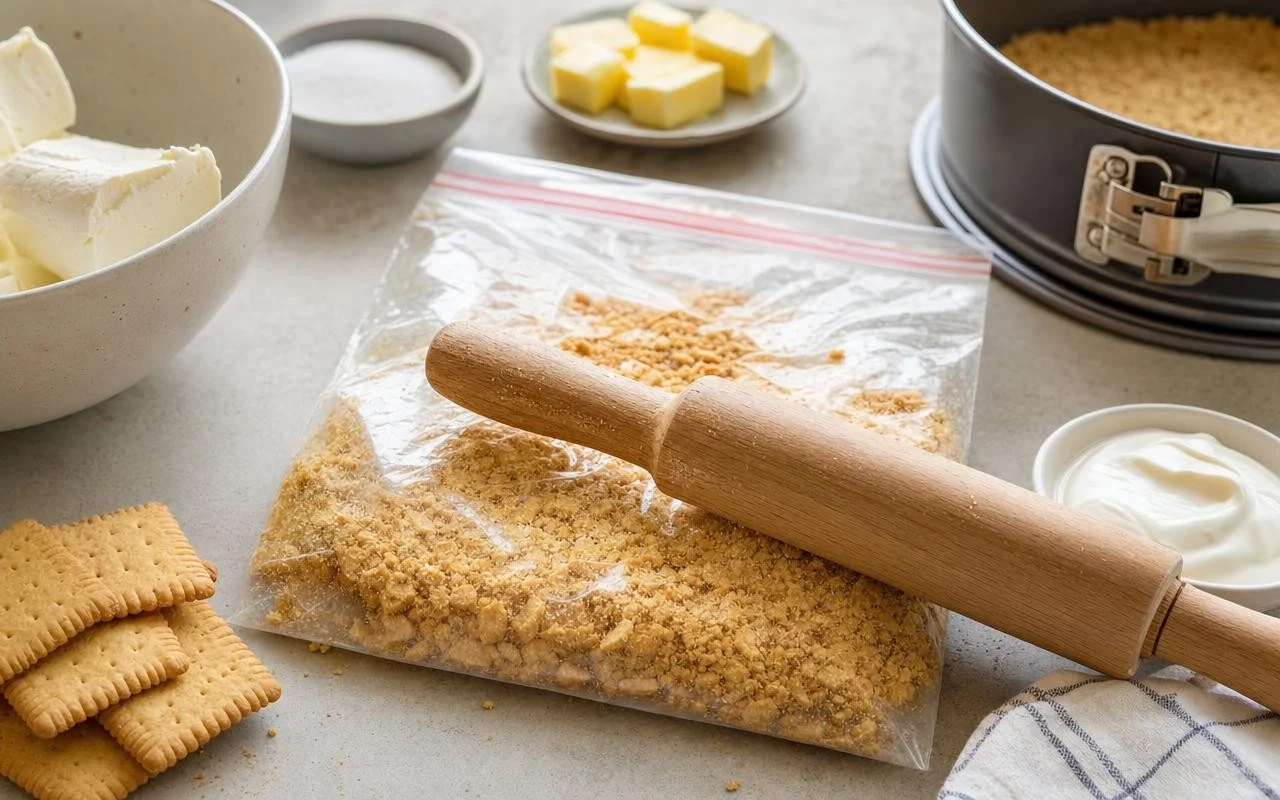
Have you ever whipped up a cheesecake in a rush and, in just a few seconds, the worktop ended up covered with cookie crumbs? Between the bag opened too quickly, the rolling pin sticking, and pieces bouncing everywhere, this simple step can quickly turn into a full-blown sweep. Hence the widely shared reflex: slip the cookies into a bag to crush them neatly.
In recent years, cooking blogs and life-hack sites have extolled this method as if it leaves “zero crumbs on the work surface“. The principle seems airtight: you put the cookies in a bag, close it, crush, and everything stays inside. Two questions remain for everyday cooks: does it really work, and can you use any bag without risking food safety?
Crushing cookies in a bag: the right move, but only with the right bag
In practice, crushing cookies in a bag indeed avoids most crumbs, provided you choose a material suitable for food contact. The Directorate General for Competition, Consumer Affairs and Fraud Enforcement (DGCCRF) notes, in a sheet updated on February 18, 2026, that “precautions must be taken because chemical substances can migrate from these items to food products”.
To prevent this unwanted transfer, the administration recommends using only containers intended for food, identifiable by the glass-and-fork pictogram. “Whether you are a professional or a consumer, use only utensils and containers designed for cooking or storing food, identifiable by their pictogram,” insists the DGCCRF, adding: “Otherwise you risk altering the qualities of the foods and exposing consumers to a danger.” Freezer bags and food-grade zip bags fall into this category.
Why the bag really limits cookie crumbs
Once this safety point is set, the trick works very well to keep the kitchen clean. The bag traps the cookies and their crumbs like a little bubble: when you roll the rolling pin, the pieces break but stay confined. Brands like Bridelice even recommend placing the cookies in a freezer bag or between two sheets of parchment paper before using the roller, precisely to prevent crumbs from sticking everywhere.
How-to sites like Comment-economiser.fr even promise “zero crumbs on the work surface” if you put the cookies in a bag and seal it well before crushing. To get close to this, it’s better to expel the air to avoid the balloon effect, not overfill the bag, and roll gradually rather than strike. The baking blog Completely Delicious warns about one precise point: watch for bag perforation, the number-one risk of crumb leakage.
Step-by-step method and clean, crumb-free alternatives
To apply the method at home, take a thick freezer bag or a zip-top bag designed for foods, fill it up to two-thirds with your cookies (Petit Beurre, speculoos, Oreo, it doesn’t matter), expel the air and then close it securely. Lightly crumble with your hands, lay the bag flat on a towel and roll the rolling pin from the center toward the edges, turning the bag once to obtain more even crumbs.
When the texture suits you, open the bag slowly, near the bowl, and immediately pour out the crumbs to prevent them from escaping. Without a zip bag or if you limit plastic, two sheets of parchment paper with the roller work very well, and a food processor yields very even crumbs in exchange for a bit of washing up. In any case, it’s best to choose bags and films designed for food contact, indicated by the glass-and-fork pictogram.
