
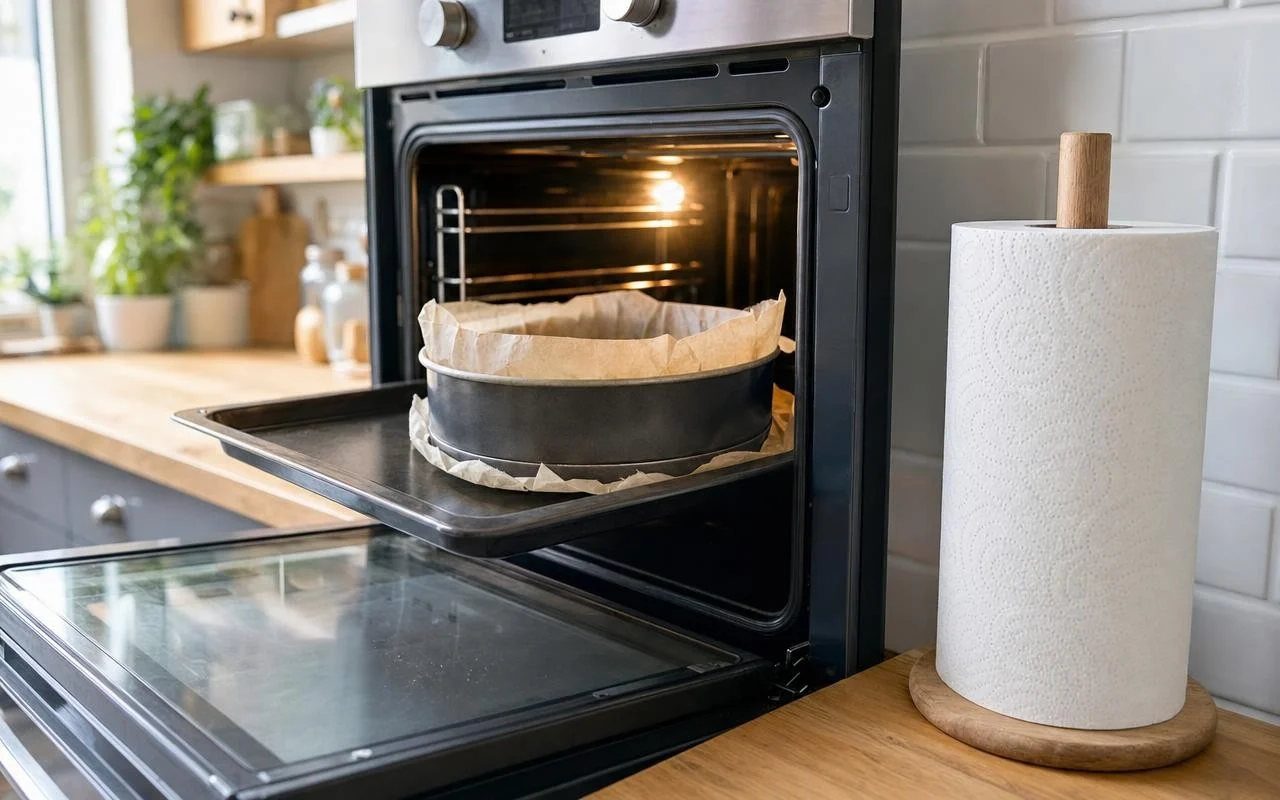
A dish ready to bake, with not a single sheet of parchment paper left in the drawer, and a temptation that keeps returning: placing the dough directly on a sheet of paper towel. The move seems clever, quick, almost obvious, given how absorbent paper already has its place in every kitchen.
Between videos of household “hacks” and tips exchanged among friends, the idea of using oven-ready paper towels circulates widely. Yet, as soon as you look at what the texts say about papers in contact with food and heat, the picture changes markedly. The real question is less “will it hold up?” than “what could migrate into the dish?”
Paper towel in the oven or baking paper: two very different uses
Baking paper sold for the oven belongs to the family of papers known as “supports for baking with release coatings (e.g., silicones),” cited by DGCCRF on economie.gouv.fr. In plain terms, it is paper specifically designed for heat, coated with a thin layer of silicone, that withstands the temperatures of a home oven, around 200 to 220°C depending on brands.
Paper towels, by contrast, are absorbent papers intended for soaking up liquids, covering, and drying. Their exact composition varies from one manufacturer to another, with whitening treatments, sometimes printed patterns, or even recycled fibers. They are not marketed as a “baking support” and typically do not indicate any maximum usage temperature. However, DGCCRF states that “papers and boards coated with waxes or paraffins cannot be used at temperatures above 40°C.” Some household papers may fall under this rule.
What the regulation says about heat, coatings and migration
For the Directorate General for Competition, Consumer Affairs and Fraud Prevention (DGCCRF), papers and boards intended for contact with food must be evaluated based on their composition, but also on real usage conditions: temperature, contact duration, type of food (greasy, moist, acidic…). The reference framework notably points to Regulation (EU) No 10/2011, with both overall and specific migration tests.
“Migration” simply refers to what can pass from the material to the food during contact. The higher the temperature, the greater this risk. For waxed or paraffin papers, the 40°C limit set by the DGCCRF clearly signals that they are not designed for the oven. Another important point from the same document: “The printed face must not be in contact with foods, even if protected by a varnish or glaze.” With a decorated paper towel, the idea of placing it under cookies becomes even less suitable.
In which cases should you use the paper towel, and what should you use instead of baking paper?
Instructions for combination microwave ovens often remind that the paper towel can be used only in microwave mode, to cover a dish or absorb moisture, but not for traditional cooking. The heat of a microwave cooks food from the inside; the heat of a conventional oven comes from very hot elements that dry out and can more easily ignite a thin paper placed close to the source.
In practice, the paper towel retains its use for draining donuts for a few minutes, covering a bowl in the microwave, or blotting excess fat after cooking, but it does not replace baking paper in the oven. If the roll is empty, several solutions exist: line the mold with butter or oil and then flour, use a silicone baking mat designed for pastry, or make papillotes using plant leaves (cabbage, leek, banana) that have been blanched beforehand. Before baking with paper, a few checks help you decide:
- Verify that it is labeled “food contact safe” and, if possible, has a maximum temperature.
- Avoid letting the printed side touch the food directly.
- If in doubt about a household paper not intended for cooking, refrain from putting it in the oven.
