
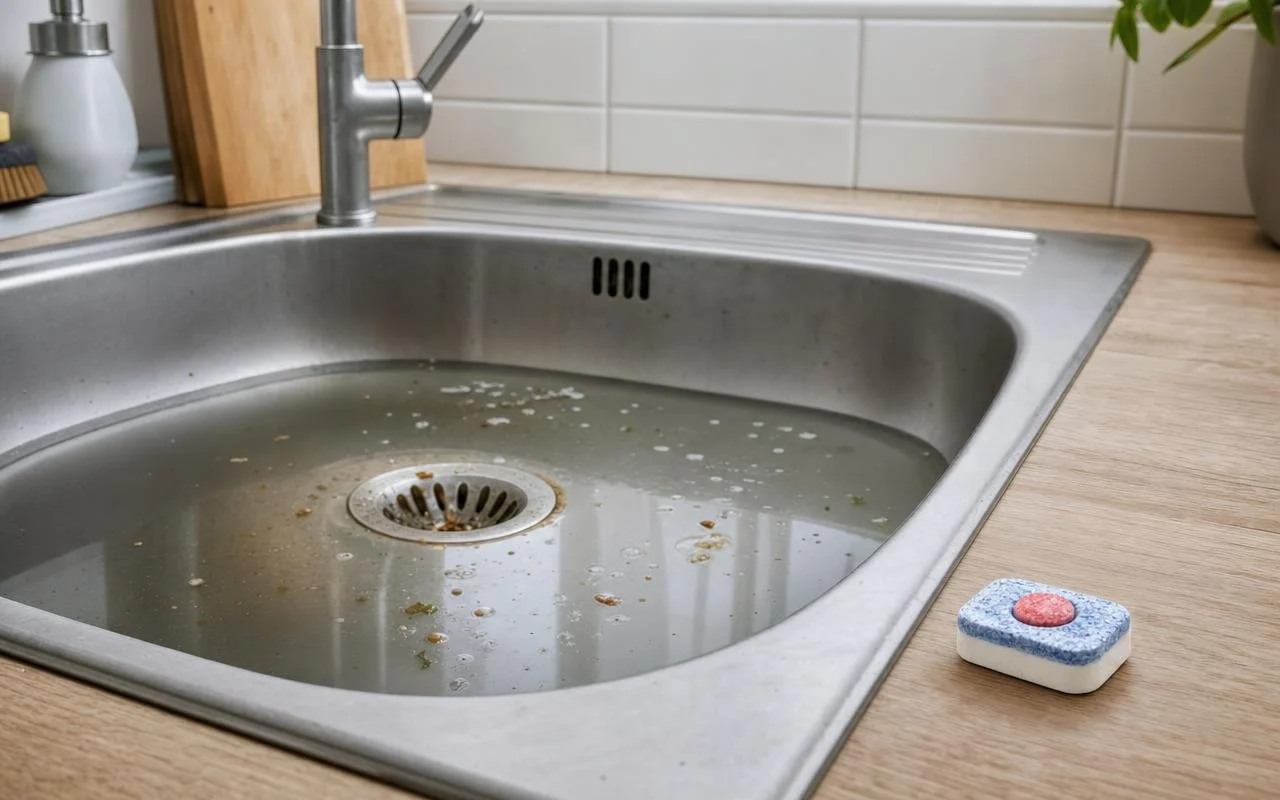
A video watched by thousands promises to rescue any a clogged sink with a single dishwasher tablet and a splash of hot water. You drop the tablet into the sink, let the water run, wait a few minutes… and there you have it, no plunger or plumber needed. The tip checks all the boxes of a miracle remedy that people readily share with friends and family.
In response to this promise, plumbers, consumer associations, and even authorities like the U.S. Environmental Protection Agency (EPA) remind us of the less glamorous reality of pipes. A clog is not merely a matter of dissolving grease, but a physical obstruction that builds up over weeks. So why does the famous tablet almost never live up to its unclogging promises?
Dishwasher tablet in the sink: a tempting but deceptive trick
The idea rests on a real observation: in a kitchen, cooking fats solidify in the pipes, cling to the siphon walls, and trap other waste. Very hot water, around 60-70 °C, combined with a highly degreasing dishwasher tablet can, in theory, dissolve these deposits that are still “soft” on the first few centimeters of the pipe. For light buildup, the mixture sometimes helps the water to flow more easily.
As soon as the clog has formed, the situation changes. Professionals describe it as a compact mass mixing solidified greases, food scraps, coffee grounds, and sometimes limestone. This lump lodges in the bend of the siphon or further down the tube. The soapy water produced by the tablet remains on top, with little movement and a rapidly dropping temperature. At best, the outer crust softens a little, but nothing comes loose from the stuck block inside the pipe.
What actually blocks a pipe and why the tablet doesn’t do the job
Under the sink, the first link is the siphon, that U-shaped section filled with water that masks odors. It is here that greases and debris accumulate. When only the sink is problematic, the clog is often at this level. If water backs up into the dishwasher or other equipment, the clog is more likely in a shared drainage line, sometimes several meters away. In that case, the amount of material and its compaction far exceed what a simple cleaner can manage.
A clog acts like a cork: it seals the passage. The EPA reminds, regarding on-site wastewater systems, that “one in five homes in the United States has a septic tank.” The agency explains that these systems operate thanks to microorganisms and that additives or “miracle” products do not replace good use or regular maintenance. In a typical household network, the logic remains the same: even a very powerful product cannot dismantle a solid blockage. To unclog, mechanical action is required, such as dismantling the siphon, a plunger, or a drain auger.
The right steps to truly unblock… and protect septic tanks and pipes
Guidance converges. First, place a bucket and loosen the siphon to manually remove accumulated grease and debris. If the water still pools, the plunger, a blocked overflow, creates pressure and suction movements that can dislodge the clog. When that is no longer enough, the drain auger allows breaking up the mass further down the drain. Concentrated chemical uncloggers remain the last resort: they stagnate at the clog, can attack joints and old PVC pipes, and complicate subsequent work by a professional.
For homes equipped with a septic tank, caution is even higher. The EPA notes that these systems already contain the bacteria necessary and that additives are not essential for proper function. The agency recommends inspecting and pumping every 3-5 years, not an accumulation of harsh products. In the kitchen, the best prevention remains simple: dispose fats and oils in the trash, install a strainer, avoid coffee grounds and food scraps in the sink. The dishwasher tablet then returns to its logical place: in the dishwasher, not in the pipes.
