
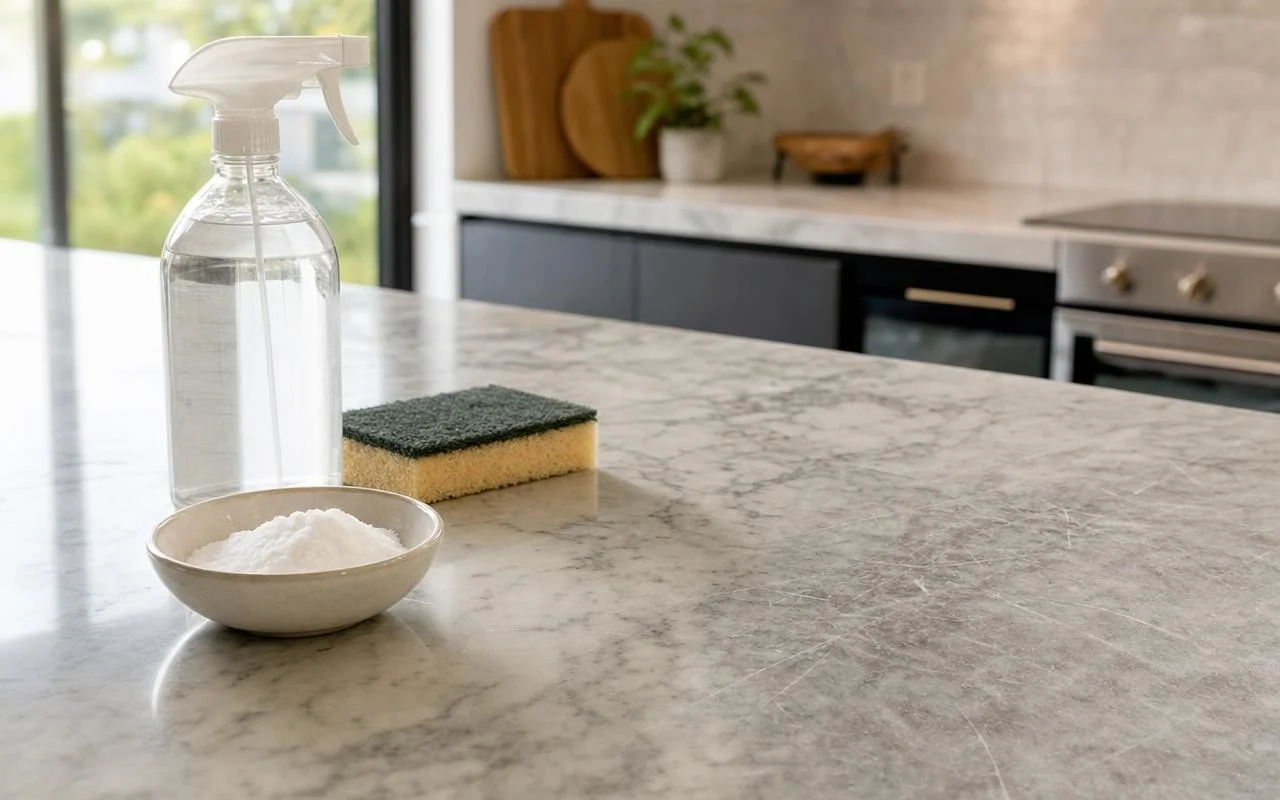
Among social media chatter and traditional home tips, baking soda has become the cleaning star. You’ll see it everywhere to brighten grout, scrub an oven, or deodorize a fridge. When faced with a grease mark or a wine stain, many instinctively sprinkle it directly onto the countertop and scrub with a sponge.
When that countertop is marble, this seemingly harmless gesture can prove costly. For several years, stone professionals have warned against this very common reflex, echoed in a Maison & Travaux article published on October 6, 2026. Marble, for its part, does not respond well at all.
Baking Soda on Marble: why this trick seems so appealing
If the habit of using baking soda on marble is so widespread, it is because the product works well on many surfaces. The American site The Kitchn nevertheless highlights a key point: “Baking soda is abrasive, which means you need to be careful with surfaces that are lightly protected or whose finish can wear away,” explains journalist Ayn-Monique Klahre. In other words, it is not a universal cleaner.
Maison & Travaux describes baking soda as a powder made of tiny crystals capable of gently sanding. On stainless steel or certain laminates, this slight abrasion remains acceptable when used occasionally. But marble is among the most sensitive polished natural stones. On this glossy surface, those same crystals can leave irreversible marks.
Micro-scratches and worn sealant: how baking soda dulls marble
Experts at Atouts Marbres remind us that dry-baking-soda, combined with rubbing, acts as an abrasive. With each pass, minute scratches form on the surface of the polished marble. Individually they are invisible; when accumulated, they scatter light and the surface loses its mirror-like sheen. That is what gives this dull, ever-so-slightly dirty appearance to the worktop.
Another issue raised by The Kitchn: the protection itself eventually wears down. “Even though I have read recommendations to use baking soda to clean marble, stone fabrication professionals do not recommend it. Even if baking soda is only mildly abrasive, repeated applications can wear down the sealant. It is better to stick to cleaners specifically designed for marble,” writes Ayn-Monique Klahre. The marble specialists at Pierres Exclusives also advise renewing this protection every 6 to 12 months, after a simple water-bead test to check whether beads still form.
The right practices for a marble countertop that lasts
For a marble countertop, professionals favor a very gentle routine: warm water, a neutral-pH cleaner suitable for natural stones, a microfiber cloth, followed by immediate drying. Both Atouts Marbres and Pierres Exclusives agree on this point: it is better to repeat these simple steps daily than to rely on aggressive “deep cleans.” On materials that are more resistant, Maison & Travaux mentions a 15 to 30-minute setting time for baking soda, without heavy rubbing; for marble, this option remains discouraged.
If baking soda has already been used, marble masons recommend first rinsing thoroughly with clear water, then drying well to remove any white residue from the stone’s pores. Next comes the water-bead test proposed by Pierres Exclusives: if the water no longer beads and spreads quickly, the protection has probably been weakened. In the case of a already dull or “hazy” surface, repolishing by a stone professional may be the only way to restore the original luster.
