
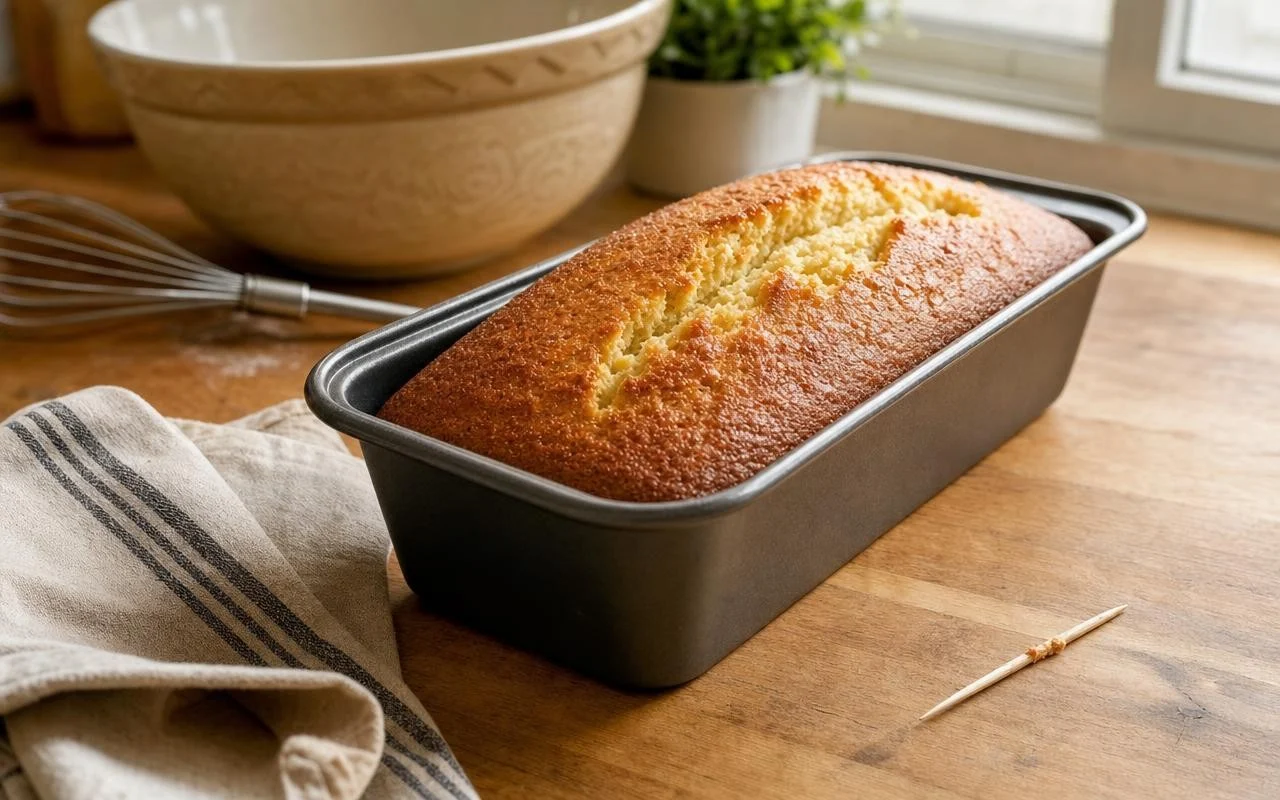
You have probably done this almost automatic gesture: open the oven, insert a toothpick into the center of the cake, and pull it out with held breath to see if it comes out clean. This little test reassures you, especially when you fear a raw center. Yet, this wooden stick does not merely say “it’s baked” or “it isn’t.”
Behind the toothpick test lies, in fact, the entire chemistry of cake batter. For home bakers who want well-risen, moist but not doughy cakes, understanding what happens in the oven changes everything. Because the toothpick does not read the recipe; it reads the internal structure of the crumb.
What the toothpick test reveals in cake batter
In the beginning, your batter mixes water, flour, sugar, fats, and eggs. As it heats, the starch in the flour starts to swell around 65 °C, the proteins in the eggs solidify between roughly 70 and 85 °C, and all of this forms a network that traps air bubbles. By about 95–99 °C at the center for many classic cakes, this network is fairly solid: the crumb stands up.
As long as this network has not “set,” the center remains fluid, almost like a thick cream. When you insert a toothpick at this stage, it passes through a mixture still liquid that clings to the wood in a shiny, sticky layer. Once the structure is formed, the batter is no longer a uniform mass: there are air pockets and crumbs. The toothpick then comes out almost clean or simply speckled with small crumbs.
Reading what the toothpick says: raw batter, damp crumbs or too dry
For the toothpick test to be truly useful, you need to learn to read the three main “states” possible. That’s where everything hinges to avoid a dry cake.
- Raw sticky batter : the wood comes out coated with a shiny, spreadable batter. The center hasn’t reached a sufficient temperature, the crumb hasn’t formed. Return the cake to the oven for a few more minutes.
- Damp crumbs : the toothpick bears only a few crumbs, slightly moist but well formed. The starch–protein network has taken hold, and the center’s temperature hovers around 95–99 °C. This is often the ideal moment for a moist cake.
- Totally dry : nothing but a dry wood, especially if the edges of the cake have already pulled away from the pan. Baking is very advanced; residual heat could still dry the crumb after removing from the oven.
Once the pan sits on the work surface, the accumulated heat continues to diffuse toward the center: baking lingers without flame or resistance. If you wait for the toothpick to be perfectly immaculate, the center has already reached a high temperature, and this “residual bake” can turn a moist cake into a dry one, especially for a pound cake or a fine genoise. It is better to target the stage of damp crumbs, testing at the center where the thickness is greatest.
Temperatures, limits and good habits around the toothpick test
Professional bakers also like the temperature probe: many cakes are judged done when the center temperature sits between 93 and 99 °C. But this threshold varies with the amount of sugar, fat, and the type of pan. The toothpick therefore retains real value, as it provides a direct reading of texture and moisture. It is not infallible: for a chocolate fondant or a brownie, the center should remain very moist, almost gooey. The toothpick will come out stained, and that is normal.
Other recipes also complicate the reading: cakes loaded with juicy fruit, large chunks of chocolate, nuts. Sometimes you hit a very moist piece with the toothpick and believe the whole cake is raw, while the crumb around it is cooked; in that case, test another spot. For very light genoises, angel food cakes, or chiffon cakes, some prefer to judge mainly by the surface: the top should spring back under the finger, the edges should retract slightly from the pan, and the scent of toasted biscuits should be clearly noticeable. By combining these cues with a well-interpreted toothpick test, each bake becomes more consistent and moist.
