
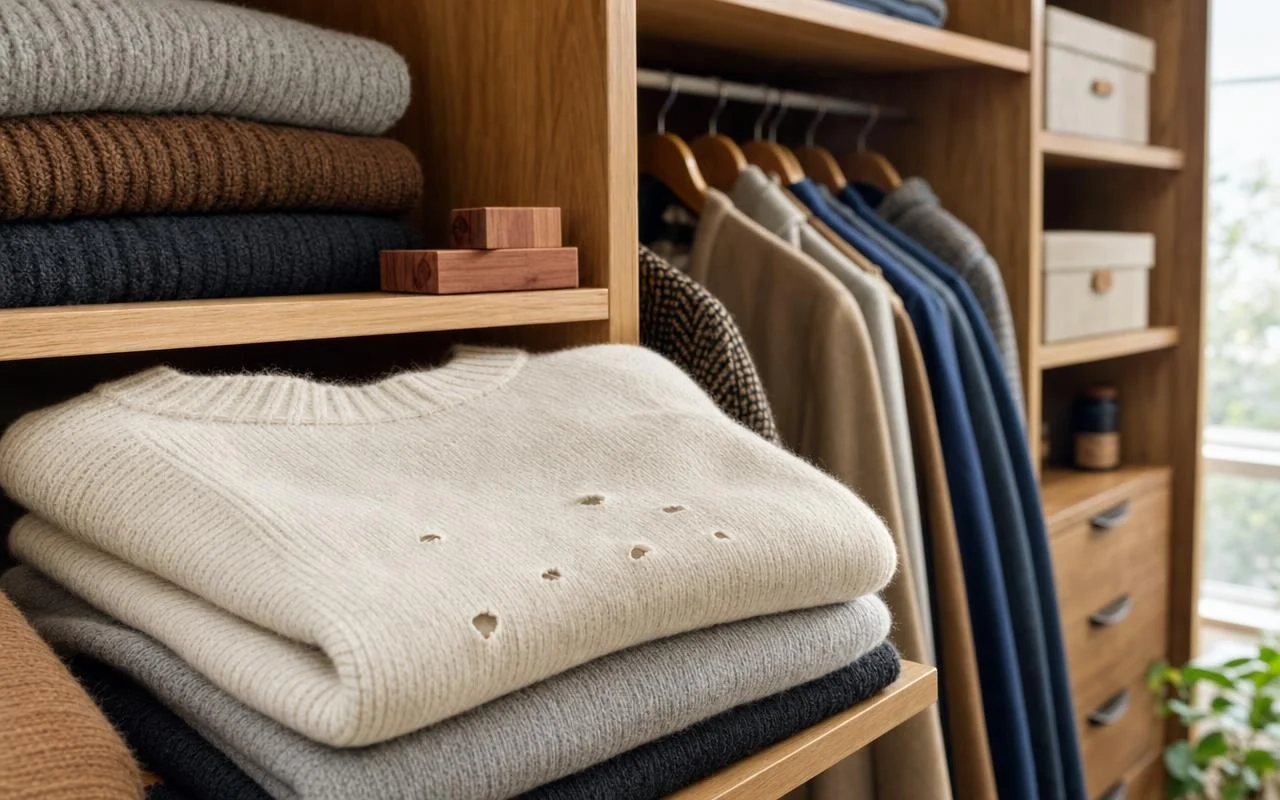
You open the closet to take out your wool sweaters, and there it is, the dread: tiny holes at the collar, at the cuffs, sometimes an entire pattern gnawed away. The culprits rarely show themselves, yet they work in silence for months.
These intruders are clothes moths, different from the little bugs that infest flour in the kitchen. They feed mainly on wool, silk, fur, or down and love dark, undisturbed wardrobes. Good news: we can stop them before the textile carnage, provided we spot the signs quickly and apply a rigorous protocol. The real challenge is played out well before the first hole.
Closet Moths on Clothes: Understanding the Enemy to Act Early
The main clothes moths, Tineola bisselliella and Tinea pellionella, pose problems mainly in the larval stage. The adults, these pale beige or brown moths with brown spots about 1.2 cm wide, do not eat your sweaters. It is the cream-colored larvae, hidden in folds, seams, and linings, that devour the keratin of animal fibers: wool, cashmere, silk, feathers, fur, down. The eggs, sticky, are often introduced via second-hand clothes or rugs, but also from outside, through an open window or a bird’s nest in a chimney.
Pure cotton interests them little, unless it is blended with wool or soiled (food stains, sweat). A dirty garment stored away attracts larvae much more. The first signs to watch for: areas of fabric that thin, broken little threads, tiny silky galleries, cream larvae curling up when disturbed, or repeated flight of small beige moths when opening the door. A female can lay from 50 to 200 eggs, which explains how quickly an infestation can develop. Wool rugs, throws, and blankets often serve as satellite nests worth inspecting at the same time as the closet.
Express Protocol to Get Rid of Closet M moths in a Closet
At the slightest doubt, you should empty the entire closet. Take out every item, shake it outside if possible, then isolate the risky textiles (wool, silk, down, blends) in hermetically sealed bags. Heavily damaged garments can be discarded, tightly sealed in a bag to limit dispersion. For the others, mandatory treatment before putting them back in the closet.
- Isolate all sensitive textiles in sealed bags or boxes.
- Treat the garments: freezing at -18 °C for 3 to 7 days (up to 2 weeks for thick pieces) or washing for at least 20 to 30 minutes at around 50 °C if the fabric can withstand it, pressing for fragile items.
- Vacuum the closet thoroughly: floor, skirting boards, cracks, undersides of shelves, vents, then empty the bag or container outside.
- Wash all surfaces (shelves, walls, skirtings) with soapy water; for a carpet, plan steam treatment or professional help.
- Treat nearby areas as well: wool carpets, blankets, cushions, under furniture.
- Install 1 or 2 pheromone traps to catch mostly males and to monitor any remaining activity.
After freezing, let the garments come back to room temperature inside the bag to avoid condensation on wool or cashmere. The return to the closet should only occur with textiles that are clean and completely dry, ideally in dustproof covers or sealed storage containers. Without this step, residual larvae or new eggs will quickly restart the cycle.
Preventing the Return of Closet Moths: Routine, Repellents and Mothballs
Once the infestation has been treated, prevention hinges on daily habits. Air the closet regularly, avoid piling too many clothes in tight spaces, handle coats and sweaters once a month to disturb any potential larvae. The vacuum cleaner should run along the baseboards, in dark corners, and under furniture where dust and animal hair accumulate—ideal feeding ground for larvae. Before a long-term storage period, wash or have items cleaned, then store them in sealed bags or boxes.
Cedar (blocks, chips, rings) or lavender can help make the closet less attractive, but they do not kill larvae. The scent fades over time, so replace them as soon as the odor weakens. Pheromone traps mainly serve as a “radar”: many captures indicate that a problem remains to be addressed. For mothballs containing substances such as paradichlorobenzene, health authorities advise using them only in a perfectly sealed container, closed with the clothes, to prevent vapors from dispersing into the room. They remain toxic to children and pets, and the exposed clothes should be washed before wearing. In most households, regular cleaning and good storage are more than enough to keep favorite sweaters safe season after season.
