
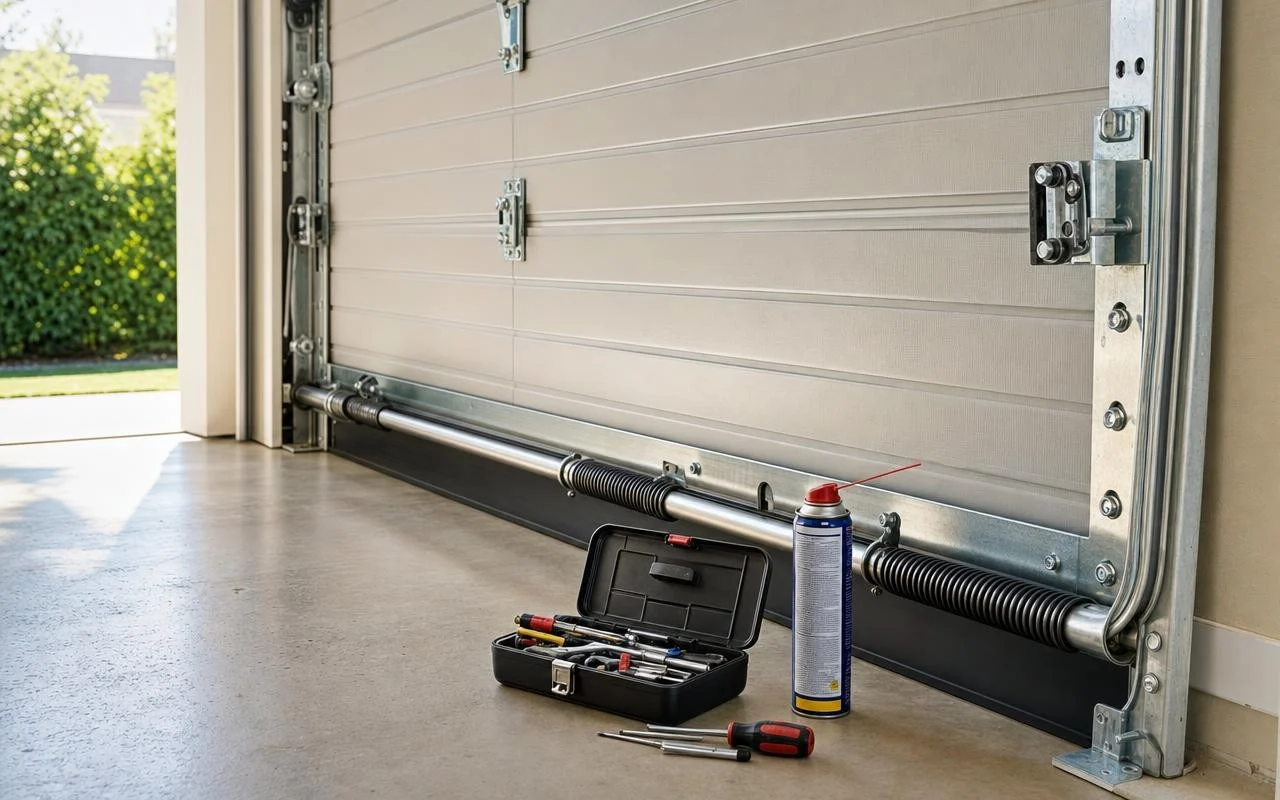
Every year, with the return of the cold, the same scenario unfolded: I would take out my cloth, a jar of grease, and diligently coat the garage door tracks. In my head, this shiny layer would help it slide more smoothly, prevent squeaks, and extend the life of the mechanism. Yet, season after season, the door required more and more force, and the motor struggled to lift it.
One day, fed up, I finally called a technician. He barely set his toolbox down, ran his finger along the rail, and showed me a black, sticky paste. It was then I understood that my famed autumn ritual was causing more problems than it solved.
Garage Door That Binds: Diagnosing the Black Paste in the Tracks
The scene is common among professionals: a track filled with a dark mix of grease and dust, lifted away almost like putty. The Journal des Seniors describes this phenomenon precisely, noting that this maintenance mistake is “very widespread.” The guiding tracks, made of galvanized steel or aluminum, are nevertheless designed to stay clean and relatively dry.
When these tracks are smeared with grease, the nylon rollers that should roll start to slip. Through repeated rubbing in the same spot, a flat develops on the wheel and throws the whole movement off balance. The old grease plus dust mixture gradually compacts into an abrasive paste that slows the door, makes it vibrate, and can even lead to a complete jam—exactly the opposite of the desired effect.
Why it is Not advisable to grease the tracks of a garage door
The major door manufacturers are categorical. The Hörmann, Tubauto, or Novoferm manuals all carry a clear instruction such as “Clean the tracks… do not grease them.” The idea is simple: the tracks guide, the rollers roll, and this movement is proper on a clean surface, not on a greasy film. The Journal des Seniors sums it up this way: “The tracks must never be greased because the grease mixed with dust forms a paste that creates flat spots on the rollers and jams the door.”
By contrast, other parts require regular lubrication: hinges, roller axles, sometimes springs. Maintenance guides recommend a silicone or PTFE lubricant, applied in a small amount. For rubber weather-stripping, Garaga emphasizes an important rule: “NEVER use petroleum-based lubricants. Petroleum attacks rubber, which must remain flexible for effective operation.” Excess product and thick greases are therefore to be avoided in the guiding areas.
Dry Tracks, Lubricated Parts: The Right Routine for a Garage Door
When the tracks have been greased for years, the first step is to remove this paste. Manufacturers recommend a dry cleaning: vacuum cleaner or a soft brush to lift the buildup, then a non-linting cloth to finish. If residues persist, a little degreaser applied to the cloth (never sprayed directly onto the rail) helps restore a smooth surface. A properly maintained track is recognizable by the “finger test”: it feels dry to the touch, with no greasy trace or black deposit.
Once this reset is completed, you simply need to follow a small, straightforward checklist, once or twice a year, or every three months if the door is heavily used:
- Inspect and clean the guide rails dry, without grease or oil.
- Check the condition of the rollers: no cracks or visible flat spots.
- Apply a light coat of silicone lubricant on hinges, axles, and any springs designed for lubrication.
- Clean and then lightly lubricate the weather-strips with a PVC-compatible, petroleum-free product.
Manuals also remind of the limits of DIY. Garaga warns, for example: “Do NOT attempt to adjust the spring system, the parts attached to it, and the lifting cables yourself. Everything is under high tension, and your safety is at stake.” If the door remains stiff to operate despite clean tracks and lubricated pivot points, the sensible move is to call in a professional to adjust the springs or realign the tracks.
