
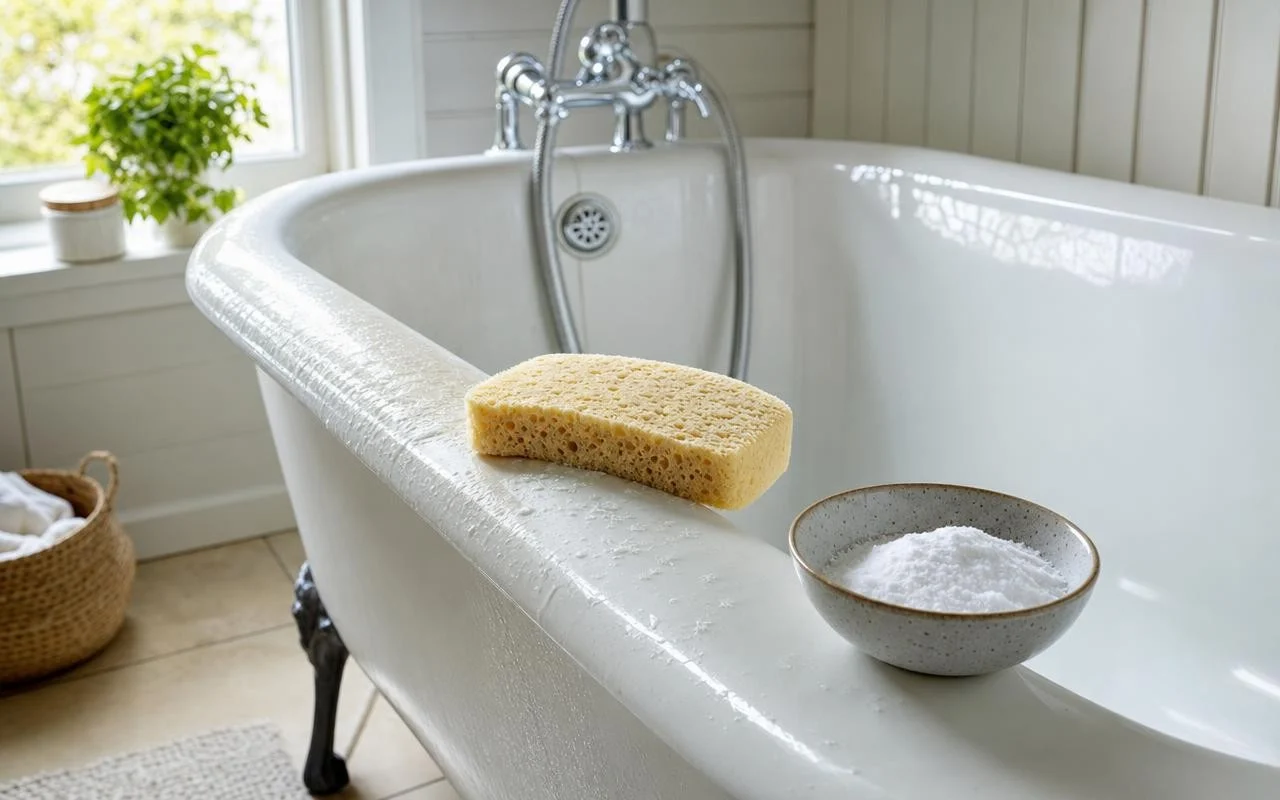
Your enameled bathtub has yellowed, a dull veil catches the light and soap scum resists ordinary cleaners. Many households turn to washing soda crystals, that white sparkling product found on the cleaning aisle. They are often touted as a miracle solution for cleaning everything in the bathroom, including enamel surfaces.
These crystals, which are sodium carbonate (Na₂CO₃), bear the CAS chemical reference 497‑19‑8 and display a pH of about 11.4, thus clearly alkaline. They dissolve fats very well and the famous soap film that clings to the walls. A question remains for those who own an old bathtub or a shiny, brand‑new one: what exactly do they do on enamel, and within what limits?
Washing soda crystals and enameled bathtub: what they really clean
On an enameled bathtub, washing soda crystals mainly act as a powerful degreaser. Their highly basic pH breaks down fatty acids and “saponifies” the grime, a property highlighted by hardware store data sheets. They remove the mixture of soap, sebum and bath oils that forms the notorious gray or yellowish ring. This is where they prove truly effective.
For enamel, the benefit is twofold. By eliminating this greasy film, the washing soda reveals the original shine again and reduces the adhesion of subsequent dirt. By rinsing carefully and then drying with a microfiber, you obtain a smooth and bright surface. However, they do not remove everything: very ingrained limescale or metal stains may remain visible.
Gentle washing soda recipe for enamel of the bathtub
To regularly maintain an enamel bathtub, a gentle recipe recommended by consumer associations consists of dissolving 1 to 2 tablespoons of washing soda crystals and 1 teaspoon of eco-friendly liquid soap in about three-quarters of a liter of hot water. You pour the solution onto the wet walls, then spread with a non-abrasive sponge, focusing on the bottom and around the drain.
For a simple touch-up cleaning, one teaspoon of crystals in 1 liter of very hot water is often enough. Let it act for a few minutes, scrub gently, then rinse thoroughly before drying with a microfiber to avoid water marks. On tougher stains on the enameled cast iron, some guides suggest a paste of crystals with warm water, applied locally and then well rinsed.
Washing soda on enamel: precautions and limits to know
This cleaning power has a counterpart: with a pH around 11.4, sodium carbonate is a strong base for domestic use. So wear gloves, avoid splashes to the eyes, and ventilate the bathroom. Washing soda crystals should never be used pure on enamel, always dissolved, and preferably after a small test on a less visible area.
- Do not mix washing soda crystals with vinegar or other acids: the reaction releases heat and can spray irritating droplets.
- Avoid fragile surfaces around the tub, such as aluminum, polished marble or waxed woods, sensitive to alkaline products.
- Do not confuse washing soda with baking soda (sodium bicarbonate), which is milder, and caustic soda (NaOH), much more aggressive, reserved for tightly controlled uses.
For soap stains, body grease and general grime, washing soda crystals remain a reliable ally on enamel. In the case of very thick limescale, a slightly acidic product used separately is preferred. When facing true metallic stains, some DIY enthusiasts report better results with preparations based on phosphoric acid.
