
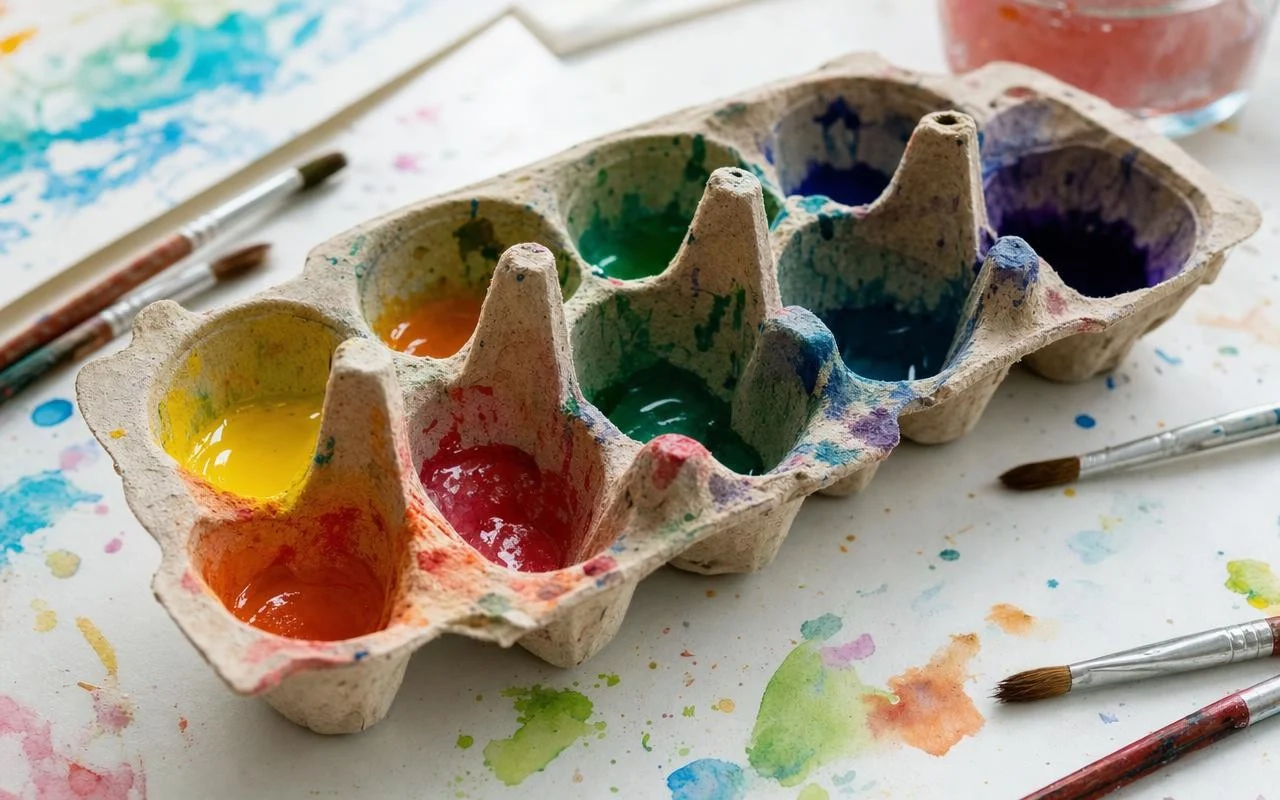
Recycling packaging in creative workshops has become a common reflex in many households. Among the most shared tips, the idea of turning an egg carton into a paint palette appeals to parents, activity facilitators, and teachers. A object that would normally end up in the trash becomes a convenient surface for gouache, especially with small hands that tend to spill over easily.
On paper, everything seems to check all the right boxes: no purchase needed, colors neatly separated, no cleaning because you throw away the box after the workshop. Creative sites describe it with simple dollops of gouache in each cell. Behind this highly appealing upcycling trick hides, however, a less visible question: what about health risks, especially for children?
Egg carton paint palette: why this trick is so popular
Molded pulp boxes naturally offer several small individual wells. For a children’s painting session, each compartment receives a drop of gouache, which minimizes waste and prevents colors from mixing at the center of a large palette. When the session is over, you simply let it dry and throw away the box, with no sponge to rinse nor water to change.
Activity sheets also mention plastic egg cartons, used solely for painting, as a kind of washable multi-well palette. In schools, this solution avoids the need to purchase additional equipment, and the familiar shape reassures children who recognize the object immediately. Many families see it as a simple way to extend the life of a packaging before recycling, in a zero-waste spirit.
Egg carton and Salmonella: the real hidden issue behind the DIY
Food safety authorities remind, however, that eggs can carry Salmonella Enteritidis, even when the shell appears clean. The FDA notes that young children, older adults, pregnant women, and immunocompromised individuals are more exposed to the severe forms of this infection. When a contaminated egg rests in a carton, bacteria can attach to the shell, then to the inside and outside of the packaging.
The USDA ARS service tested egg cartons made of molded pulp, Styrofoam, and plastic. Its findings show a possible transfer of Salmonella between contaminated shells and the boxes, in the context of hands-on activities. Along the same lines, USDA FSIS regards these packages as single-use to limit cross-contamination, and Michigan State University Extension notes that recycling them for crafts can lead to a foodborne illness.
Egg carton paint palette: how to limit risks in practice
Confronted with these findings, authorities advise against reusing containers that have already stored raw foods, including egg cartons. For a craft project, the simplest approach is to use a clean box that has never contained eggs, such as a plastic model purchased for painting. It should then not go back to the refrigerator nor be used for food storage, in order to break any contamination chain.
When a box has already contained eggs, the prudent stance is to treat it as potentially contaminated. If one still chooses to transform it into an egg carton paint palette, it must be reserved for single-use and discarded after the workshop. The CDC stresses washing hands for at least 20 seconds after handling, and Michigan State University Extension echoes the same hygiene guidelines for children’s craft activities.
