
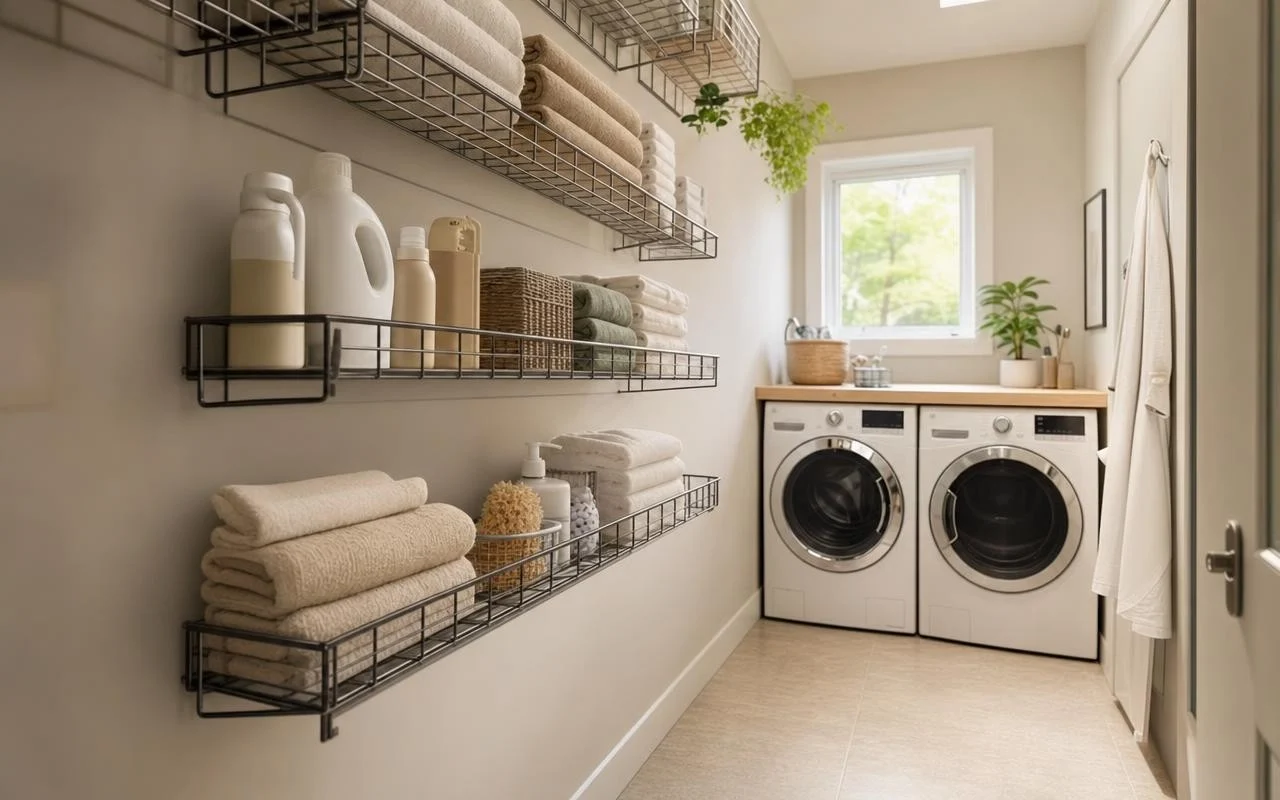
A tiny laundry room, floors cluttered with bottles and baskets, a constant sense of disorder: many households end up opting for a rolling storage cart, hoping to gain space. This instinct seems logical, as people add shelves where there is a hint of empty space, between the washing machine and the wall.
The result, however, is often disappointing. The site HouseDigest notes that the average laundry room in a US home is around 5 square meters, sometimes less in older housing. Once the washer, the dryer, the laundry basket, and, possibly, a sink are tucked in, every centimeter of floor space matters. And if the real solution wasn’t to add another piece of furniture, but to move the storage… to the wall?
Pourquoi le chariot à roulettes finit par gêner dans la buanderie
Shop catalogs show it clearly: the three-basket rolling storage cart has become a classic, marketed around the laundry space as a “space-saving” piece. In practice, this furniture often adds 20 to 30 cm of depth at floor level, right where you need to move around or open a door. In a corridor-shaped room, the clearance quickly narrows.
Many users also notice that the shelves on a cart aren’t enough for large detergent bottles or bulky boxes. They end up cramming small products, hard to reach on the lower shelves. Each laundry load then requires bending down several times, a repetitive motion that fosters lower back pain. In the end, the cart “eats” both floor space and ease of use, prompting people to look for another approach.
Paniers filaires suspendus : le rangement vertical qui libère le sol
The solution proposed by HouseDigest is to forget the cart and switch to wired hanging baskets. These organizers appear as a metal frame, often made of steel or iron, equipped with one or more wire mesh baskets that are mounted directly on the wall or under a shelf. Installed above the washing machine, on a free wall section, or behind a door, they exploit the vertical storage without occupying a single inch of floor space.
Another major advantage: everything stays at hand height or eye level. No more bending down to reach the fabric softener or the laundry capsules, which clearly relieves the back. The wire mesh makes it easy to see what’s in each basket and promotes air circulation, handy for gloves, brushes or small damp items. Some wall-mounted supports specify a load capacity of about 13 kg, more than enough for detergent bottles. In practice, this type of laundry wall basket ticks several boxes:
- Floor space completely clear for easy movement and cleaning;
- Products grouped by use, visible at a glance;
- Ability to add or remove baskets as needed.
How to choose and install a laundry wall basket without missteps
Before buying, you must first define what you want to store. For laundry detergents, a small wired basket about 26 x 26 cm and 14 cm high often suffices. For lightly awaiting laundry, wall-mounted folding models around 48 x 36 x 12 cm, to hang behind a door, free up floor space while replacing a basket placed on the floor. A quick measure of the width available above the machines or on the side wall avoids bad surprises: the basket should not hinder the door opening, nor protrude excessively into the passage.
Attachment remains the key step. DIY guides advise starting by identifying the wall type: concrete or brick will require standard expansion anchors, while a plasterboard wall requires specific metal anchors. Manufacturers indicate a maximum load, sometimes around 13 kg; it’s safer to leave a margin by not filling the basket to the absolute limit of what the metal could theoretically bear. In a damp laundry, opt for a basket in rust-resistant steel or epoxy-painted. For rentals, hook-on systems that attach to the edge of the door or adhesive fixings exist, but they are best suited for small bottles and light accessories, to turn even a simple patch of wall into real vertical storage.
