
A kitchen fire that spirals out of control, a short circuit behind a piece of furniture, a stove that isn’t well maintained: in a home, a fire often starts where you least expect it. People instinctively think about smoke detectors or evacuation, far less about the materials that make up walls, floors, or partitions. Yet their behavior in the face of flames can make a significant difference in survival time and in the extent of damage.
Behind the term “fireproof material”, there are in reality two clearly distinct regulatory notions: reaction to fire and fire resistance, governed by European standards NF EN 13501-1 and EN 13501-2, as well as by the decree of November 21, 2002 and the decree of March 22, 2026, which came into effect on March 27, 2026. Among designations like “A1”, “EI60” or smoke indices, it can quickly become difficult to navigate when choosing the right products at a hardware store or in a home improvement retailer. This is where a few simple reference points can make all the difference.
Reaction, fire resistance and classes A1 to F for home materials
The NF EN 13501-1 standard classifies the fire reaction of construction products into Euroclasses ranging from A1 to F. A1 corresponds to non-combustible products that do not contribute to the fire, while classes E or F are much less effective. Indices complete this classification: s for the amount of smoke emitted and d for flaming droplets, which yields for example a code like A2-s1,d0. The decree of November 21, 2002 adopts this logic and applies it to French buildings.
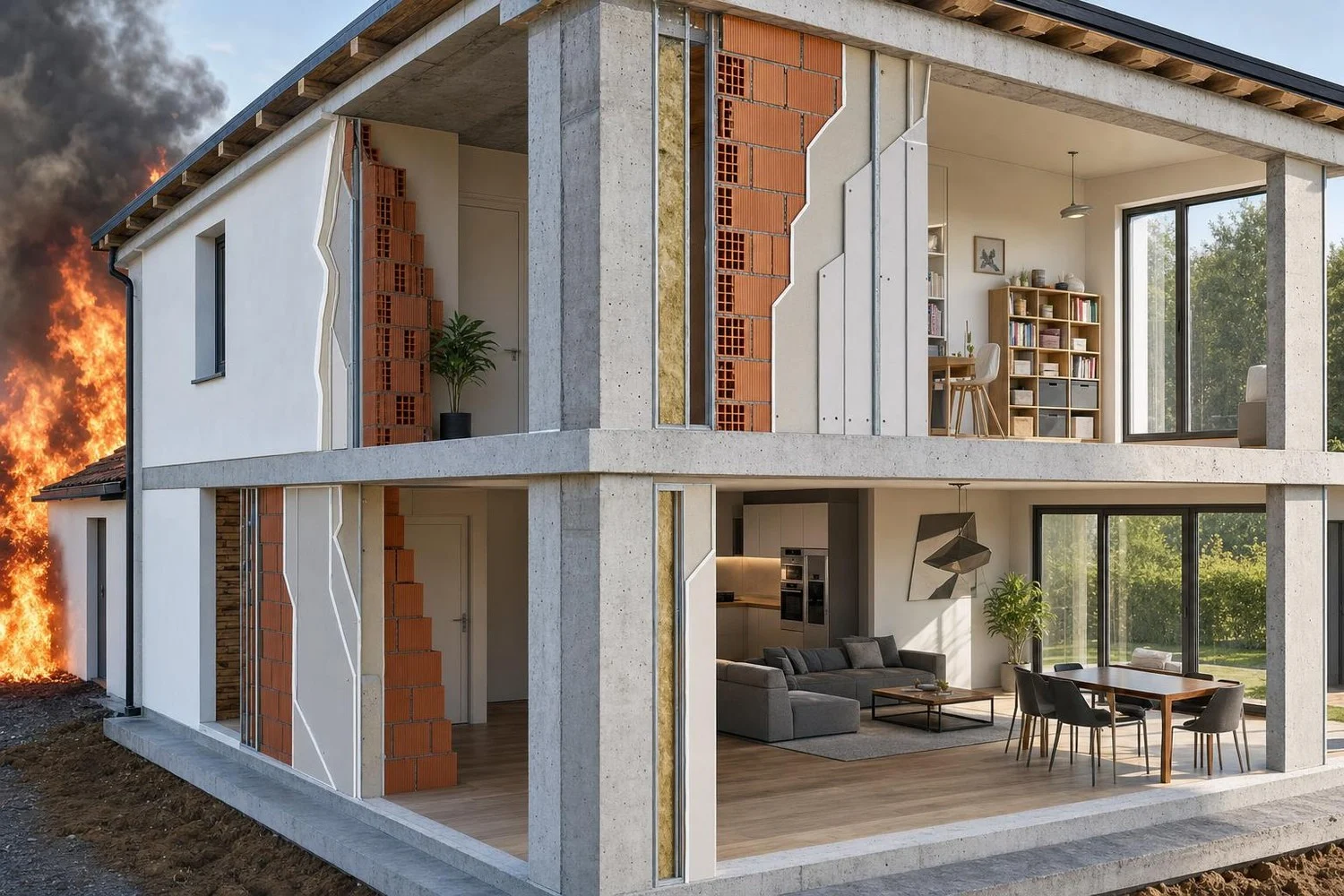
The fire resistance, on the other hand, falls under the EN 13501-2 standard with criteria R, E and I: load-bearing capacity, flame and hot-gas tightness, and thermal insulation. The EI30, EI60 or EI120 classes indicate that a building element has been tested to maintain tightness and insulation for 30, 60 or 120 minutes. The decree of March 22, 2026 reminds that this performance pertains to a complete system (wall, floor, partition) rather than a bare material laid on its own. In a home, the most robust combination rests on three major classics: concrete, fired-clay brick, and the fire-rated plasterboard.
Béton et brique en terre cuite : le socle minéral le plus résistant aux flammes
According to Infociments data, the concrete is classified in Euroclass A1, hence non-combustible. Its low thermal conductivity results in a slower internal temperature rise when exposed to fire, which buys more time before the reinforcements are compromised. In a single-family home, it appears in load-bearing walls, floors, beams, or stairs. The fire-resistance performance of a concrete structure nonetheless depends on sizing, the encasement of steels, and connection details, as considered in EI or REI rating tests.
The brique en terre cuite used in load-bearing masonry or partitions also sits in Euroclass A1 according to industry professionals. Like concrete, it does not burn and does not propagate flames within the wall. Used for exterior walls, interior partitions, or certain floors, it provides excellent mechanical stability in case of a fire. The exact performance depends on thickness, block type, and chosen assembly, but combining a concrete structure with fired-clay masonry yields a house envelope that is naturally highly fire-resistant.
Invalid YouTube URL.
Plaques de plâtre, classes EI et repères simples pour des matériaux résistants au feu maison
Less visible, plasterboard nonetheless plays a key role in fire protection. Made of gypsum, it is classified A1 for reaction to fire and serves as the facing for walls, partitions, and ceilings. Manufacturers like Knauf offer specialized “fire” boards, denser or reinforced, integrated into complete systems tested according to EN 13501-2. These systems allow achieving EI30, EI60 or EI120 resistance levels for distribution partitions, technical ducts or ceilings, protecting the structures or vulnerable spaces behind them.
To make informed choices, a few quick checks are enough. First, favor fire-resistant home materials classified A1 for the structure and main walls, such as concrete and fired-clay brick. Next, verify on the technical data sheets the fire resistance class of the complete system, looking for EI or REI mentions followed by the duration in minutes. Finally, for more complex projects or those subject to specific regulations, refer to the requirements of the March 22, 2026 decree and Civil Security guides, or ask a professional to confirm that the chosen material assembly truly meets these performance levels.
