
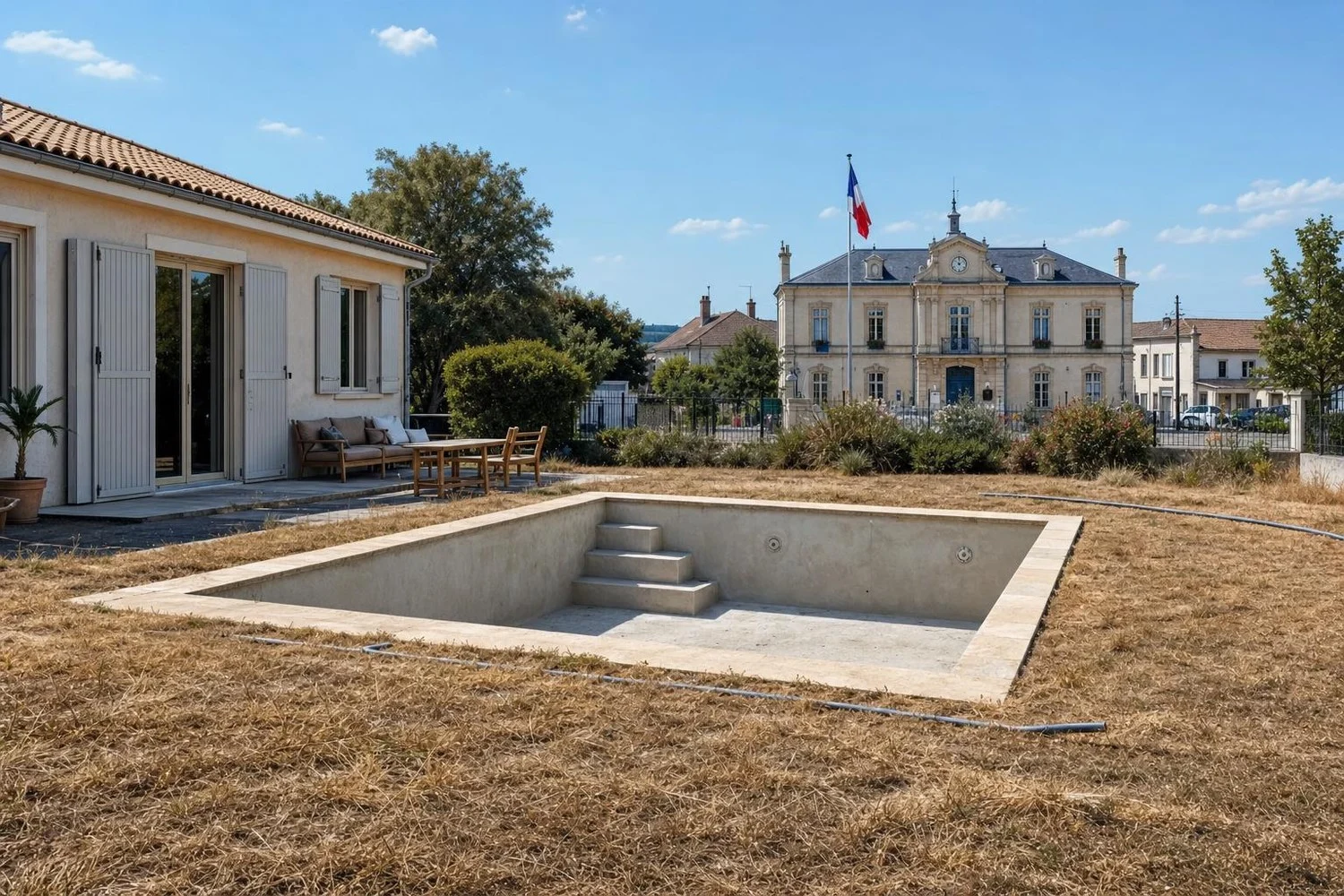
Heat waves keep rolling in one after another, and the idea of installing a pool in the garden comes back every summer. France already counts nearly 3.5 million private pools, making it the leading European country for this type of equipment. Many homeowners therefore turn to their town hall with the same hope: to obtain permission to dig quickly.
In several regions affected by drought, rules have nonetheless tightened. Examples include the Communauté de communes du Pays de Fayence, the town of Elne in the Pyrénées-Orientales, and the Rennes metropolitan area: cases of limitations, even bans, are multiplying to safeguard the water resource. All of this leads one to wonder, very concretely, how far your municipality can go.
Interdire une piscine : ce que votre commune peut décider sur la construction
A local authority cannot ban a pool “on a whim”. It acts first through the Plan Local d’Urbanisme (PLU) or the PLUi, which set the construction rules for the territory. These documents determine the zones where constructions and annexes, including private pools, are allowed, and serve as the basis for the review of prior declarations and building permits filed at the town hall.
In some cases, the rule is very clear. The Communauté de communes du Pays de Fayence, northwest of Cannes, decided in 2023 to freeze for five years the construction of new pools, until 2028, due to the dwindling groundwater and to protect the supply of drinking water. The PLU of Saint-Paul-en-Forêt, in the Var, even goes so far as to state: “In all zones: new pools are forbidden.” Once these rules are approved, they become binding on any project.
Piscine et urbanisme : PLU, PLUi et motifs légaux de refus
According to the site Service-public.fr, creating a private pool may require an urban planning authorization depending on its size and characteristics. The mayor, as the competent authority, then checks the project’s conformity with the PLU or the PLUi. If the urban planning document limits, for example, the surface area of annexes or imposes implantation rules, the municipality can refuse the construction if the pool does not comply. Rennes Métropole chose this route in 2025 by integrating into its PLUi the ban on private pools larger than 25 m³.
The law also provides a supplementary lever. Article R.111-2 of the Urban Planning Code allows refusing a project, or attaching special prescriptions, when it could harm public health or public safety. This power complements the framework set by the PLU and remains bounded: the decision must be justified and tied to identified risks. The mayor finally holds a general policing power, provided for in Article L.2212-2 of the General Code of Territorial Collectivities, used to maintain public safety and order.
Sécheresse, préfet, amendes : quand votre piscine reste vide malgré l’autorisation
Another key actor: the prefect. In times of water shortage, prefectural orders can limit usages, based on Article R.211-66 of the Environment Code. Service-public.fr recalls that “prefects can establish exceptional, gradual, and temporary measures to limit or suspend non-priority water uses for individuals and professionals.” These measures apply to everyone, even to those whose pool has been regularly authorized.
The restrictions are organized into four levels. From level 2, the so-called alert level, filling and draining pools are prohibited, just as watering gardens or washing cars. Failure to comply with these rules carries a fine of up to €1,500, raised to €3,000 in case of a repeated offense. Some municipalities have gone further in anticipation: in Elne, the mayor issued an order banning new pools, explaining: “How can one, on the one hand, forbid a four-child family from watering a garden worker’s yard that helps them live, and sometimes to survive, and, on the other hand, allow neighbors to enjoy a pool?” So for an individual, the safest path remains to first check the PLU or PLUi, then the urban planning steps required by their town hall, and finally the current drought level in their department.
