
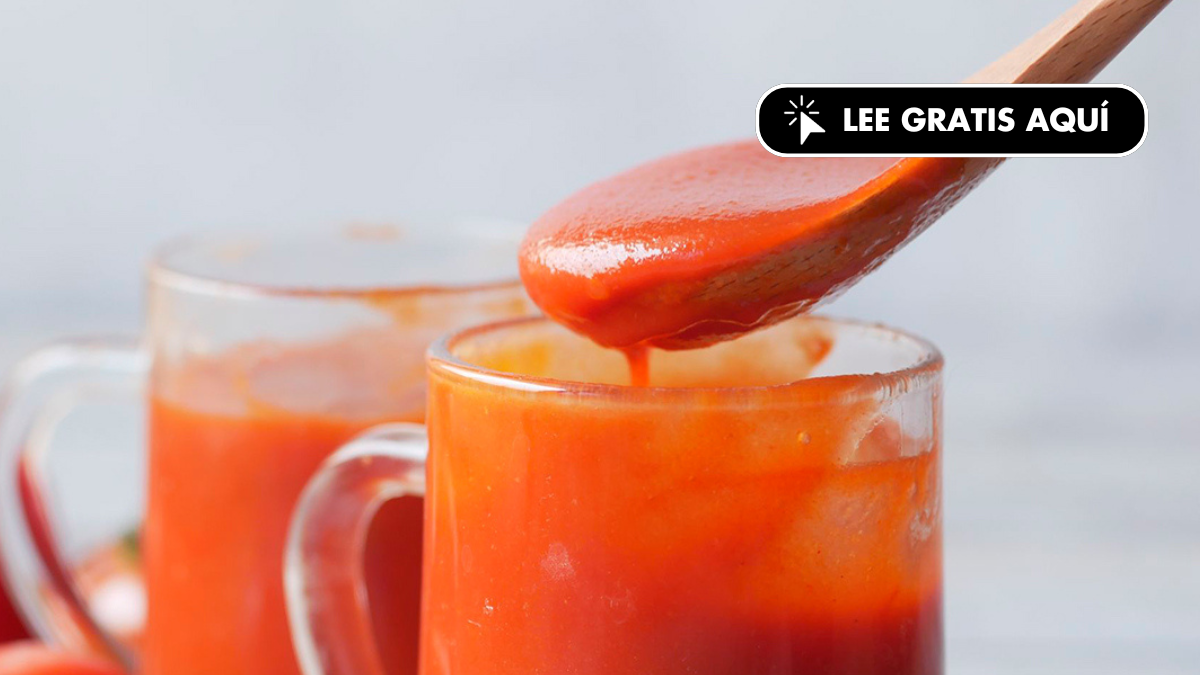
Tomato sauces are one of those almost indispensable items in our pantry. They act as the background for a sofrito, but also as an ad hoc sauce to accompany pasta, for example, and they please everyone. But not all of them are the same, as you can imagine.
And no, we’re not referring to the organoleptic profile –which is, evidently, different between brands–, but to the nutritional paradigm we are going to find in them. At first glance, stumbling upon a tomato sauce would make us think there won’t be any unwanted element, or, in a sense, not very advisable. After all, what could happen with a tomato?
However, the reality is more stubborn if we take a look at the composition of some tomato sauces. Something that was warned about by the nutritionist Fran Susín, @fransusin, on his social networks when taking a look at the Mercadona shelf, the leading supermarket chain in Spain, with a market share that exceeds 25 %.
Tomato and nothing more than tomato?
It is evident that a tomato sauce on its own is not going to be the enemy of our diet. A different story is when we are monitoring certain intakes, especially if added sugars start to torment us. What is clear is that you cannot criminalize tomato sauce thinking that it will be responsible for our extra kilos. Especially if it is used as sparingly as it is usually done.
Even so, it is worth checking that, a priori, there may be sauces less desirable from a nutritional standpoint. In this sense, apparently, in a normal everyday supermarket tomato sauce there should only be tomato, salt, some fat, such as olive oil or sunflower oil, and perhaps some type of sugar. There may also be an acidulant or other vegetables. And, in some cases, tomato concentrate is used. Also modified corn starch, which is used to provide texture.
In this case, what Fran Susín indicated is that, if you were in a “weight-control period,” he would advise, in the case of Mercadona, three very concrete references: double-concentrated tomato, sieved tomato, or chopped tomatoes. If that were not the case and calories were not a problem, he would opt for a fried tomato with olive oil. In his example, he would pay special attention to some tomatoes that, for example, boast of no added sugars, but are “packed with sunflower oil,” which is why he would discard that reference specifically.
View this post on Instagram
Although, in this case, the tomato alone has only 65 kcal per 100 grams of product and barely 3.5 grams of total fats, coming from, yes, refined sunflower oil. The fried tomato with olive oil Hacendado recipe also isn’t great, this time because it contains a lot of fat, despite being olive oil. This places 100 grams of the product at 200 kcal, which is considered high for a tomato sauce.
The problem isn’t just the tomato sauce: it’s the company behind it
As expected, the dilemma with tomato sauce is not usually solely about the sauce itself. A common accompaniment, especially for pastas, the possibilities to increase the calories of a pasta dish with tomato lie in the details. For example, in the amount of cheese that could be added to make it more complete. Or in the type of meat we would use if, for example, we were making spaghetti Bolognese, about which we have already talked in THE OBJECTIVE.
In this way, part of the problem with tomato sauces lies in the lack of time to prepare them. As the nutritionist Blanca García-Orea also commented on her Instagram account, making a homemade tomato sauce is quick and easy. In fact, her recipe includes crushed tomato, garlic, basil, oregano, salt, extra virgin olive oil and a pinch of bicarbonate. It can be made in a saucepan or in the oven.
Another element to consider is, as Susín cited and as the nutritionist Terica Uriol also explained through her social networks, the fat percentage. In this case, she warned that if we really want a low-fat tomato, we should look for one with less than 0.5 % fat.
