
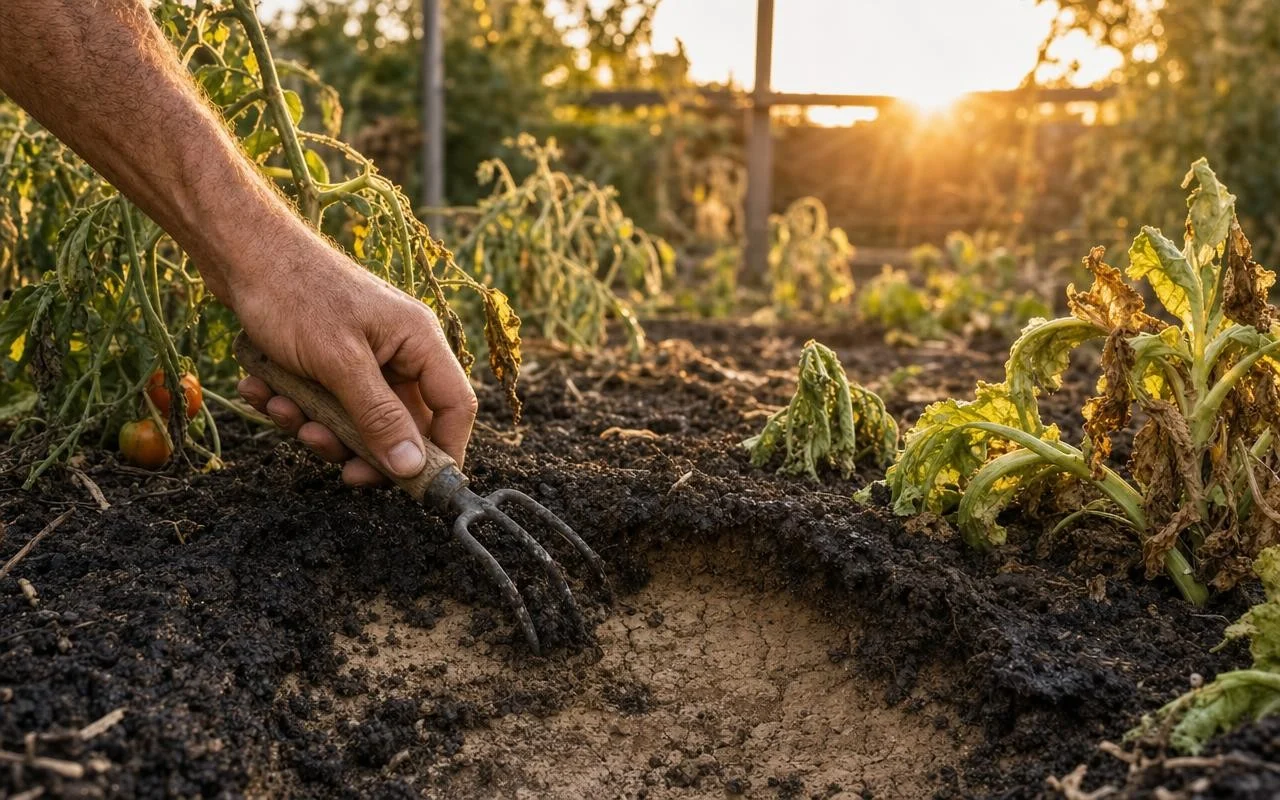
During the last heatwave, you may have done what many did: watering every evening your tomatoes, roses, and borders, convinced you were saving them. The soil seemed damp, the leaves stood up a little, and you tucked the watering can away with the feeling of a job well done. A few days later, however, the stems bent, the flowers withered, as if nothing had been done.
Faced with this sight, many gardeners blame a lack of fertilizer, a disease, or an irreversible heat stress. One of them finally picked up a small tool to scratch the soil at the base of his plants, just “to see.” Beneath the thin dark layer, he uncovered a surface as hard as dry concrete. From there, everything began to make sense…
Watering every evening during a heatwave: the trap of shallow watering
This superficial watering each night mainly gives the impression of freshness. The water stays on the surface, barely cools the first centimeter of soil, and then evaporates very quickly by sunrise. The roots, drawn to this fleeting moisture, stay near the surface instead of sinking deeper. The slightest surface soil heated above 35 °C eventually ends up burning them almost literally.
By scraping this watered soil every evening, the gardener revealed a genuine hard crust: a dry, pale, compact layer that formed a lid. The repeated light waterings had hardened it day after day. The water poured would slide or pool on top, never reaching the root zone. The plants were thus dying of thirst, right in the middle of a watering.
Under the fine damp soil, a crust that blocks everything
This crust is quick to spot: the surface is hard, cracks into slabs, and sounds almost hollow when struck with a hoe. When the soil reaches this point, even a large watering all at once hardly helps. Water rushing along the sides sometimes carries a bit of soil away, but it does not descend. The vegetable garden remains dry underneath, without realizing it.
Added to this is another trap: seeing the dry surface and reacting immediately. In the middle of a heatwave, the proper frequency for well-rooted vegetables tends to be around 2 to 3 thorough waterings per week. Specialists advise checking the leaves around 6 p.m., then performing the famous finger test a few centimeters deep before deciding.
Heatwave: break the crust, water deeply, and protect the soil
To break out of this vicious circle, the first step is to break this crust. A light tilling over 2 or 3 centimeters crumbles the surface and reopens pathways for the water. Next comes deep watering: a gentle jet, aimed at the base, until the soil is moist in depth, even if it means returning a second time a few minutes later if the soil was very dry. In practice, this routine can be summarized in three simple steps.
- Scratch or till the surface around each plant to break the crust.
- Water slowly, in two passes if needed, until delivering 5 to 8 liters per tomato plant.
- Install a mulch layer of 5 to 8 centimeters to retain moisture and limit heat.
Tomatoes tolerate this pace well: in midsummer, a plant can receive 12 to 18 liters per week, ideally distributed as 5 to 8 liters per watering, 2 to 3 times. The best window is early morning, between 5 a.m. and 7 a.m. In pots or for very shallow-rooted greens, checks should be more frequent. Will you scratch the soil this evening before turning on the water?
