
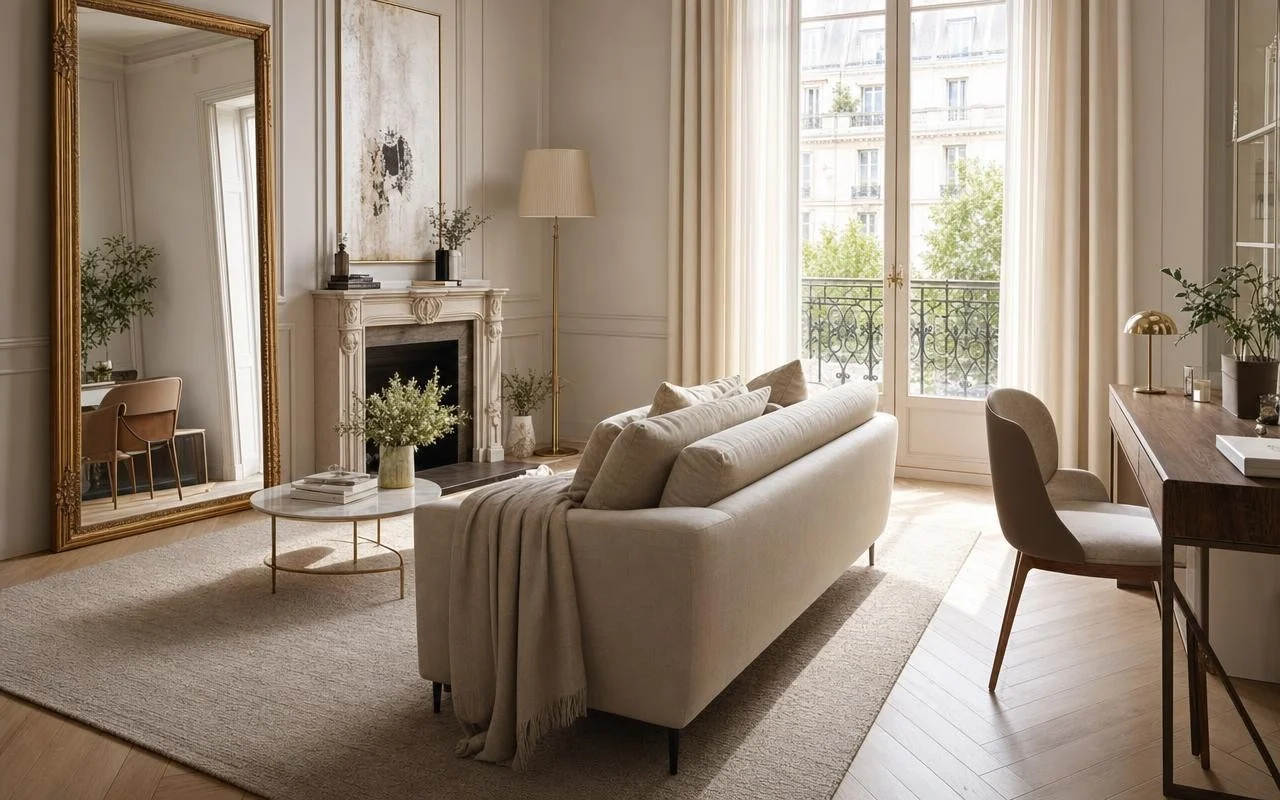
Do you feel that your small living room shrinks the moment you add another cushion or a plant? Many French living spaces stack a sofa, a TV, a desk, and children’s toys within just a few square meters, resulting in a cluttered look quickly. Without touching the walls, interior designers nevertheless work on another string: the eye.
We gathered tips from Tara McCauley, Michal Rubin (MR Interiors) and organizer and décor creator Sydney Nicole Gifford to understand how make a small living room look larger in appearance, almost instantly. All emphasize circulation, height and visual coherence. The good news is that a few targeted gestures are often enough to completely change the perception of the room.
Making a small living room look bigger: the right diagnosis before moving furniture
First reflex: observe the living room as a plan viewed from above. Some interior designers, like those interviewed by Amadeco, recommend keeping about 90 cm of main passage and at least 50 cm around the coffee table to allow circulation without weaving. If you do not reach these benchmarks, the problem stems less from the room’s size than from the number of items placed on the floor.
Another key question: isn’t your living room actually a living-room-office-laundry? Tara McCauley notes that many rooms look tiny because they “do too many things at once.” She explains: “I recently had the inside of a client’s closet painted in a bold contrasting color and installed in front of spectacular curtains, which open to reveal a glamorous telework corner,” says Tara McCauley. By concentrating the desk in a closed alcove, she visually freed up the rest of the living area.
7 designer moves to immediately make a small living room feel bigger
On the walls, Tara McCauley recommends creating a single large focal point above the sofa. “A tall work of art or a beautiful large mirror can emphasize the ceiling height and fool the eye into perceiving the room as larger,” explains Tara McCauley. Michal Rubin agrees, focusing on wallpaper: “Wallpaper is an instant tool that opens the eyes when designing a small space as a living room,” she explains. A repeated pattern or a textured plain applied to a strategic wall is enough to visually stretch the space. She also recommends rugs: “Look for area rugs with patterns or subtle textures to emphasize a portion of the room and give the rest of the space the impression of being larger,” explains Michal Rubin. A single large rug that spans under the sofa and coffee table gives the impression that the floor extends.
When it comes to furniture, Sydney Nicole Gifford challenges a common belief: it’s better to have fewer items, but at the right scale. “Keep the number of pieces you use to a minimum, but choose furniture that fills the space at the same time,” she advises. A simple sectional sofa with a lightweight coffee table will work better than a multitude of small seats and side tables. Michal Rubin also loves original shapes: “It helps keep the eye moving and creates angles that did not exist before,” she explains. A rounded sofa, an arched console or a central leg that is unobstructed frees the view under the furniture. On colors, she adds: “With small pieces, color blocking and using different colors in decorative accessories, for example on a bookshelf, help bring interest to a small space,” says Michal Rubin. Clean blocks of color and a few well-placed colorful accents guide the eye around the room.
Colors, storage and mistakes that shrink a small living room
The stylists interviewed by Apartment Therapy remind us that a single bare ceiling light, which they call “the big light,” tends to flatten the volume. It’s better to combine a floor lamp, a table lamp and accent lighting to create zones and depth. The same logic applies to color: a very dark accent wall in the middle of a bright space can act as a stop wall. An enveloping color blocking, or coordinated accessories on shelves, gives a more fluid impression.
To keep these tips in mind, a small checklist helps ensure you don’t shrink your living room without realizing it:
- Cluttering with too many objects and small furniture pieces that cut circulation.
- Either a single large sofa or, conversely, only tiny pieces that float.
- Several small rugs or layered rugs that fragment the floor.
- A single very bright ceiling fixture, without softer accent lamps.
- A permanent desk in the middle of the living room instead of a fold-away or hidden station.
- A very dark, isolated wall that stops the eye instead of colors designed to travel around the room.
