
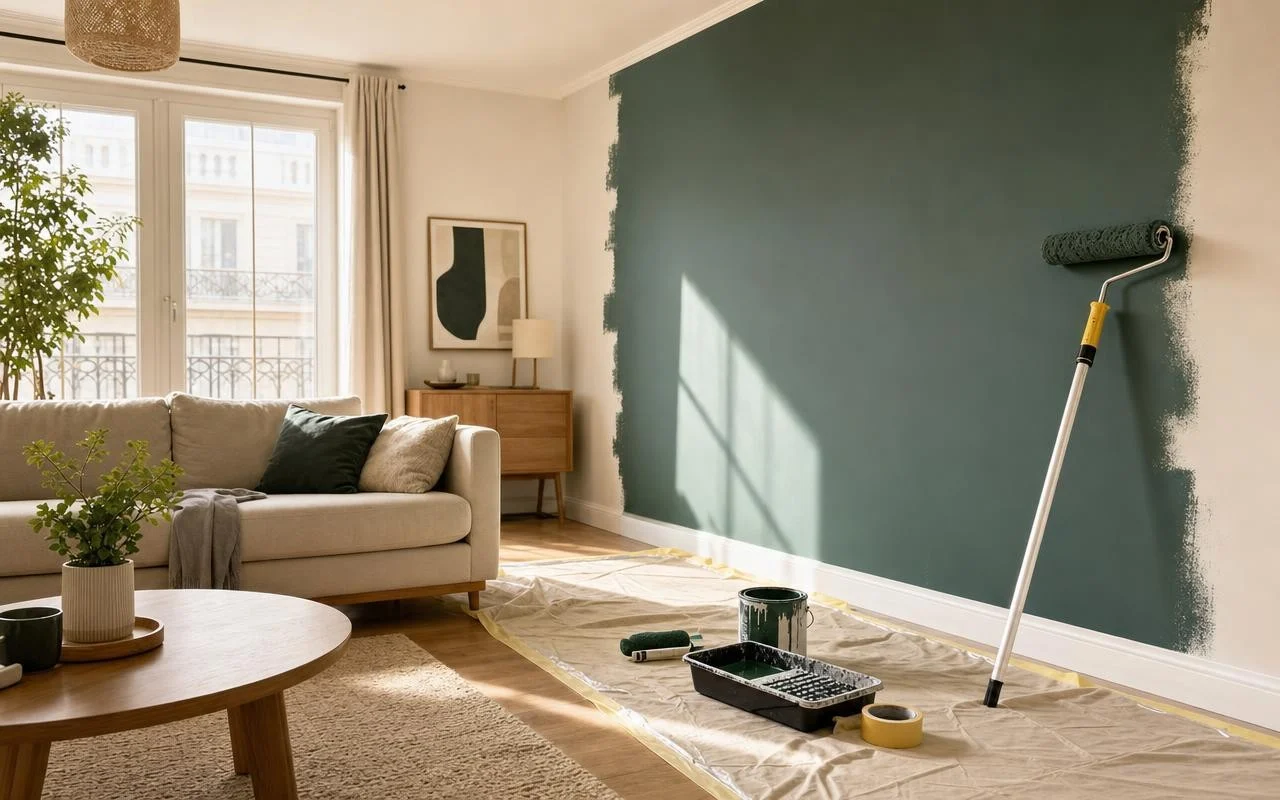
Painting a living room from floor to ceiling is something of a rite of passage that accompanies every urge for a refresh. We clear the space, cover everything, and apply layer after layer, only to end up with results that can be disappointing: too loud if the color is vivid everywhere, almost invisible if the approach is to go fully neutral.
Decorators are increasingly betting on another strategy: painting a panel of wall or a simple, well-placed shape with just one can and one roller. These targeted placements structure the space, create a focal point, and even allow testing a bold color without committing to the entire room. It all hinges on a single move.
Why repainting the whole living room isn’t always essential
For a long time, refreshing a living room meant covering all the walls in the same shade. For a medium-sized living room, that implies several liters of paint, a lengthy prep, and two to three coats for a uniform finish—equating to an entire weekend spent on the project. This reflex costs time, energy, and budget, while the decorative impact isn’t always commensurate.
A bright color applied everywhere can quickly overwhelm the space, especially if natural light is scarce. Conversely, a generalized beige or white can end up lacking depth. Targeted application techniques alter this scenario. By concentrating color on a specific zone, you create a visual anchor, play with the room’s proportions, and bring character without repainting the whole area.
The 7 painting poses that transform a living room without doing everything
Painting only a portion of a wall changes the perception of volume. Round shapes soften corners, a diagonal adds movement, and a low band warms things up without heaviness. These poses suit all styles, from Bohemian to more graphic, and also help define a reading nook or a work corner without a divider.
Here are the 7 painting poses that are enough, each in its own way, to metamorphose a living room:
- Organic arc: a large, rounded, asymmetric shape, often placed behind the sofa, which softens angles and creates a gentle visual center.
- Angle split: color extending across two walls in a corner, with a clear boundary line, to structure a neglected angle and give depth.
- Framed: a rectangle or square painted around a sofa, a console, or a fireplace, like a frame that highlights the main element.
- Inset: color that gradually enters a niche or recess, ideal for exploiting alcoves and often-underutilized corners.
- Compact curve: a tighter rounded shape, perfect for materializing a reading nook or a small desk in the living room.
- Diagonal: a bold, straight diagonal line across a wall, very dynamic, well-suited to contemporary or industrial atmospheres.
- Low curved band: a wide, wavy band along the lower part of the wall, like an enlarged baseboard, which adds warmth and subtly dresses the space beneath low furniture.
Wall preparation, masking tape, and colors: the keys to a pro result
For these poses to endure over time, preparing the surface remains decisive. Years of layered coats without proper sanding end up forming fragile strata that peel, often around outlets and in corners. A light sanding after cleaning helps create micro-roughness where the new paint can grip, especially if a primer is applied to even out the wall. Any area that sounds hollow or peels should be scraped before repainting.
The masking tape plays an equally important role in obtaining a clean line. A tape suitable for painted surfaces, properly pressed to the wall, prevents paint from seeping underneath, especially on curved or geometric shapes. Pros recommend planning at least two coats, testing the shade on a small area, removing the tape while the paint is still slightly tacky, and limiting the living room to three coordinated colors with a finish in matte, velour, or satin depending on the desired ambiance. A single well-defined zone is often enough to completely change the perception of the living room.
