
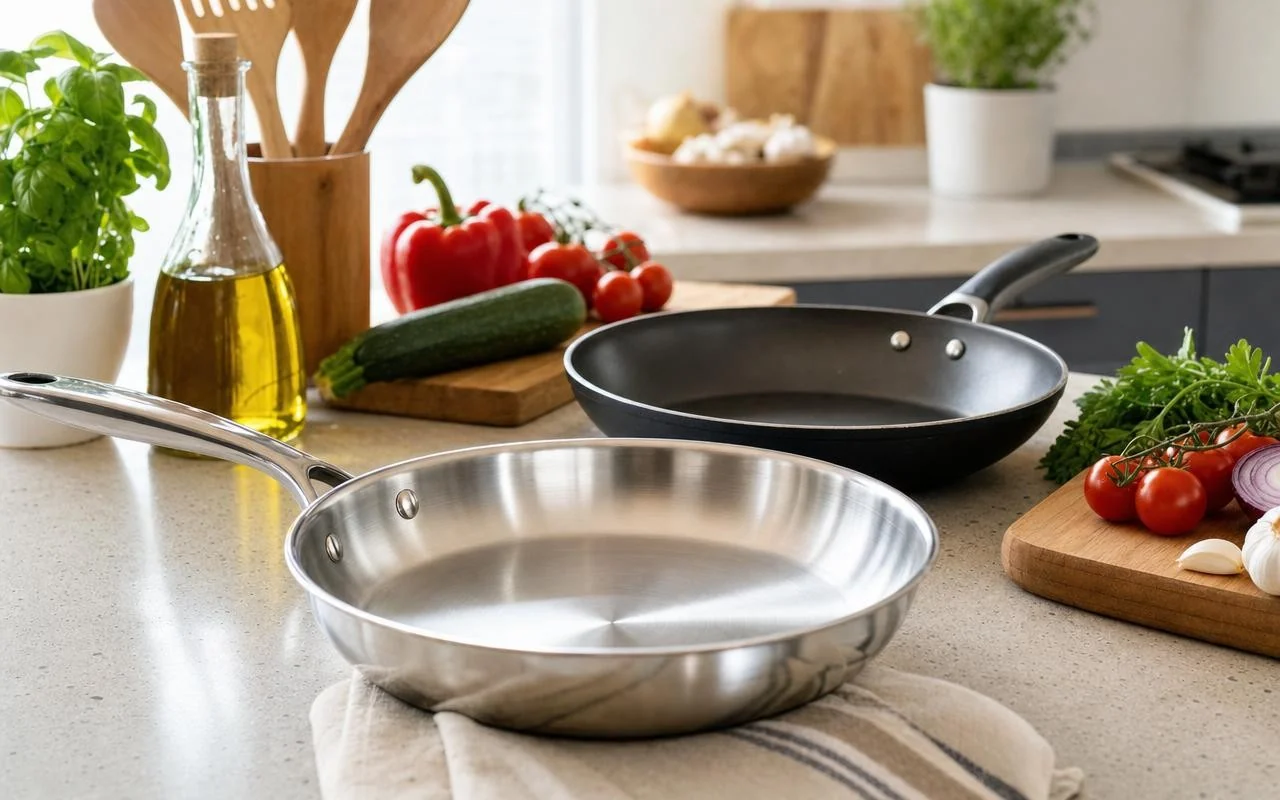
In many kitchens, the nonstick frying pan has become a reflex, almost automatic. We move from omelets to vegetable sautés and pancakes in quick succession, rarely stopping to consider what is happening with the coating. Yet the debates surrounding PFAS, those persistent chemical compounds found in some coatings, have sown doubt: which pan should be chosen when you want to minimize what leaches into the family’s plate?
Food technologists are questioning this repeated contact between hot metal and food. The Spanish expert Mario Sánchez notes that “the food safety of pans is very important, because we use them daily and they are in constant contact with food.” According to him and other experts cited by consumer associations, one material stands out for everyday use. The question remains why this choice is gradually becoming the default.
Why food technologists champion the stainless steel pan
Invited by the health media Saber Vivir, Mario Sánchez is blunt: “If I had to buy myself a pan, the best option would be stainless steel.” He adds about this material: “It is an inert material, which means it doesn’t leach toxic components into the food. Additionally, it is easy to clean and dishwasher-safe, and it doesn’t harbor bacteria like wood, for example.”
Practically, a stainless steel pan has no fragile coating that could flake off. It is manufactured from a chromium-nickel alloy, often in 18/10 stainless steel, praised by UFC-Que Choisir or Allo Docteurs for its good performance in contact with food. The absence of an antiadhesive layer reduces the risk of releasing unwanted substances, while offering a sturdy pan that can withstand high temperatures and endure years of washing.
PFAS, PFOA, Teflon: what a stainless steel pan changes
The current caution mainly stems from the recent history of nonstick coatings. Up until 2020, many Teflon pans contained PFOA, a PFAS-family compound, now highly regulated at the European level and virtually banned since July 4, 2020. Mario Sánchez notes that “the main problem isn’t Teflon itself, but the PFAS that coat Teflon to make it adhere to the pan.”
According to a test published early in 2024 by UFC-Que Choisir, 17 different PFAS were still found in 8 nonstick pans out of 70 substances tested. Health authorities, such as Singapore’s Food Safety Authority, also note that PTFE begins to degrade at around 260 °C, especially if the pan is heated empty. In light of these limits, the OCU reminds that cast iron, ceramic, and Teflon retain their appeal, but each comes with its own constraints of weight, fragility, or maintenance.
How to choose and use a stainless steel pan daily
To avoid these coating questions, many experts recommend a quality stainless steel pan, in an 18/10 alloy with a thick base that distributes heat well. Some studies show that stainless steel can release trace amounts of nickel or chromium, especially with very acidic foods and during the initial cooking, but the levels remain low for most people; in case of nickel allergy, cast iron or ceramic are more suitable.
The idea that “stainless steel sticks” persists. Specialists recommend the water drop test: heat the pan empty, place a drop of water, and when it forms a bead that slides across the surface, add the fat and then the foods without moving them for a few moments. Mario Sánchez acknowledges that “it is true that at first it is tricky to cook with,” but with these steps, stainless steel becomes a daily tool.
