
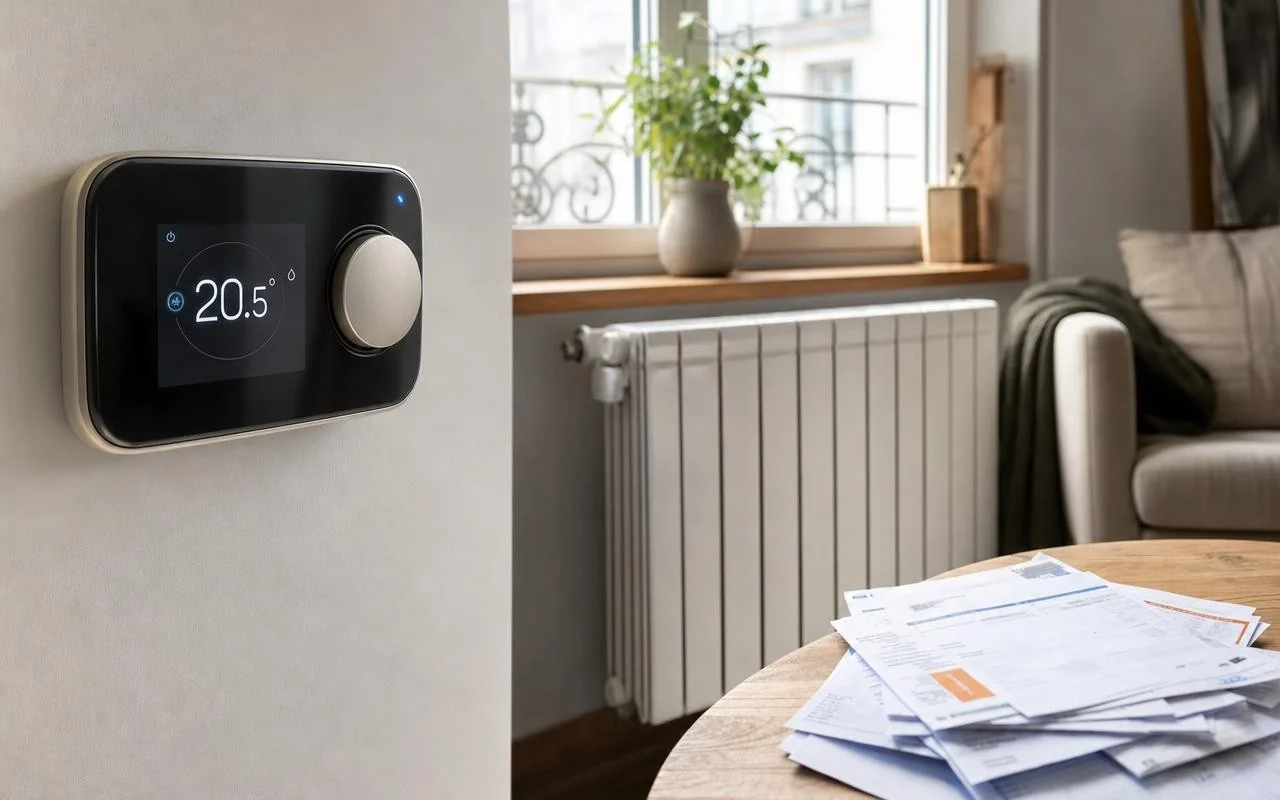
When cold weather sets in, the hand often drifts toward the thermostat almost by itself. One extra degree, and we tell ourselves that it won’t be drastic for the bill. For a long time, the famous 19 °C rule served as a reference, without really knowing what each additional notch of heating costs.
Energy agencies and specialists now agree on a new equilibrium: around 20 °C, most homes find a good balance between comfort and spending. Behind this figure lies above all a simple, quantified rule that changes how to adjust one’s thermostat and deserves to be explained in detail.
20 °C, the tipping point where every degree weighs 7%
The Spanish Institute for Energy Diversification and Savings (IDAE) sums up the issue very clearly: “each additional degree increases energy consumption by about 7 %.” According to this public body, “between 19 and 21 degrees are enough for almost everyone, and with 20 you maintain well-being in a home.” In other words, 20 °C serves as a reference point; above it, the bill climbs quickly.
Nick Barber, an expert in energy management, also reminds us that “this temperature was defined as an economic compromise rather than a true comfort optimum.” Practically, the extra cost can be calculated easily: the additional cost is roughly equal to your heating bill multiplied by 7 %, then by the number of degrees above 20 °C. This makes clear why you should check whether you really need 22 or 23 °C in the living room.
The right temperatures by room to limit the 7 %
Comfort is not determined by a single global figure. Brad Roberson, specialist in heating systems, notes that “the sensation of thermal comfort depends on many factors beyond the simple temperature.” The IDAE and the experts cited in Presse-citron converge on a room-by-room approach, with simple benchmarks:
- Living areas: about 20 °C.
- Bedrooms: 16 to 18 °C, and 15 to 17 °C at night.
- Bathroom: 22 °C during the shower.
- Corridors and passageways: around 17 °C.
- Kitchen: a little cooler, thanks to the heat produced by appliances.
This distribution avoids overheating the whole house while you enjoy an evening in a single room. It also limits condensation and mold problems that appear in homes kept too cold, while reserving the “expensive” degrees for when you truly enjoy them.
Thermostat, programming and smart moves to retain those 7 %
To apply these guidelines without thinking about them constantly, the simplest approach remains the programmable or connected thermostat. The IDAE explains that a regulation system tailored to the schedule and usage of the dwelling makes it possible to adjust the temperature rather than turning it on and off without logic. Coupled with thermostatic valves on radiators, this type of equipment can generate between 8 and 15 % energy savings per year according to estimates reported by energy organizations.
Daily life then follows a simple rhythm: thorough airing for about ten minutes in the morning with the windows wide open, then the heating is restarted; the temperature is lowered to around 15 °C when the house is empty for a few hours; a reduction of 4 to 5 degrees in case of extended absence; nighttime shut-off in temperate zones, taking advantage of the inertia of the walls and closed shutters. With radiators bled, not covered, and windows properly insulated, these settings around 20 °C already allow you to take back control of those famous 7 % per degree.
