
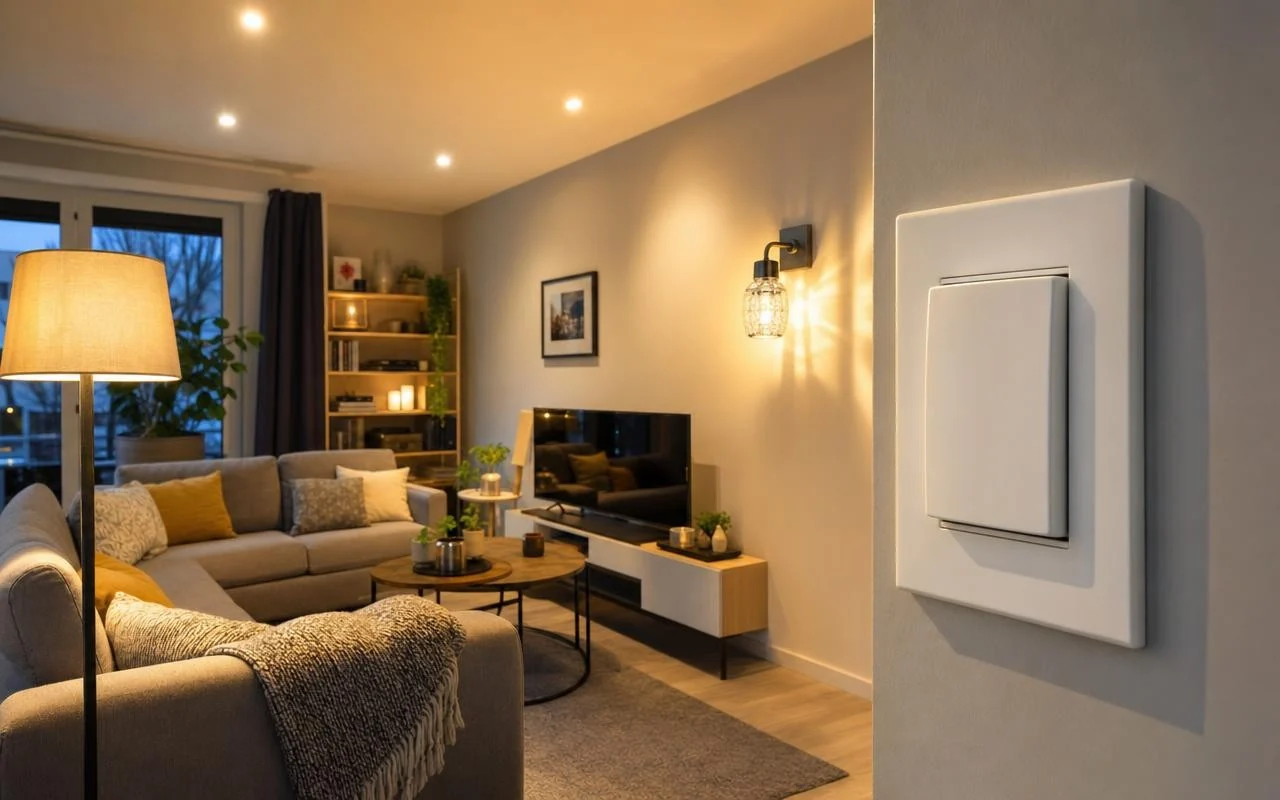
Turning off the switch every time you leave a room reassures many households. This small gesture gives the impression of taking back control of the bill and doing good for the planet. Yet lighting specialists explain that this reflex does not always yield the savings hoped for, especially when we look closely at the technology of the installed bulbs.
Energy efficiency experts go even further: “Experts emphasise that the key is to distinguish the type of bulb,” they summarize. In other words, turning off the light when leaving a room is not decided the same way for a LED bulb, a compact fluorescent (CFL), or a halogen. It all comes down to instantaneous consumption, lifespan, and the frequency of switching on.
Turning Off the Light: The Myth of a Consumption Spike on Relighting
It is often said that turning a lamp back on uses more electricity than leaving it on for a few minutes. The technical data sheets cited by Brussels Environment show otherwise: the extra energy at the moment of switching on remains very small and does not justify leaving a lamp burning in an empty room. The real issue, especially for CFLs and fluorescent tubes, lies in wear caused by on/off cycles.
A study cited by Brussels Environment and based on Osram data illustrates this phenomenon well: a lamp designed to operate in cycles of 3 hours retains 100% of its theoretical lifespan, but drops to about 70% with 1-hour cycles, and to only 20% if it is turned on in sequences of five minutes. Multiplying the number of relights on certain technologies can therefore be costly in bulb replacements, even if immediate consumption decreases.
LEDs, Compact Fluorescents, Halogens: Different Rules by Bulb
The LED bulbs are today the champions of sobriety: they consume up to 90% less energy than a traditional incandescent bulb and last on average 25,000 hours, according to figures cited by OkDiario. They tolerate repeated switching very well. In this case, the rule is simple: with a LED, you can switch off as soon as you leave the room. A numeric example cited by JeChange indicates that a 6 W LED left on unnecessarily costs about 0.12 euro-cents per hour, i.e. nearly €1.75 per year if left on 4 hours each evening for no reason.
Compact fluorescent lamps (CFLs) and fluorescent tubes show an efficiency of about 85% and an average lifespan close to 8,000 hours, but their components suffer from frequent relighting. OkDiario reports that experts advise turning them off if the room is unoccupied for more than 15 minutes. Brussels Environment adds that beyond twenty minutes, turning off becomes clearly beneficial, while below a quarter of an hour, the gain is more questionable for lifespan. Halogen and incandescent lamps, on the other hand, convert 80 to 90% of energy into heat, last only 750 to 2,000 hours, and should be switched off as soon as the room is empty, their relighting not really harming them.
The Right Decision Room by Room and Tips to Go Further
To see clearly what to do in a home, several organizations summarize recommendations in the form of practical guidelines. They can be kept in mind very simply:
- For LEDs: turn off every time you leave, even for a few minutes.
- For CFLs and fluorescent tubes: switch off if the absence lasts more than 15 to 20 minutes, leave on for a very short pause.
- For halogens and incandescent bulbs: always switch off as soon as the room is unoccupied.
Experts from UFC-Que Choisir also remind us that a so-called “eco” halogen consumes about six times more than a LED, and OkDiario estimates that replacing a conventional bulb with a LED can represent a gain of around €72 over its entire lifetime. In this context, “experts repeatedly stress that participating in the energy transition requires a change in mindset,” also notes EDF. Gradually replacing old lamps, installing motion detectors or timers in transit areas, making the most of natural light, and regularly cleaning luminaires complete this long-term effort to improve home lighting.
