
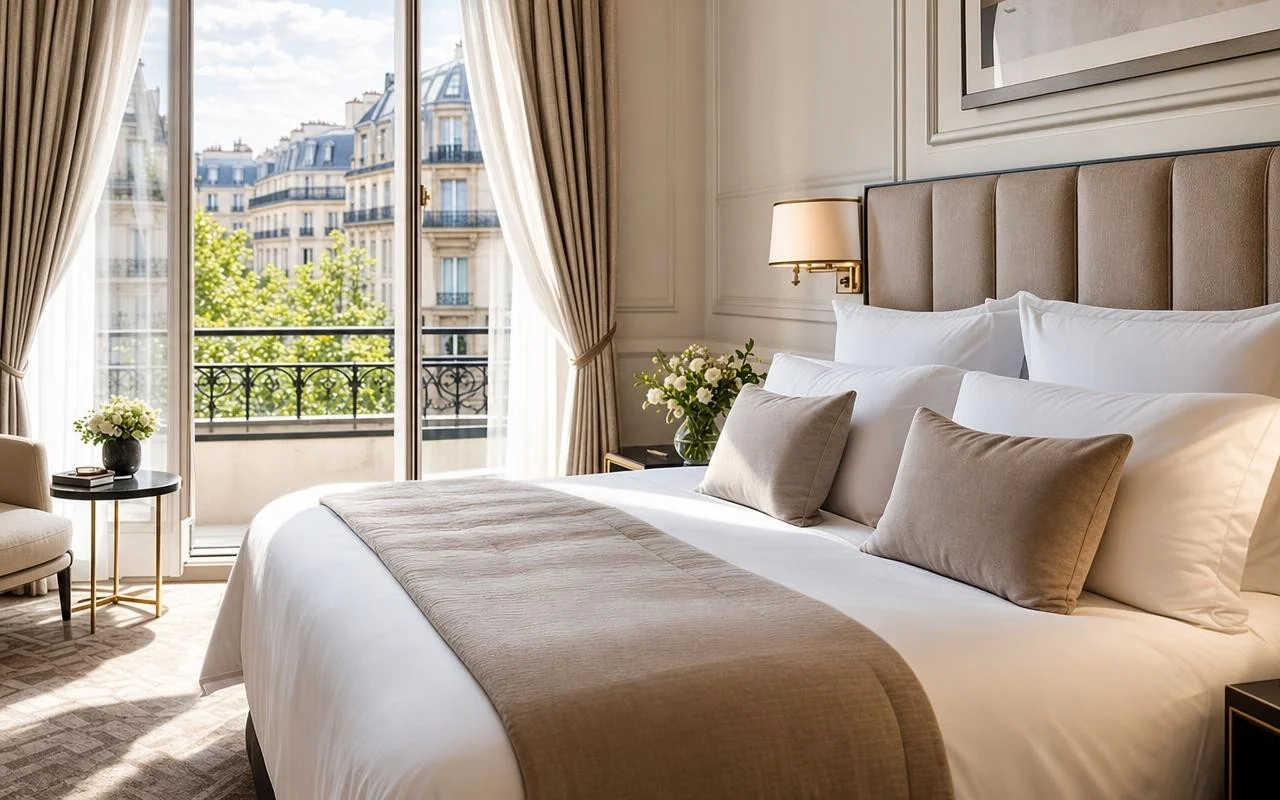
In my mind, achieving that five-star suite effect hinged on one detail: a colossal bed, an outrageously expensive mattress, and an imposing headboard. In short, everything started with the bed. Until the day, in a mountain hotel, a housekeeper slipped that I was completely mistaken. Her explanation changed the way I saw my own room.
As she watched me study the matelàs, she smiled: true luxury doesn’t hide beneath the sheets; it leaps out as soon as you enter. The classic error is to confuse bedding (mattress, foundation, pillows) with the linen—the textile cover you choose, wash, and iron. It is here that the ability to make a bed like a hotel is forged, and the luxury-room effect begins exactly at this point.
Making a bed like a hotel: it all starts with the linen you can see
The housekeeper emphasized one point: a competing-grade mattress isn’t enough if the linen doesn’t follow suit. In upscale rooms, the bed is dressed with cotton percale or cotton satin. Percale offers a matte, crisp touch, almost crackling to the touch. Cotton satin, on the other hand, provides a silkier texture and a subtle sheen that catches the light.
To recreate this sensation at home, a few guidelines prevent disappointment: aim for a weight of about 110 to 150 g per square meter for percale, choose a tight weave that you can feel immediately when you touch it, and stay with neutral tones such as ivory, ecru, or pearl gray. In some mountain 5-star hotels described by Yonder, the rooms also rely on subdued lighting and warm materials; at home, it is mainly the sheets that establish this impression at first sight.
Ironing, folding, and the flap: the housekeeper’s gestures that change everything
A detail struck me: for this professional, a wrinkled sheet alone spoils the overall look. Ironing isn’t an extra step; it is part of the outcome. In hotels, the flat sheet covers the top of the duvet and forms a flap of about twenty centimeters. The corners are squared, neatly tucked under the mattress, and the surface is smoothed to trace a clean horizontal line.
At home, there’s no need to replicate every technique down to the millimeter. The housekeeper summed up the method in a few simple cues:
- iron at least the flat sheet and the visible pillowcases,
- place the sheet over the duvet and create a flap of about 20 cm,
- tuck the sides firmly by pulling the fabric,
- finish with a broad smoothing gesture to banish creases.
Pillows, throw, and light: crafting the luxury-bedroom effect at home
Once the bed is structured, everything hinges on textures. Hotels carefully pile cushions, not by chance but to create depth. Three to five decorative cushions are more than enough: the largest at the back, the smaller ones in front. By playing with materials such as washed linen, corduroy velvet, or bouclette, you achieve a tactile contrast with the smooth softness of percale or satin.
The throw, meanwhile, serves as the final touch. Thin rather than thick, it can be laid across the foot of the bed or slightly offset to the side to avoid a too-still look. The housekeeper also reminded us of the rest of the décor: soft lighting on the bedside tables rather than harsh ceiling lights, a discreet scent of fresh laundry, no pile of clothes left lying around. Ultimately, the mood of the finest rooms lies in this harmony of textures, visual order, and small repeated gestures, far more than in the mere thickness of the mattress.
