
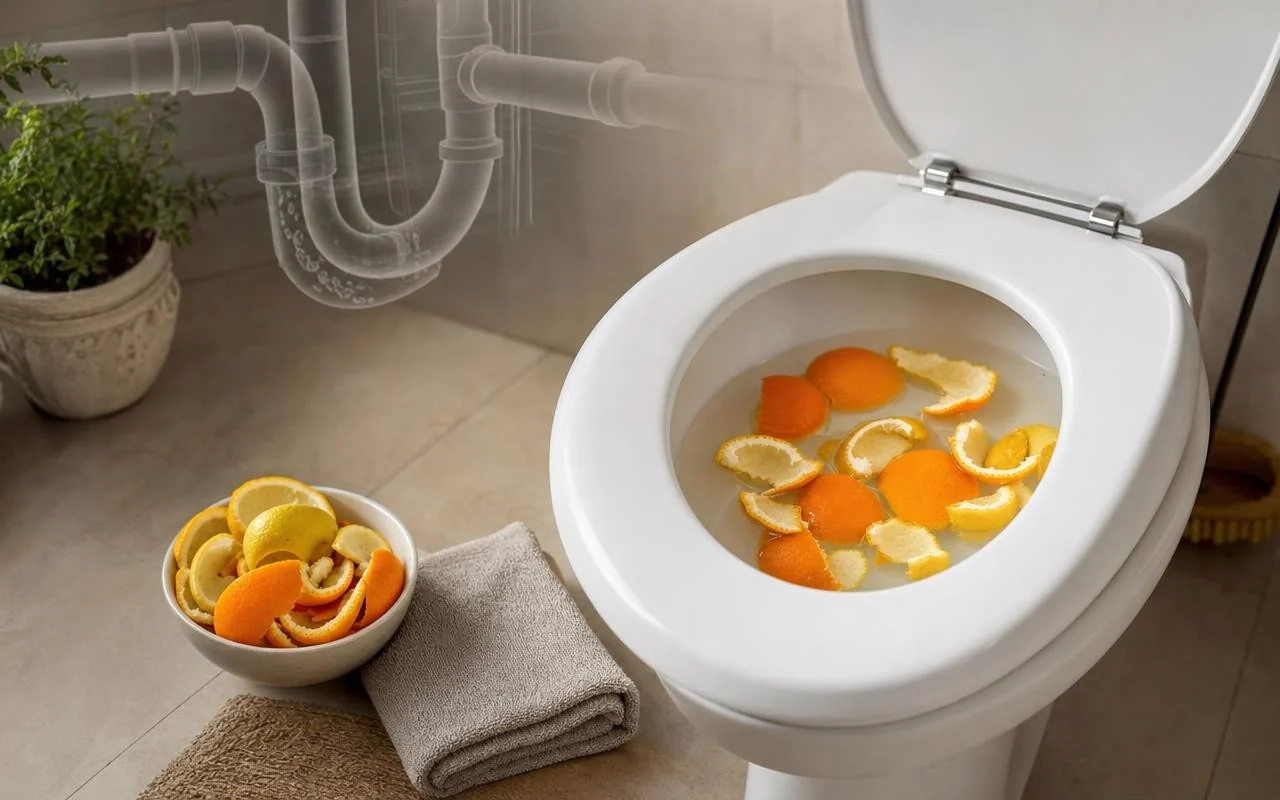
In the heat of summer, many people seek solutions to banish bathroom odors without multiplying chemical sprays. On TikTok and other networks, a tip keeps resurfacing: drop orange or lemon peels into the toilet bowl once a week and let them work. The idea seems simple, economical, almost magical.
Behind these highly viewed videos, the promise often goes beyond reality: some speak of a deodorizing effect, others of disinfected, descaled toilets, or even unclogging thanks to citrus. Before adopting this reflex in your bathroom, it’s worth taking a closer look at what these peels actually do, and what they will never do.
Orange and lemon peels in the toilet: what are they really for?
Citrus peels are rich in essential oils, particularly in limonene, a highly scented compound highlighted by Toutvert for its degreasing properties and fresh fragrance. In the toilet water, these oils diffuse in small amounts and release a citrus scent that masks unpleasant odors. The Spanish site Okdiario sums up the principle by explaining that “this remedy aims to naturally scent the bathroom” for about twenty minutes.
Okdiario, however, stresses that “even if this may seem like a joke, orange peels have many uses beyond cooking,” but that the toilet trick remains purely olfactory. The same outlet clearly reminds: “orange peels do not disinfect, do not remove bacteria, viruses, or the ceramic tartar. You must continue to use the usual cleaners.” Pleine Vie also explains, regarding another very popular mixture, that “baking soda is a base, vinegar an acid: when they meet, they neutralize each other, mainly producing water, carbon dioxide and a salt with no cleaning power.” A foaming fizz or a pleasant scent does not, therefore, guarantee a true deep-cleaning of the tartar and the bacterial biofilm.
Why this peel trick is recommended once a week
If the cadence of “once a week” comes up often, it’s not a directive from plumbers or hygiene services, but a rhythm proposed on social networks to establish a small routine. The idea is simple: reuse a kitchen waste to obtain a natural toilet deodorizer, especially in summer when heat amplifies odors and the small rooms are less ventilated.
Home tips sites like Lanature explain that this weekly routine is more than sufficient, because the scented effect remains temporary. A few pieces of peel are placed in the water for the days when the toilets smell more, for example in a poorly ventilated dwelling. But these recommendations are always accompanied by a reminder: to eliminate stains, limescale or a yellowed bowl, you must continue using a suitable product and a brush, citrus peels only playing a complementary role.
Safe usage instructions for toilets and peel alternatives
To limit trouble, all specialists converge on one point: never let the peels go down the pipes. Okdiario details a precise method: “it is recommended to cut the peels so they release their oils more effectively, to let them float in the toilet water for 20 to 30 minutes, then remove them with gloves or tongs and dispose of them with organic waste.” Plumbing professionals emphasize that the hard, fibrous texture of these peels easily gets caught in elbows, especially if other residues have already accumulated.
Several public sanitation services remind a simple rule: in the toilet, only three things should go down the flush: urine, feces and toilet paper. To enjoy the citrus scent without stressing your pipes, other uses recommended by Toutvert remain safer: dry the peels in a dish in the toilet, use them to refresh the small trash can in the room, or prepare an infused citrus household vinegar to clean the surroundings of the WC. Orange and lemon peels then find a real second life, without risking an urgent call to the plumber.
Sources
- Pleine Vie
“Putting lemon peels in a bowl of water in the microwave: what it’s for and why it’s recommended?”
