
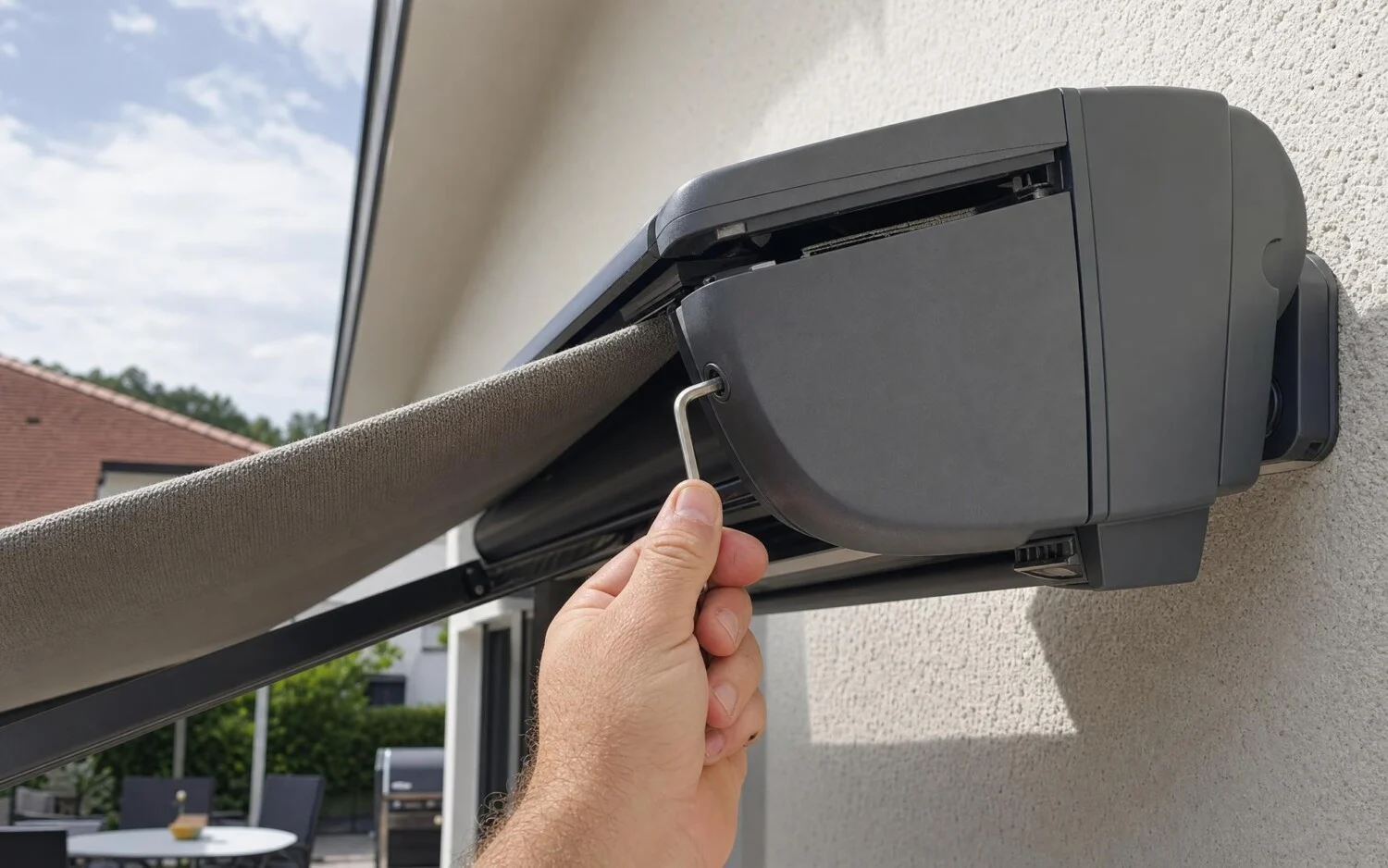
All summer long, the scene was the same: the sun blazing down, the remote control in hand, and this awning that folded up halfway before coming to a sudden stop, leaving about thirty centimeters of fabric sticking out of the housing. Annoyed, I almost always ended up pushing on the load bar to press it against the wall, convinced I was giving it a little helping hand.
When a technician finally came by, he grimaced at the sight of the arms slightly twisted and the fabric marked with creases. According to him, my gesture looked like the bad reflex many homeowners have when faced with a retractable awning that won’t close. For him, the problem wasn’t a lack of strength at all, but a tiny adjustment hidden in the wrong spot.
Retractable Awning That Resists Forcing: Why Tampering with the Arms Is a Bad Idea
Forcing the load bar or the articulated arms by hand essentially means fighting against the tubular motor and the tension springs. The axles then undergo a twist for which they were not designed, with a risk of irreversible warping. The fabric bends askew, creates false creases, and rubs against the sides of the housing with every maneuver.
Another common reflex is to spray a can of penetrating oil on every joint, thinking there is a seize. Installers remind, however, that the blockage very rarely comes from rust, but almost always from a poor end-of-travel adjustment for a retractable awning. As soon as the awning stops too early or strains to close, the correct move is to cut the power and forget any idea of “forcing” the structure.
Fine End-of-Travel Adjustment for the Awning: The Real Move Is on the Tubular Motor Side
The heart of the issue lies in the head of the motor, at the end of the winding tube. On most models, you’ll find two small screws or dials that define the lower and upper end stops. Over time, heat, and the slight elongation of the fabric in the sun, these end stops shift. Some motors leave the factory with a tolerance of about plus or minus three turns, but the actual installation eventually requires fine-tuning.
The method remains the same: a screwdriver or Allen key, and tiny adjustments. Open the awning completely, start the ascent, and notice that it stops too early, then turn the high end-stop screw by a quarter turn in the direction indicated to “increase” the travel. Specialists remind that there is no universal direction; you must follow the motor’s manual. A recommended reference point is to lower the fabric by about 30 cm, raise it again, adjust, and repeat until the front bar comes to rest gently against the housing, without binding.
Finish the Adjustment: Alignment, Radio Motors and the Safety of the Awning
Once the upper end stop is set, the installer checked the rest: wall fixings perfectly plumb, tilt screws adjusted identically on both sides, arms perfectly parallel. When one side rises faster than the other, the tube accumulates extra fabric thickness and the binding returns. Again, he worked with finesse, making quarter-turn adjustments to the tension screws on the arms, until obtaining a tightly stretched fabric that winds up straight.
On remote-controlled motors, for example some Somfy models, the end stops are no longer adjustable with screws, but via programming through the remote, sometimes after a reset sequence: two seconds off, eight seconds on, then another two seconds off. Since these motors operate at 230 V, guides insist on cutting the power before any intervention, working in pairs, and stopping at the first sign of abnormal noise. Since seeing all of this, I never touch the arms again: I go straight to the correct spot, on the motor side.
