
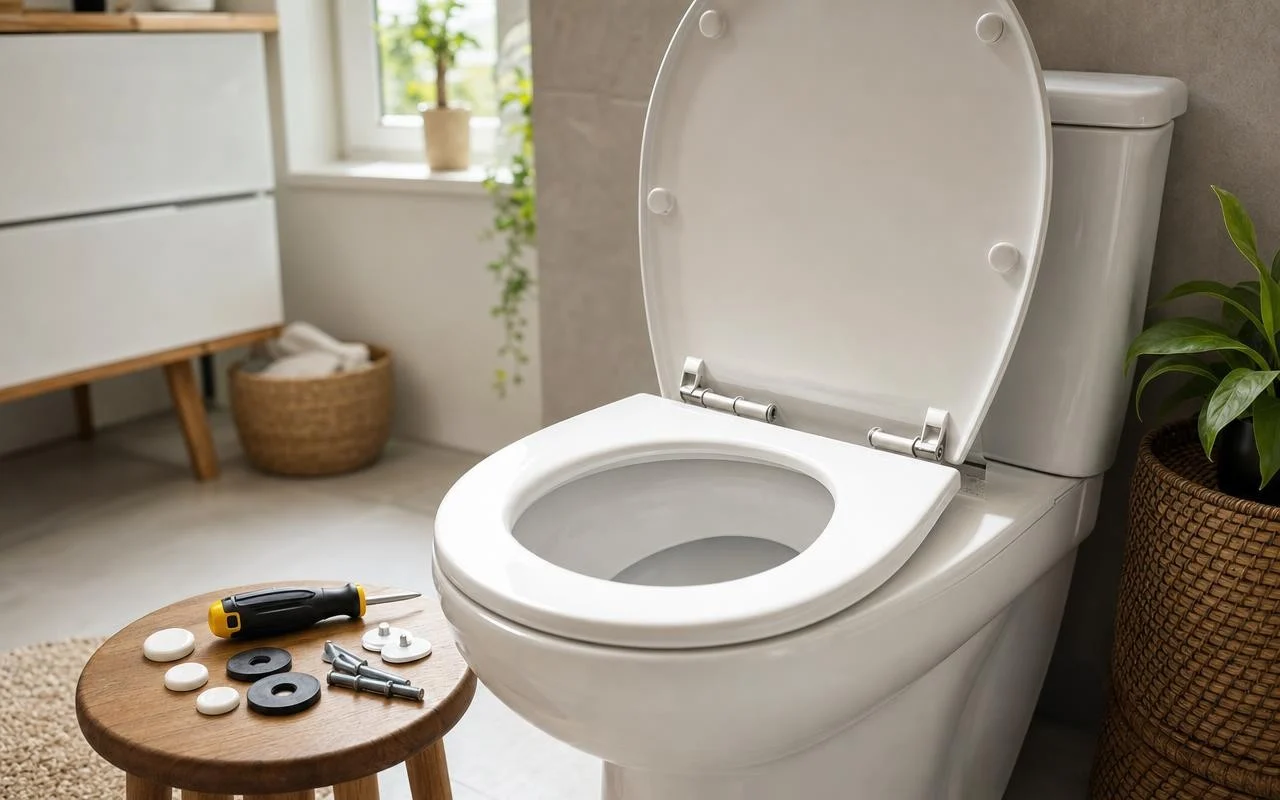
An slipping toilet seat is that small daily annoyance that can quickly turn into a scare when the lid slides to the side at the worst moment. We grab at it as best we can, promise to tighten it tonight… then we forget, until the next fright.
Experts remind us, however, that this banal problem is not negligible. “A toilet seat usually starts to slip because the hardware connecting it to the bowl has loosened over time due to normal use,” explains one expert, who adds that “every time we use the seat, the normal movement puts pressure on the screws that fasten it to the bowl. The plastic hardware can also wear, and older seats may develop cracks or deformed hinges that prevent them from staying firmly in place.” Behind this simple mechanical wobble lies a very precise trick to put an end to it once and for all.
Why your toilet seat slides with every use
In most homes, the cause is straightforward: with the years, screws, nuts, and hinges loosen play. As you lift and lower the toilet seat, lateral movement gradually enlarges the fixing holes, especially when the parts are plastic. The seat then isn’t really tight anymore, it wobbles by a few millimeters and shifts as you sit down a bit crooked.
Other factors come into play: worn or missing cushions under the seat, a model not well matched to the shape of the bowl, an imprecise center-to-center distance for mounting, or even installation done with the seat open, which leaves it skewed when closed. Experts also warn that a loose seat can cause minor injuries or falls. “When the toilet seat starts to slip, you need to reattach the screws or mounting parts,” the experts explain. “It’s fairly simple, and typically you only need a screwdriver and a pair of pliers.” On average, a seat lasts about five years, up to ten at most if everything is in good condition.
Le bon diagnostic avant de sortir le tournevis
Before taking everything apart, a few seconds of observation are enough. If the lid tends to drift to the side while the screws look tight, the problem often stems from a lack of friction between the bowl and the fittings, or from worn pads. If the seat moves forward or backward, one suspects a poor centering or a center-to-center distance that is not well suited to the ceramic.
Another simple test is to tighten a screw slightly: if everything spins in the air, it means the nut under the bowl is not secured. To intervene safely, prepare a minimum of tools:
- a screwdriver suited to the fixing screws ;
- pliers to hold the nuts ;
- non-slip pads or rubber washers if you want a durable solution.
The ultimate trick to lock a slipping toilet seat
The key is to eliminate the play while increasing the grip. Start by slightly loosening the existing fixings, without removing them entirely. Then press the unstable toilet seat all the way down onto the bowl, centering it properly. It is in this closed position that you should adjust the alignment, not with the seat lifted, so that the seat lands in the correct spot with each use.
Once the centering is perfect, slide in, if possible, thin washers or rubber rings between the bowl and the fixings, or attach new anti-slip pads under the seat. This simple rubber interface acts as a brake: the seat is no longer resting on smooth plastic but on a surface that grips. Then gradually tighten the screws while firmly holding the nuts from underneath, until you feel the assembly is well locked. Test by sitting and moving slightly: if nothing moves, the problem is solved. If, despite everything, the slip persists, or if the hinges are cracked and the seat is five to ten years old, it is wiser to switch to a new model rather than continuing with improvised fixes.
