
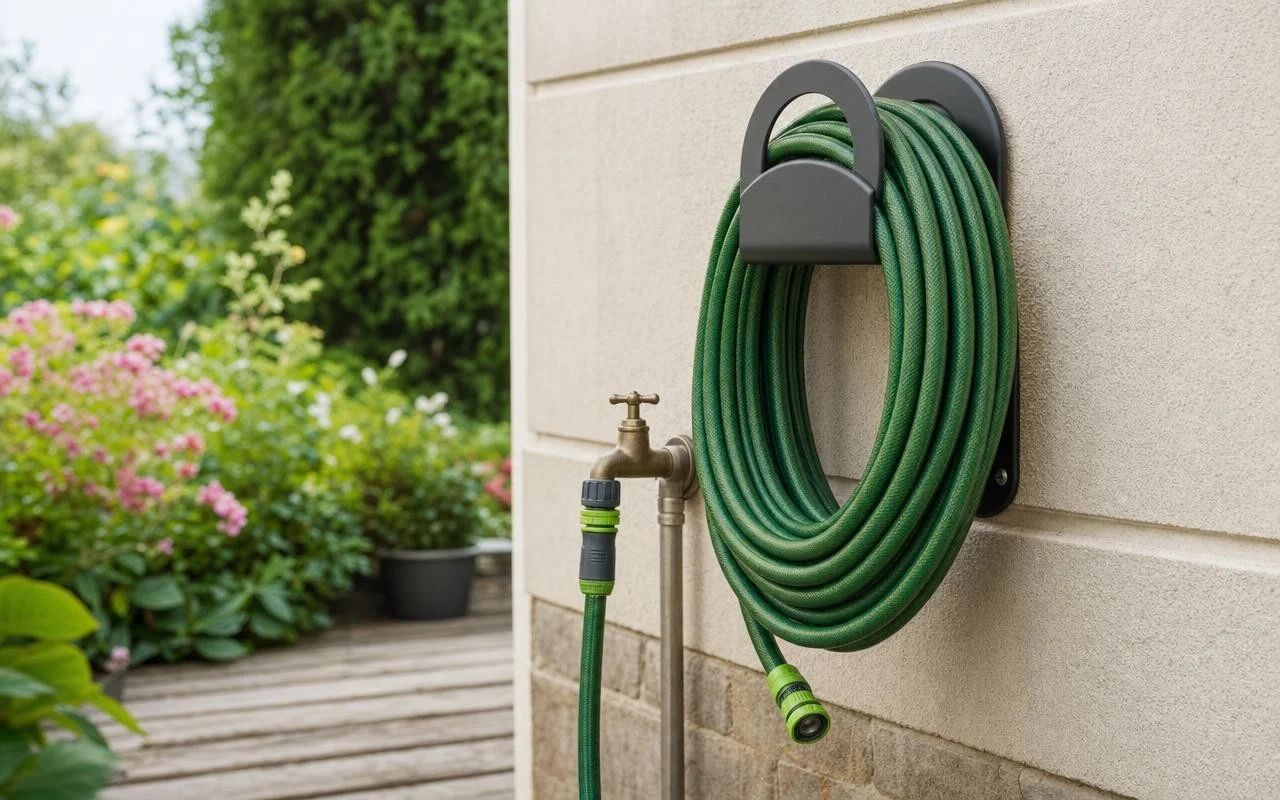
An evening watering routine that becomes a puzzle, does that sound familiar? As soon as the tap is opened, the hose knots up, blocks the flow of water, forcing you to drop everything to untangle the tangle. We end up cursing a “budget” or “too old” model, promising to buy another. Yet even a brand-new hose can coil up in just a few weeks.
In many gardens, the real problem doesn’t come from the hose itself, but from where it rests between uses. A simple hook hammered into the garage wall, a support too narrow placed too low, and the spiral is forced with every wrap. This detail might seem trivial, yet it imposes on the hose a shape it will memorize. It all comes down to just a few centimeters.
Why your garden hose kinks all the time
A garden hose made of PVC or rubber has a real shape memory. Each time it is bent at too tight an angle, the material keeps a trace of that stress. When this bending repeats around the same point, day after day, the twist eventually becomes permanent. You end up with loops that block the water flow exactly at the moment you want to water quickly.
In this scenario, the wall support plays a huge role. A bent nail, a narrow hook, or a metal ring concentrates all the strain at the same spot and forces an excessively small bend radius. Every time you store the hose, it is twisted at the same level. When summer arrives and heat softens the plastic, these folds settle in permanently.
The ideal wall mount for a knot-free hose
The solution lies in a wall-mounted hose reel or a wide U-shaped bracket, complemented by collars with a flat contact surface. Instead of marking the hose at a single point, this type of hanger distributes the pressure over a broad area. The rule is simple: the larger the hose diameter, the wider the loop should be. For a standard 15 mm hose, aim for a support with a diameter of at least 20 cm.
The height adjustment and the alignment matter as much as the shape of the mount. If the hose leaves the faucet at an angle before reaching its winding point, it begins to kink at the very first loop. It is better to place the reel in the direct extension of the faucet, at a comfortable height, often between 1.20 m and 1.50 m, so that the motion remains smooth.
The step before putting it away to say goodbye to twists
Even with the best setup, one last habit makes a big daily difference. Before storing the hose, simply unwind it completely onto the ground, then let it rest for a few moments, if possible in the sun during the warm season. The heat softens the material and allows the accumulated tensions to loosen. The hose then gradually returns to a more natural shape.
Next, you can run your hand along its entire length, turning it slightly between your fingers to undo the remaining kinks. This check takes less than a minute, but it prevents the shape memory from setting new folds when stored. Emptying the remaining water before hanging the hose also helps: a full hose is heavier, stiffer, it folds poorly and is more prone to damage during freeze in winter. A hose that lasts a long time is above all a hose properly supported on the wall.
