
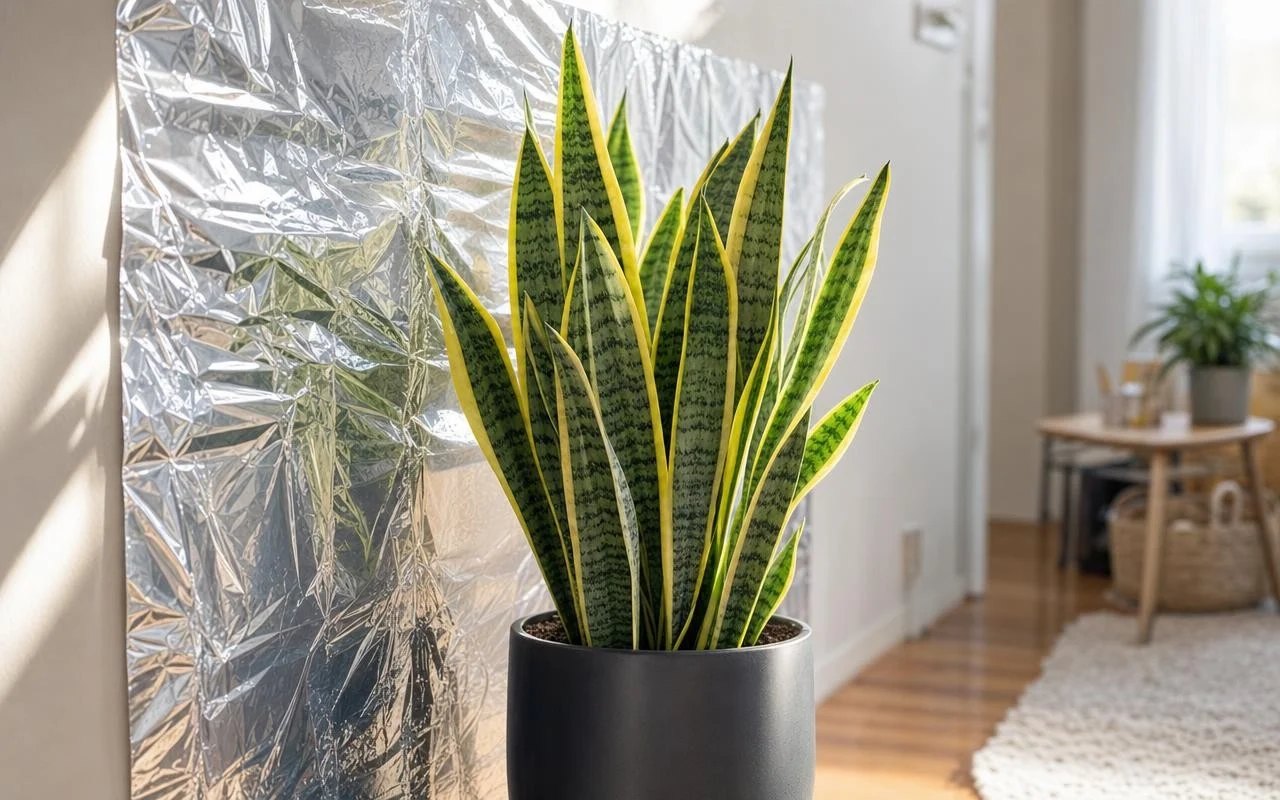
On social media, photographs circulate showing a mother-in-law’s tongue stuck to a wall covered with aluminum foil, or leaning against a sheet of foil mounted behind the plant pot. The setup isn’t decorative, yet many plant enthusiasts claim that their snake plant has regained vigor thanks to this kitchen hack. Between a viral belief and a gardening trick, the gesture captivates owners of living rooms that aren’t flooded with light.
The snake plant, also known as mother-in-law’s tongue, tolerates missed watering and modest lighting, which makes it a very popular indoor plant. When windows are small or distant, recycling aluminum foil behind the pot promises more light without moving furniture. Behind this strip of metal lies, in fact, a modification of the microclimate around the pot. The question remains: what does this setup imply for the plant?
Aluminum foil behind the snake plant: a light reflector
Placed behind the pot, a well-smoothed sheet of aluminum behaves like a tiny mirror. The light coming through the window hits the foil and is reflected toward the leaves, instead of being wasted on the wall or furniture. For a mother-in-law’s tongue tucked into a corner where natural light remains scarce, this boost can enhance photosynthesis without disturbing the layout of the living room.
Some gardeners go further and also wrap the rim of the pot with a strip of aluminum, with the shiny side facing upward. The principle is the same: redirect the brightness toward the plant. This metallic crown somewhat reduces surface soil evaporation and creates a barrier against some crawling pests. Aluminum neither provides fertilizer nor a miracle cure; it merely helps to make better use of the light already available around the snake plant.
Why this gardening trick appeals to snake-plant fans
In many apartments, the mother-in-law’s tongue languishes away from windows due to limited space on sills. It survives, but its leaves stretch and fail to thicken, and new growth becomes rare. The aluminum foil behind the pot addresses this frustration: without buying special equipment, enthusiasts create a DIY reflector meant to stimulate a plant deemed somewhat lazy.
The effects remain modest and are most noticeable when the snake plant clearly lacked light. If the plant already benefited from generous indirect light, adding aluminum changes little. Sources also remind that this trick does not compensate for an overwatering problem or a substrate that is too compact. The roots of the snake plant fear persistent dampness, and no reflector can prevent root rot if the soil stays waterlogged.
How to use aluminum behind the pot without harming the plant
To be prudent, treat the aluminum foil as an accessory around a pot that is already well prepared, with drainage holes clear and a light potting mix. Here is one method to install a reflector behind the snake plant:
- Place the snake plant near a window where it receives natural light without direct sun.
- Cover one side of a piece of cardboard or a board with taut aluminum foil, the shiny side facing outward.
- Install this panel behind the pot, with the shiny surface toward the plant and the window, ensuring the foil does not touch the leaves.
- Observe in the first days: if spots appear or the leaves feel warm, move the reflector away a little.
Covering the soil or blocking the pot’s drainage holes with foil reduces air circulation, promotes stagnant humidity, and can eventually cause root rot. With a reflector, it is better to space out watering, check dryness at depth, and when possible simply move the snake plant closer to a window or a bright wall.
Sources
- Mon Jardin Ma Maison
“Putting aluminum foil in the pot of this hardy plant: what it really changes and the mistake to avoid”
