
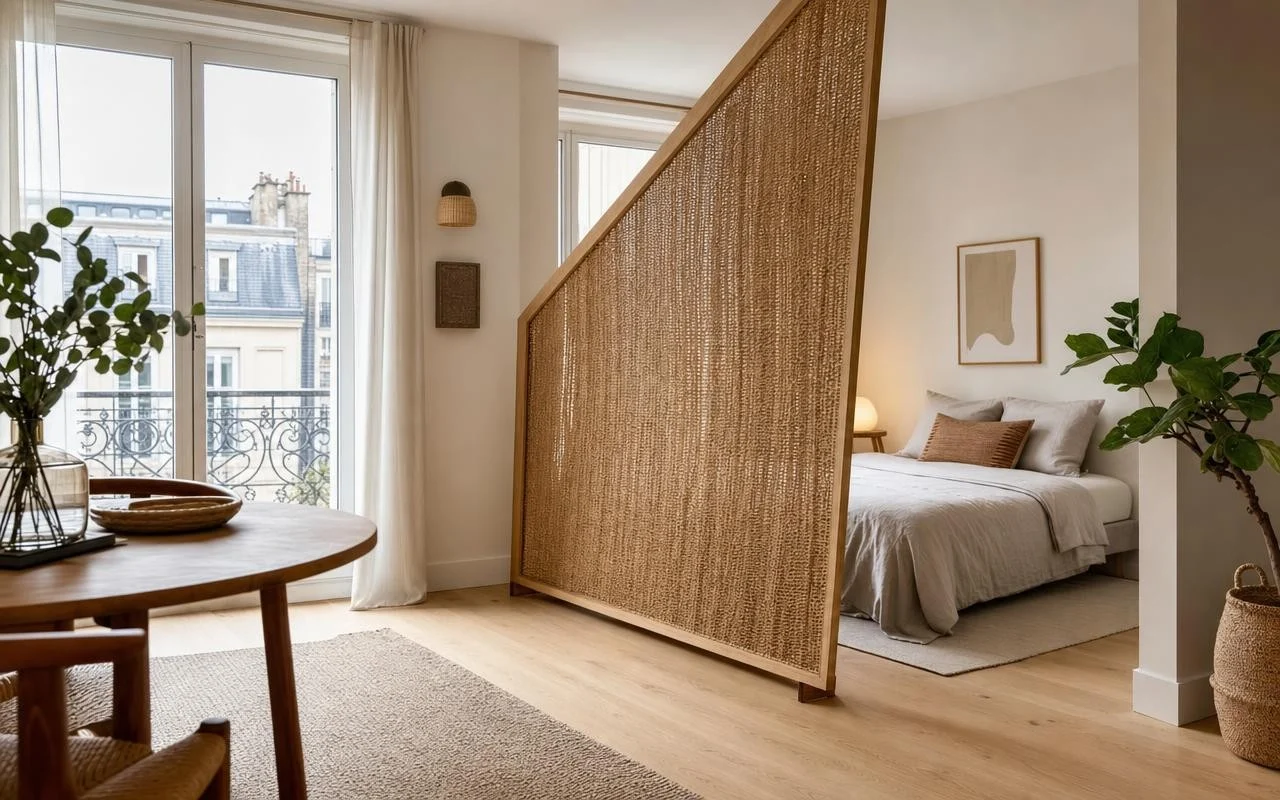
You live in a studio, and no matter how neatly you line up the shelves, your bed stays visible as soon as the door opens. The open bookshelf acts as a false ally: it lets the light through, but it also invites every gaze, right onto the wrinkled duvet and the chair sagging under the clothes. The sense of living in the middle of the living room, with no real separation, eventually weighs on you.
In 2026, designers who work on compact spaces have shifted to another solution, lighter than a wall and far more effective than a bulky piece of furniture: a simple natural-fiber screen, placed with care. It isn’t a partition, nor a theatrical prop, but a movable object that creates a sleeping nook that is almost invisible from the entry. The trick lies entirely in the way it is oriented.
Why the open bookshelf misses privacy
On paper, the open bookshelf checked all the boxes: it let light pass on both sides and avoided the effect of a solid wall. In a 25 m² studio, the idea seemed reasonable. In reality, the piece reveals nothing hidden; it merely frames the view of the bed. Consequently, from the entrance, the gaze passes through the compartments and lands exactly where you wanted to divert it.
The closed version, with doors and drawers, partly solves the privacy problem, but it immediately consumes half of the visual volume. In a single-space setting, like a mono apartment or a studio, a solid partition or an armoire-style piece cuts the room in two and gives the impression of losing square meters. This tension between light and eye protection pushed designers to seek a middle ground.
Paravent en fibres naturelles : la séparation des designers
The answer doesn’t come from a highly sophisticated gadget, but from a nearly forgotten piece: the screen. Decorators favor a three-panel model, in linen or bamboo, which simply sits in a corner of the room. The structures in natural fibers—bamboo, rattan, rush—have a double advantage: they establish a real boundary while still letting some light and visual air flow through.
A screen of this kind serves to isolate the sleeping area from the living room, partially hide a desk, or mask a small kitchen without any construction work. The panels move as needed, without drilling, which reassures tenants. Contemporary linen or bamboo models stay under 200 euros, for a height around 180 centimeters, sufficient to block an adult’s gaze, with several variants possible:
- Bamboo biombos to separate bed and living area.
- Rattan panels with a handcrafted look.
- Natural fiber curtains, very flexible.
Paravent en biais : le secret de l’angle mort
The effectiveness of this type of separation does not rely solely on the material, but above all on its diagonal placement. A screen pressed flat against a wall simply extends the room’s line, somewhat like the old bookshelf. Installed diagonally, two panels facing the entry and a third closing the triangle toward the bed side create a true blind spot from the doorway.
The proper method is to stand in the entry and look at what you want to hide. The screen is then shifted until it cuts off that line of sight, without blocking the window or hindering passage. The result is a calm sleeping corner, almost out of the frame, while keeping the room fluid and luminous. Many people also notice a pleasant feng shui touch along the way.
