
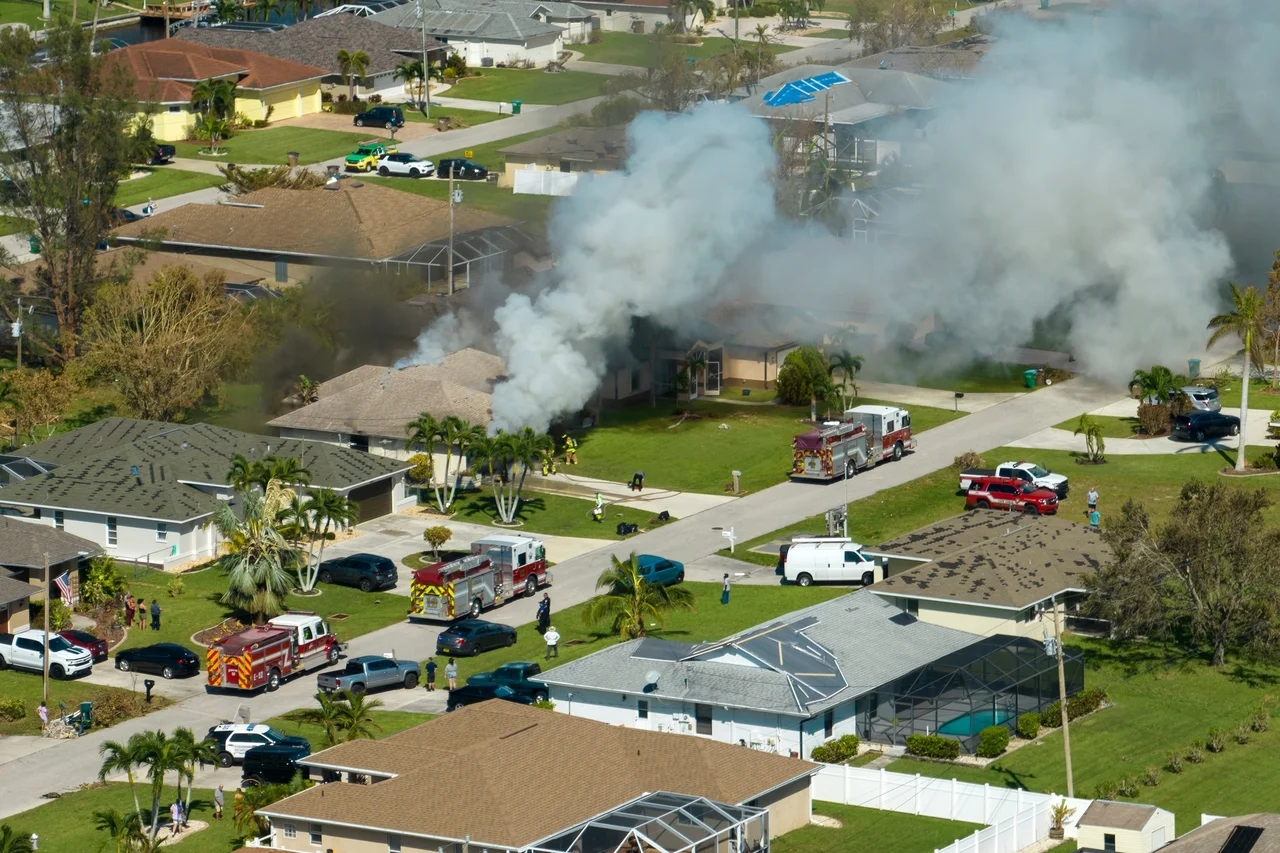
When her house burned down in a matter of hours, this homeowner realized that rebuilding it exactly as it was would condemn her to relive the same nightmare. Wooden framing, a deck attached to the façade, cypress hedges: everything had served as fuel. As she was selecting the new plans, one idea stood out. To invest in non-combustible materials for the reconstruction.
Thousands of miles away, Karina Maher and her husband, settled in Pacific Palisades, California, did not wait for catastrophe. “We always knew a fire would come here,” she told AFP after the megafires that devastated the neighborhood. Their villa, designed to resist flames, remained intact in the midst of the ruins. A source of inspiration for those who must rebuild everything after a fire.
Rebuilding after a Fire: Understanding How a House Catches Fire
Images of a blaze devouring a façade give the impression that the fire is attacking the walls directly. Specialists remind that it is often embers carried by the wind that light the house first. They slip under the roof, fall into a gutter full of leaves, ignite a wooden terrace or a hedge pressed against the wall. When rebuilding, ignoring these entry points would be like leaving the door open to the next fire.
Field reports show that an aging roof, a highly combustible façade or fragile joinery are enough to accelerate the blaze. Conversely, an incombustible roof, a mineral façade and reinforced openings significantly slow the fire’s progress. The time gained allows for evacuation, but also for firefighters to intervene. This logic now guides the rebuilding of houses after fire in exposed areas.
Choosing Non-Combustible Materials for Walls, Roof, and Insulation
For the structure and façades, experts first cite concrete, brick, and natural stone. Their mineral composition does not feed the flames and offers strong thermal inertia, which delays the collapse of walls. Many products of this type fall under Euroclass A1, considered non-combustible. On the insulation side, rock wool also stands out for its excellent fire performance, provided it is protected by an appropriate cladding.
The Karina Maher villa illustrates another path: a fiber-cement cladding instead of wood. The architect Michael Kovac explains that “the choice to use cement cladding rather than wood carries almost no additional cost.” The roof was designed as a shield, with a fire-resistant vegetated roof and a protective topsoil layer. The insulating glazing shows a high degree of heat resistance, while an irrigation system can spray a fire retardant to slow the flames.
Invalid YouTube URL.
Windows, Garden and Defense Space: Finishing an Anti-Fire Home
During a fire, windows often become the weak link. Under the influence of heat, a traditional glazing can crack, letting smoke and flames in. Specialists recommend aluminum or steel joinery, paired with more resistant tempered or laminated glass. Solid shutters made of a low-flammability material further protect the glazing. Yana Valachovic, an expert in fire-resistant construction, sums up: “Adapting to fires does not require enormous investment, just living a little differently.”
The garden remains, which Karina Maher describes as a true “defense space.” Instead of a lawn that yellows in summer, the couple installed volcanic rocks, agave plants, dwarf olive trees and other desert plants that are less flammable, all kept moist by targeted irrigation. Firefighters also advise keeping away piles of wood, wooden pergolas, and hedges touching the façades. Because a home genuinely designed to resist fire combines noncombustible materials, a well-sealed envelope, and clear surroundings, so that embers have nothing to grab onto.
