
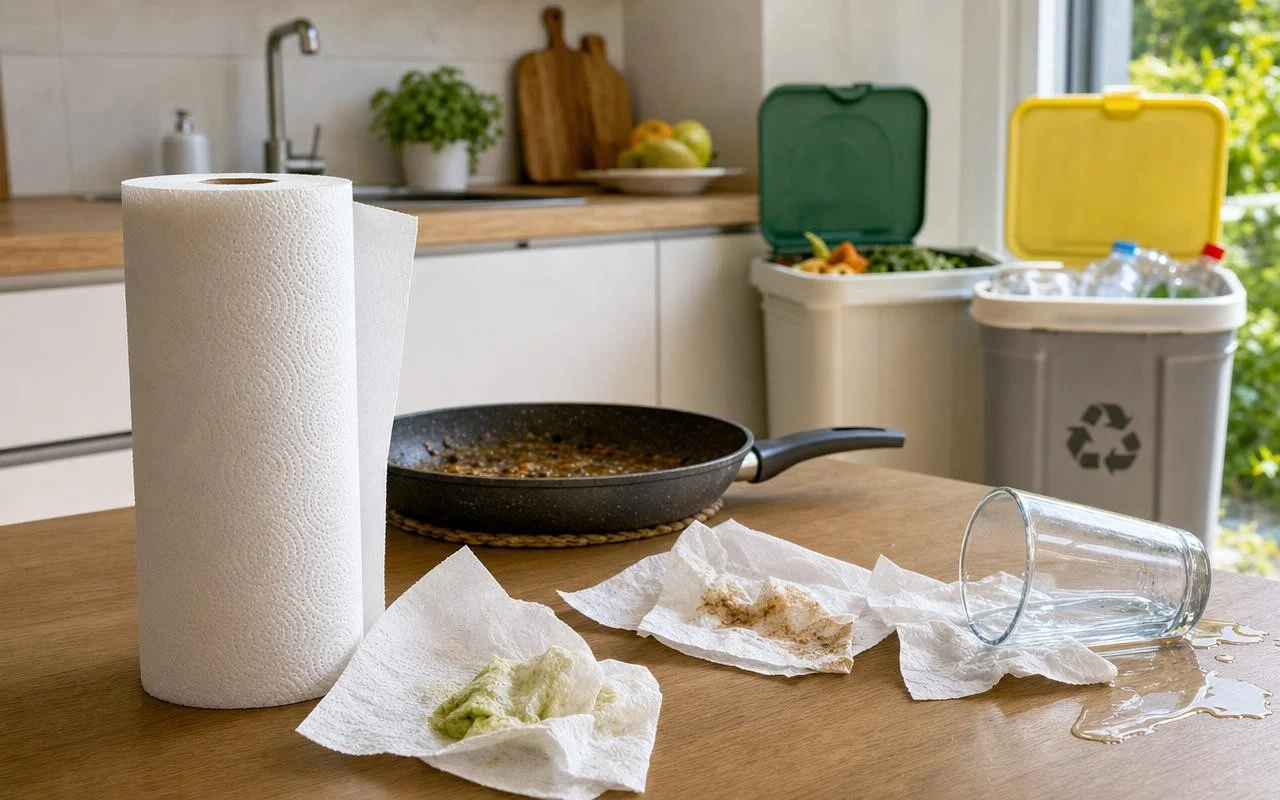
A roll in every kitchen, sometimes in the bathroom, and even in the garage: paper towels have become the reflex against stains. We tear off a sheet without thinking for a sauce spill, a mark on the glass, or a grease splatter. Behind this ordinary gesture lie uses that lend a hand, others that damage surfaces, and a real question: what should be done with the sheet after use?
In an updated briefing dated August 3, 2026, ADEME states that each French person uses about 2.9 kg of paper towels per year, i.e., mountains of absorbent paper that end up in compost or with household waste. The good news is that by sorting the uses, we can keep this ally for real fix-ups, avoid the bad ideas that scratch or dull, and significantly reduce the amount used. The question remains: for which actions does it truly deserve a place on the countertop?
Paper towel uses: the golden rule reiterated by ADEME
For the public agency, paper towels should remain a tool for occasional fixes, not a universal household cleaning accessory. Its fibers are short, wetted with water, grease, or food remnants: it does not recycle in the paper-and-packaging sorting bin, the yellow bin. This fragile nature also explains why certain applications are frankly discouraged on delicate surfaces.
ADEME recommends reserving disposable paper for soiled or urgent tasks, when a washable cloth is not available. In other cases, table napkins, sponges, microfiber cloths, and old T-shirts repurposed as rags perform exactly the same job, without filling the bin. This sobriety logic is especially relevant in the kitchen, the main place where people unthinkingly unfurl several sheets for a small incident that could have been settled differently.
Paper towel: compost, household waste, or sorting error
A recurring question in homes: once dirty, where should you throw the paper towel? The rule is simple. It never goes into the sorting bin for papers and packaging, even if it still looks clean. Two paths remain possible: composting for small quantities contaminated only by biodegradable waste, or the household waste bin for everything else.
In a domestic compost bin or neighborhood composting site, the paper breaks down and contributes to soil health. However, as soon as a sheet has absorbed household cleaners, solvents, or other chemical substances, it must not go to compost. When placed with household waste, it will be incinerated, typically with heat recovery to generate energy, or buried in a waste storage facility.
20 uses of paper towels scrutinized, and the good alternatives
On this basis, one can review the most common uses. For tasks involving simple liquids or foods, the sheet goes to compost in small quantities; for very greasy residues or household products, it goes with household waste. Here are 20 typical ways to use paper towels, between genuine fixes and bad habits.
When it comes to truly handy uses, paper towels are good for soaking up a small puddle of water or oil, picking up a cracked egg, wiping up a spilled sauce, quickly draining rinsed salad, herbs, and vegetables, wrapping peeled ginger or garlic in the fridge, keeping green onions slightly damp, stabilizing a slippery cutting board, or handling a temporary pet accident. Conversely, avoid paper towels for mirrors, clean glass, screens, crystal glassware, glasses, polished surfaces, waxed wood furniture, piano, shiny fixtures, ceramic cooktops, and for everyday cleaning, where a washable microfiber cloth does a much better job. And when purchasing, ADEME recommends the European Ecolabel and the FSC label, with an absorbency of at least 10 g of water per gram of paper.
