
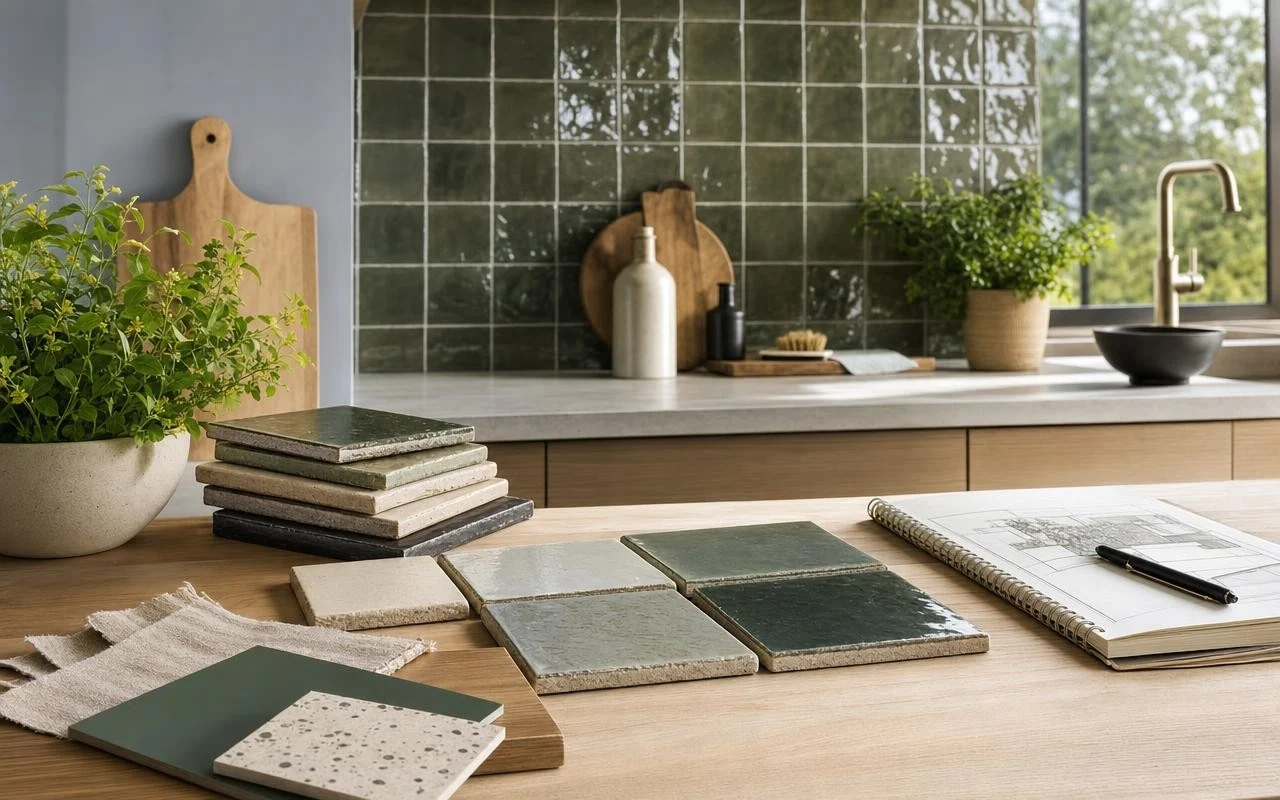
Hammer already in hand, eyes fixed on this glossy zellige backsplash that reflects every ray of sunlight, the idea seems obvious: break everything to follow the trend. This sparkling tile, adored a few years ago, now appears dated, almost aggressive, especially when you see on social networks kitchens with matte walls that are perfectly subdued.
In showrooms, the kitchen designers often hear the same line: “I want to remove everything.” They note, however, that more often than not, the problem does not come from the zellige itself, but from its glossy finish, from its maintenance and from the condition of the substrate. Without saying so, their first reflex is rarely to bring out the sledgehammer.
Why your glossy zellige backsplash really wears you out
The glossy zellige captivated with its artisanal look, its changing reflections, its slight irregularities that give depth to the wall. Placed behind the sink or the stove, it creates a bright backdrop. In everyday life, the picture is less flattering: grease splashes, mineral scale drops, fingerprint marks show up immediately, which demands almost daily cleaning to preserve the mirror effect.
To this are added the joints, which trap dust and stains, especially near the cooking area. Many homeowners say they’ve “fallen behind the trend,” while their weariness mainly comes from these maintenance constraints. The kitchen designers then steer toward a matte zellige or matte zellige effect: same format, same charm, but a satin glaze that catches light without dazzling and better conceals small traces.
What kitchen designers propose to recycle a glossy zellige backsplash
The professionals stress one point: before talking demolition, it is essential to check the condition of the existing tiling. If the tiles are sound, well-sealed, without cracks or hollow-sounding areas, a layer-on-top installation over the old surface becomes possible. This solution avoids debris, masonry work, and waterproofing problems around the sink. On the other hand, if the backsplash shows loose tiles or poor installation, removal is advised to guarantee long-term stability.
Kitchen designers then recommend an on-site diagnostic, often shared with a tiler, based on a few simple checks:
- Check for cracked tiles or tiles that move to the touch.
- Observe the condition of the joints, especially around the sink and the cooktop.
- Ask whether the extra thickness of an overlay would hinder outlets or the hood.
- Check for any signs of moisture before re-adhering over the surface.
When to switch to matte zellige or to the monolithic backsplash in the kitchen
When the substrate is sound, many kitchen designers steer toward a matte zellige effect tile, glued onto the existing surface after preparing the glossy base to ensure adhesion. The joints remain thin, between 1 and 2 millimeters, to respect the material’s spirit without weakening the whole. A tinted joint rather than white helps to camouflage micro-stains. On the maintenance side, the recommendations are simple: a mild non-abrasive and non-acid cleaner, a damp sponge after cooking, quick wiping of fats, annual check of the joints’ waterproofing.
Another option, increasingly visible in catalogs: the monolithic backsplash. The principle is to raise the countertop onto the wall, by about 30 to 60 cm, in a single continuous panel, with no visible joints. Quartz, Dekton, treated natural stone, resins like Corian or Hi-Macs, composites mixing ceramic and stone… the materials are numerous. The installation requires real craftsmanship and the cost remains higher than a traditional tile, but the comfort of use is clear: a large smooth panel, few joints, a swipe of a sponge to erase splashes. In kitchens installed since 2026, this visual continuity is slowly imposing itself, proof that between breaking everything and keeping everything, there are several possible paths.
