
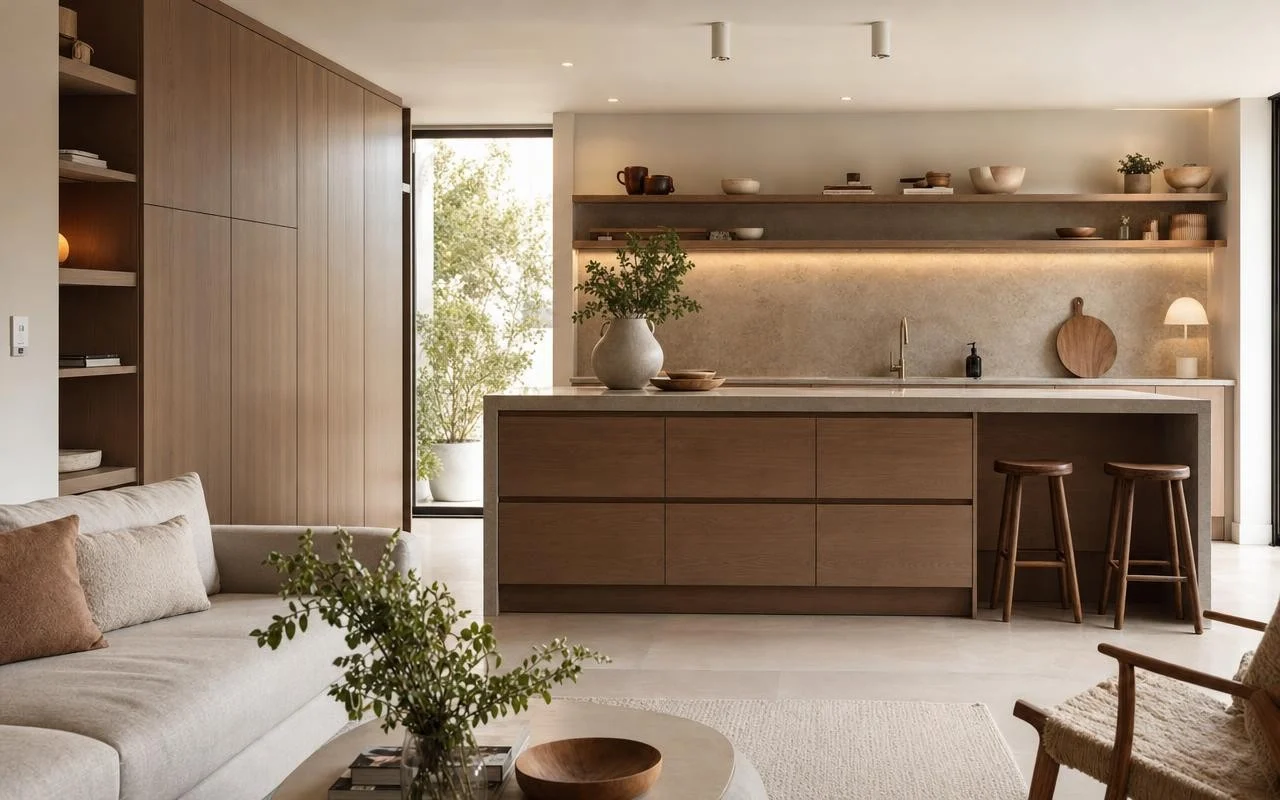
Immaculate work surfaces, white glossy fronts, and a built‑in black oven proudly on display: this image long summed up the contemporary kitchen. Yet, this setting is beginning to be viewed as too cold, too “technical,” especially in open‑plan living spaces. Looking ahead to 2027, designers and kitchen makers describe a clear shift, where the kitchen stops being a white ultra‑functional box tucked at the back of the living area.
Projects already published in decorating mags and catalogs are signaling the change: warmer materials, matte facade panels, furniture that almost resembles a living‑room sideboard. According to several interior designers interviewed by Veranda or House Beautiful, the kitchen is becoming a true, standalone room, integrated with the rest of the house. With a strong idea: to stop looking like a kitchen.
The 2027 Kitchen Trend: The End of White, Cold Kitchens
For the 2027 kitchen trend, bright white is no longer king. Designer Shea McGee notes that “materials like walnut and oak are regaining importance, especially when their natural grain shows, and wood must be part of the kitchen’s architectural design rather than merely a decorative element,” she explains. Wood-fronted cabinetry, textured laminates, and sober mineral countertops are gaining traction.
The kitchen designer Rubén Rodríguez observes that “clients are seeking materials with personality, such as granite and highly veined ceramics,” he explains. According to Xataka Home, the palette shifts from pure whites toward earth tones, muted greens, sandy beiges, or powdery pinks, while Lapeyre already highlights a matte Sillage Terracotta kitchen, available as a kit from €825.
Invisible Kitchen 2027: a Room That Blends with the Living Room
Beyond color, the major novelty lies in the very status of the room. “Homeowners are looking for kitchens that increasingly resemble rooms, rather than spaces solely meant to cook our meals,” explains Jason Hoffman of J.P. Hoffman Design Build, in Veranda. In practice, the floor, wall tones, moldings, and even the style of furniture extend from the living room into the kitchen, creating a single cohesive volume.
This mindset is described by designer Tanya Smith‑Shiflett: “Homeowners no longer want to enjoy a living room they’ve decorated with care, only to have an ever-present work zone staring them in the face,” she explains. Tall storage runs create a broad wall of cabinets, the cupboards evoke a closed library, and lighting borrows from the living room, with wall lamps and softer ambient light.
Integrated Appliances: How the 2027 Kitchen Becomes Almost Invisible
This invisible kitchen rests mainly on maximum integration of appliances. For Izabella Marino of GKV Architects, “technology will remain present, but will stop dictating the aesthetics of the room,” she says. Recent projects hide refrigerators and dishwashers behind matching panels, conceal ovens behind retractable doors, and reserve closed niches for small appliances. Katie Wood explains in House Beautiful that some of her clients even want to eliminate electrical outlets to preserve visual continuity.
An article in 20 Minutes Maison notes that about 20% of dishwasher owners in the United States use theirs less than once a week, with cycles of 2.5 to 4 hours deemed impractical. Meal deliveries, disposable tableware, and denser urban kitchens limit the amount of dishwashing to be done, making these bulky stainless blocks less indispensable. Some remove them entirely, others hide them behind facades. In the high end, Maison et Travaux even cites invisible cooktops beneath the countertop, priced around €4,000 excluding installation, provided ventilation and maintenance access are carefully planned.
