
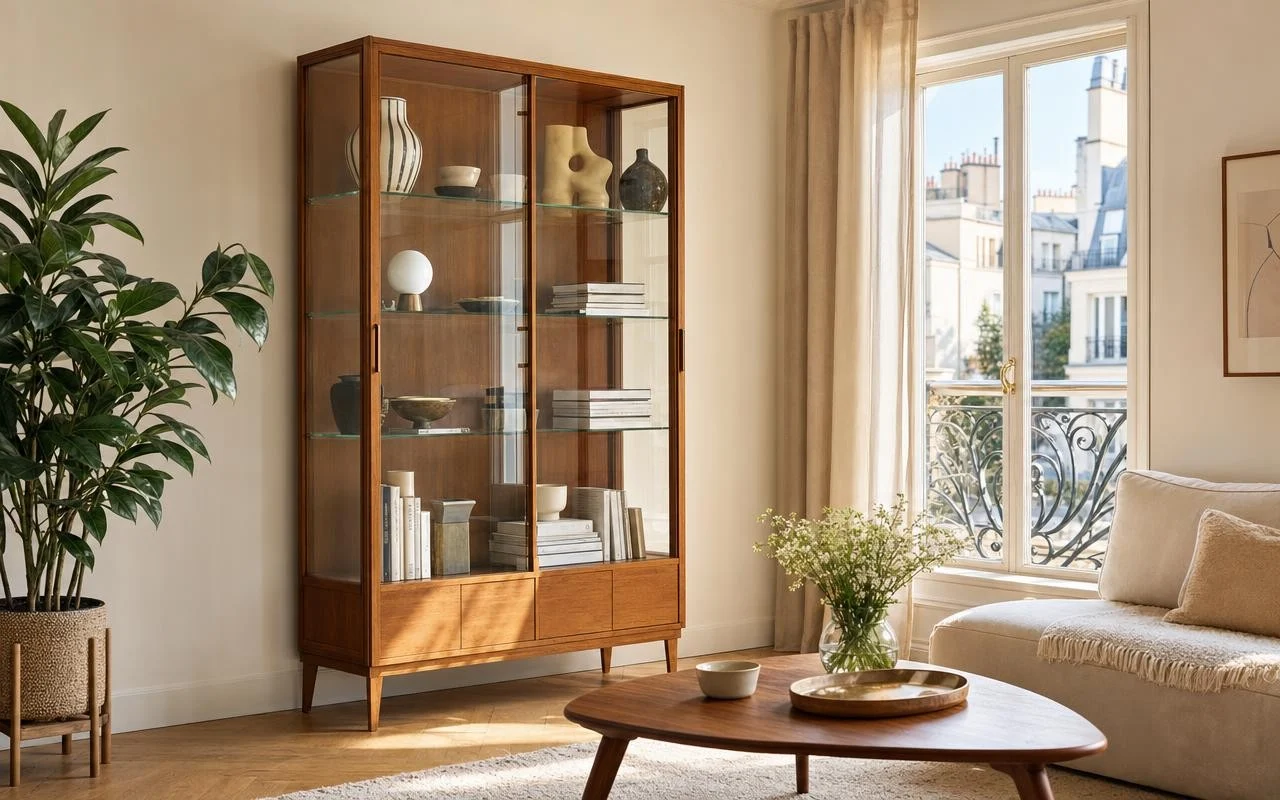
In many French living rooms, one detail sticks out: the long, closed sideboard that spans an entire wall suddenly feels heavy.
Cluttered top, solid doors, a sense of bulky mass…
The complete opposite of today’s desire for lightness and brightness.
Yet a piece that the older generation knows by heart, long relegated to the attic or sold at flea markets, is quietly staging its comeback.
The year 2026, marked by slow decor and the return of characterful pieces, confirms this shift. Magazines, decoration accounts and shop windows highlight sleeker furniture that displays beautiful objects rather than hiding them all. Over the seasons, this retro piece asserts itself as the warm alternative to the heavy buffet, especially when autumn invites us to redecorate the living room.
Why the closed buffet now visually fatigues the living room
The closed sideboard, whether rustic or in the style of a low Scandinavian sideboard, stretches in length while remaining very low.
The eye hits this continuous line that cuts the wall in two and flattens the perspective, especially in urban apartments. Its top quickly becomes a giant catch-all for mail, keys and toys. Even when neatly organized, the room retains a sense of visual clutter that’s hard to pin down.
In response to this, designers lean toward verticality and transparency. Instead of a solid mass, they seek a taller piece on slender legs that lets light flow through and frees up the floor. This is where the 70s vintage display cabinet, wood and glass, already common in grandparents’ living rooms, comes into play. Bringing it up to date, it replaces the old closed sideboard.
The 70s vintage glass-front display cabinet, a tall glazed sideboard that’s very current
Born in the 1970s, this cabinet is recognizable by its restrained lines inspired by the Scandinavian style: teak, rosewood, light oak or walnut, glass doors framed by slender mullions, sometimes mounted on a compass pedestal. In the past, it housed Sunday porcelain and crystal glasses; today, it becomes the centerpiece of the living room. According to Le Journal de la Maison, a well-restored vintage model typically costs between about €600 and €1,500, with designer pieces going beyond €2,000.
I ts current appeal rests as much on aesthetics as on the mindset. This tall glass-front cabinet lets light through, does not block the walls, and turns storage into a display. Each shelf becomes a mini cabinet of curiosities where what matters is showcased. Often you can see, behind the clear or lightly textured glass:
- a collection of artisanal ceramics and blown-glass vases;
- vintage stemware bought at flea markets, inherited from grandparents;
- a few beautiful art, cookery, or gardening books;
- carefully folded linen table linens.
By selecting a few strong pieces rather than an accumulation, the display cabinet tells a personal story while staying visually light.
How to choose and integrate this vintage display cabinet into a modern living room
Before adopting a 70s display cabinet, it’s best to measure precisely the stretch of wall freed up by the buffet. The room gains height if the piece remains narrow enough to allow smooth circulation around the sofa and coffee table. Place it preferably against a light wall—off-white, linen, or sage green—and fix it if necessary to guarantee stability.
One last point: styling. Avoid filling every shelf; alternating piles of books, sculptural objects, and open spaces gives the composition room to breathe. A discreet LED lighting, a light refresh of the wood, and period-appropriate hardware are often enough to make this cabinet the new centerpiece of the living room.
Sources
- Peaches
“Low sideboard: in 2026, this tall glass-front cabinet marks the end of a cult piece and reveals the true chaos of your living room”
