
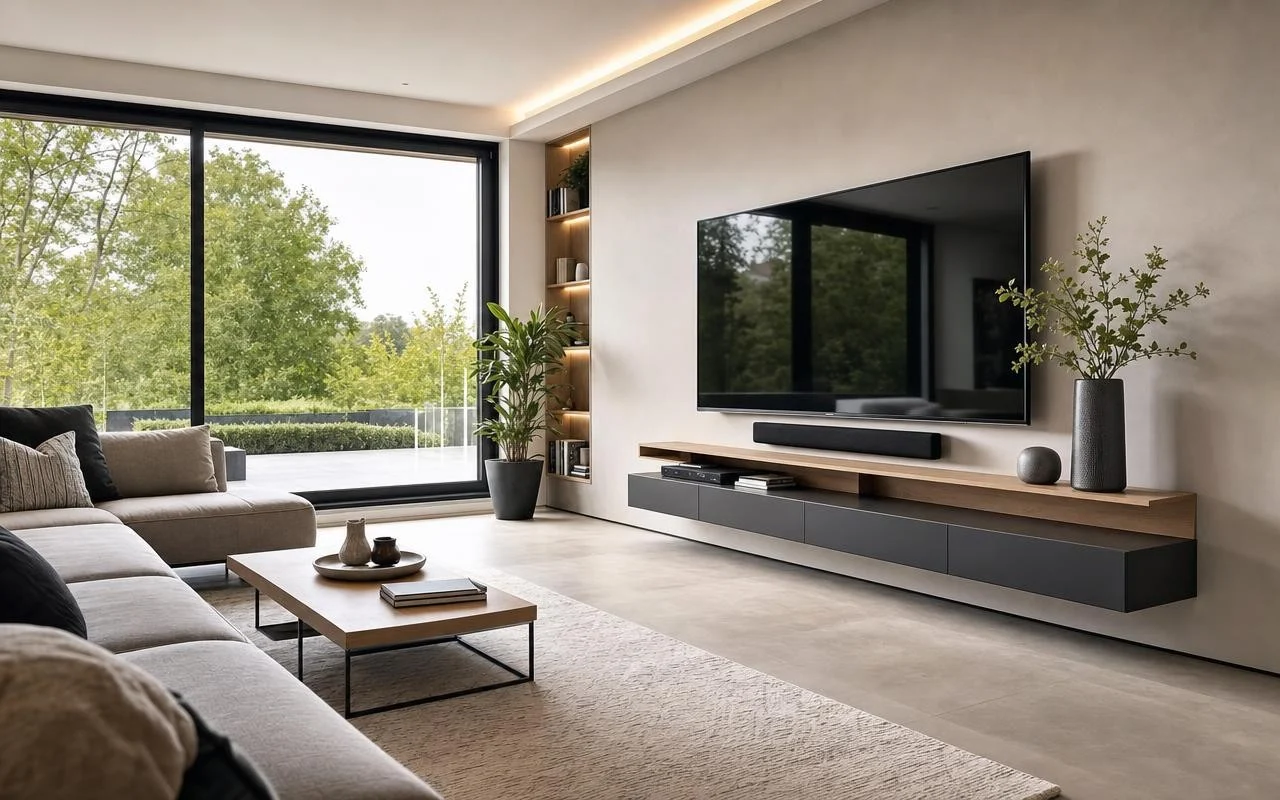
For years, the decor looked the same in most living rooms: a long low cabinet running under the screen, loaded with boxes, magazines and knick-knacks. Practical, this floor-level block eventually crowds the view, especially in small spaces where the table, chairs and sofa must share a few square meters.
The decor signals for 2026 all point in the same direction. A study on colors and design indicates that 71% of specialists see strict minimalism retreating and 58% deem impersonal design outdated. Pinterest even noted in spring 2026 a rise of over 545% in searches related to kitchens grandmacore. The living room is following the trend, often starting with the TV wall.
Why the floor-standing TV unit makes the living room feel smaller
In a living room that also serves as a dining area, the TV cabinet under the television seems logical: it carries the screen, hides cables and offers drawers. In reality, its depth encroaches on the passage between table, chairs and sofa, and at the bottom of the wall forms a long dark band that weighs down the perspective and makes the room appear narrower.
In 2026, decorators therefore advise completely freeing this lower wall space. The solution is to mount the TV on the wall and remove the floor-standing cabinet, as illustrated by TN or the magazine Country Living. An expert quoted by the latter notes that residents want rooms that feel lived-in rather than sterile showrooms, full of warmth and nostalgia. The TV corner adopts this same more convivial attitude.
TV mounted on the wall and suspended modules: the flagship combination of 2026
Once the screen is hung on the wall, the floor becomes entirely visible again. TN recalls that, even without gaining a single square meter, the room looks larger as soon as the bulky volume of the cabinet disappears and the visible floor area increases. Under the TV, very shallow floating shelves or a suspended module hold boxes and consoles without touching the floor, which reinforces the sense of lightness.
These wall-mounted modules also answer the desire to reduce “visual noise,” this overload of objects and lines that fatigue the eye. The Spanish media Okdiario shows TV walls dressed with panels in wood, stone or microcement, sometimes highlighted by indirect lighting. The colors warm up with beige, sand, terracotta, caramel, olive green or clay tones, combined with wood, linen and plant fibers to soften the whole.
Granny chic, controlled accumulation: the TV wall that enlarges the room
Removing the low cabinet does not mean giving up storage. The solutions then exploit verticality: narrow columns, display cabinets or curiosities beside the TV wall. “Maximizing living space has become essential. Display cabinets and other vertical storage solutions can take advantage of unused wall space,” explains Jochim-Smoot, vintage expert and founder of Portland Revibe. Modes et Travaux links this return of buffets and sideboards, designed to last nearly 100 years according to the FCBA technological institute, to the Heritage trend 2026.
This new TV wall pairs well with the granny chic movement described by Céline Lomprez, which blends memories and modernity. To keep the sense of space, Maison et Travaux speaks of a “controlled accumulation”: only a few carefully chosen objects and one-third of the shelves left empty. This balance, added to the empty floor, gives the illusion of a living room that feels much larger.
Sources
- Maison & Travaux
“If your TV is placed on this low cabinet, you’re missing the 2026 trend that makes the dining room bigger and chicer” - Marie France
“This vintage piece beloved by grandmothers is making a comeback, it’s now selling for more than 2000 euros”
