
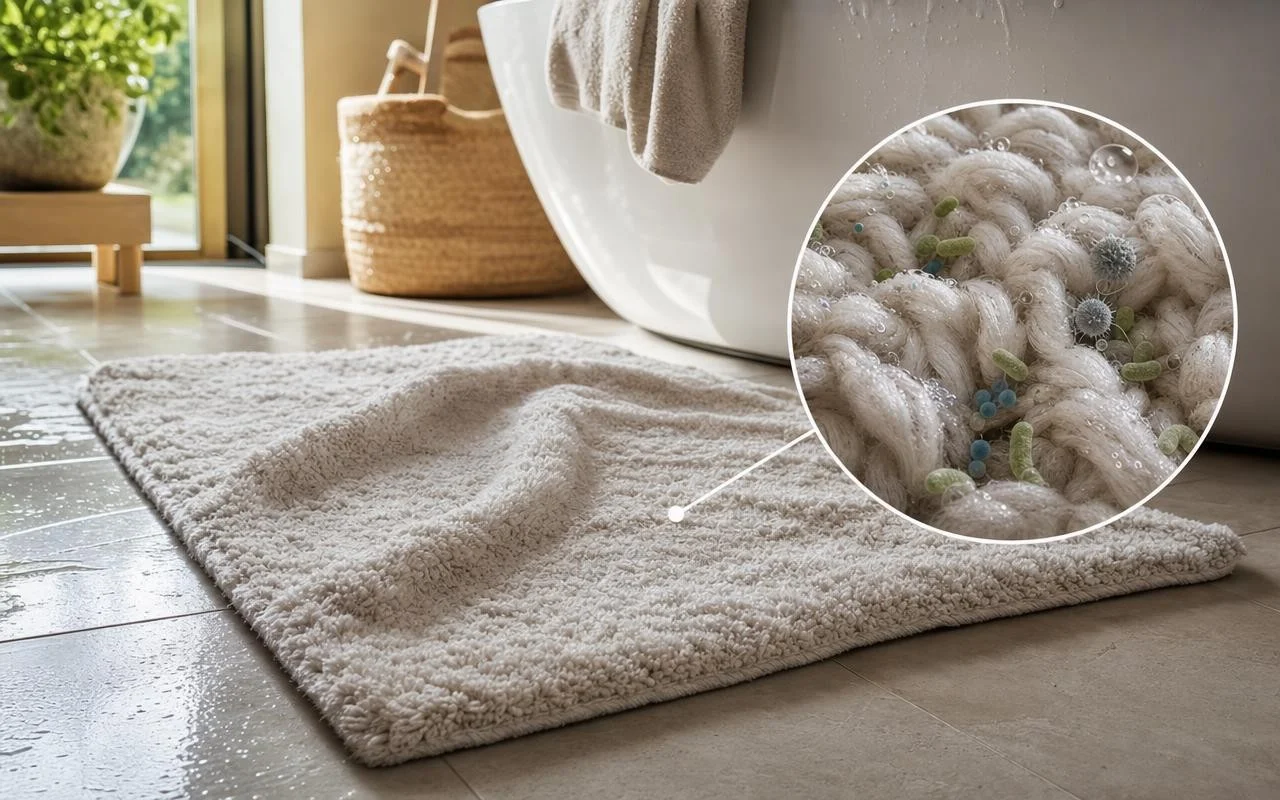
Your brand-new bath mat smells clean… for three days, at most. Then a musty odor takes hold, even if you’ve just started a wash. Many immediately blame the laundry detergent or the mat’s quality. In reality, the true culprit is much more discreet, nestled between the cotton fibers.
The bathroom brings together everything that micro-organisms love: heat, steam, floors that are often damp, sometimes with no window or ventilation. When laid flat, a cotton bath mat remains damp longer than you think. In a matter of hours, millions of bacteria and molds can develop there, and after two or three days, the nose detects what the eyes do not see.
Why your cotton bath mat smells musty so quickly
Cotton is a highly absorbent fiber, which is why we like it under our feet. But this quality becomes a drawback: it soaks up water and holds onto it deeply. The surface may look dry, but the mat’s core, especially if it’s thick or equipped with a non-slip rubber backing, remains soaked with residual moisture. In these hidden areas, bacteria, yeasts, and molds find an ideal refuge.
Public health bodies remind that a material left damp for more than 24 to 48 hours fosters mold growth. Yet, in a poorly ventilated bathroom, a cotton mat can stay damp much longer, especially if several showers follow one another. The musty odor corresponds to the compounds produced by these microscopic colonies. You wash the mat, it becomes neutral… then the same cycle restarts with the next shower.
The mistakes that let humidity settle between the fibers of the bath mat
In daily life, a few ordinary habits are enough to condemn a cotton mat. We leave it flat on the floor, close the door right after the shower, forget to hang or spread it out, and the ventilation runs little or not at all. With a rubber backing that blocks evaporation from underneath, the water trapped between the fibers simply has nowhere to go.
The most common mistakes are:
- leaving the mat balled up or folded in a corner after the shower;
- never hanging it up to promote air circulation;
- using a single mat for the whole family, without full drying time;
- keeping the bathroom closed, with no open window or ventilation running long enough;
- keeping a very thick mat or one with rubber backing on a poorly ventilated floor.
A healthier routine remains fairly simple: after each shower, shake and hang the mat, open at least the door, or even a window, let the ventilation run. A weekly wash at 40 °C helps, especially if you rotate two mats so that one model is always completely dry. When despite these steps the odor returns within 24 hours, when grayish stains appear or the texture becomes sticky, replacement becomes clearly necessary.
Diatomite bath mats: a dry alternative to musty odors
To circumvent this structural cotton problem, some households adopt a diatomite stone mat. This is a sedimentary rock formed from fossilized skeletons of microalgae, full of tiny pores. Placed at the shower exit, this slab absorbs water like blotting paper, then distributes it and allows it to evaporate very quickly. Many users report complete drying in less than two minutes, even after several passes.
Because the water does not stagnate, bacteria and molds have far fewer chances to settle, hence the usual absence of musty odors. Maintenance is limited to a quick wipe with a sponge, with light sanding when the pores get clogged by lime scale or soap residues. However, diatomite remains a mineral slab: less plush, sometimes a cold sensation on the feet, and a higher purchase price than a basic mat, offset by good durability. Some therefore choose a smart compromise: the diatomite stone right at the shower exit to manage humidity, and a comfortable cotton mat a bit further into the room.
