
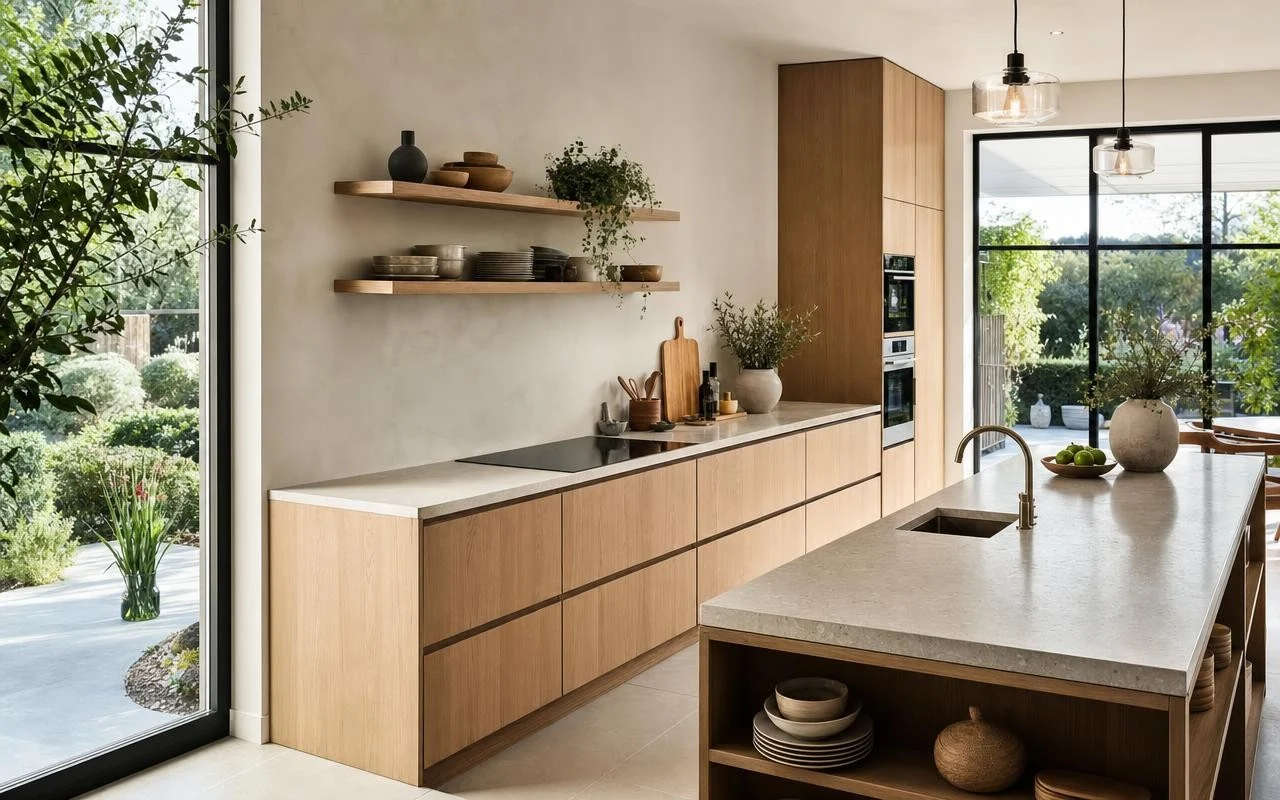
The most shared kitchen photos of 2026 carry a discreet yet striking common trait: walls above the countertop are almost bare. No more cabinets stacked up to the ceiling, but light shelves, or sometimes nothing at all. This choice is intriguing, especially when storage is already scarce.
According to Le Journal de la Maison, which looked into the trend in a piece published on July 6, 2026, the kitchen is becoming more than ever the heart of the home, open to the living room and designed as a living space. In this context, the kitchen without upper cabinets promises a lighter, brighter style, without sacrificing practicality… provided it is well organized.
Why a kitchen without tall cabinets feels larger
Tall cabinets occupy the portion of the wall at eye level. Visually, they form a continuous block that closes the perspective, especially in small rooms. By removing these volumes, the walls breathe, the horizon line clears, and the eye automatically perceives more depth. Light tones such as white or taupe, highlighted by Le Journal de la Maison, further reinforce this sense of space.
Another compelling argument: light. When you liberate the area around the window or an entire wall, natural light circulates more freely, shadows are less pronounced, and the work surface appears more welcoming. In open-plan kitchens that flow into the living room, this absence of upper cabinets also creates visual continuity with the living space. Clean, simple Scandinavian influences and industrial touches in black metal or stainless steel suit this setup particularly well.
Where does all the storage go when you remove the upper furniture
Choosing a kitchen without upper cabinets does not mean giving up storage, but relocating it. Many interior designers now concentrate the bulk of the storage on a single wall with tall floor-to-ceiling columns. Here you group the refrigerator, ovens, and pantry, which frees up the other walls and avoids a crushing linear look while still offering substantial capacity.
The Journal de la Maison also underscores the key role of lower units. Deep drawers, pots-and-pans drawers, and wide cabinets absorb a large portion of dishware and pots. The central island, often in stone, becomes a true centerpiece: it structures the space, provides storage on both sides, and serves as a meeting point. In small kitchens, an integrated table with bespoke benches can replace the island while adding storage compartments beneath the seating.
What to replace upper cabinets with to keep style and practicality
In place of the cabinets, recent projects multiply open shelves in wood or metal. They hold everyday dishes, a few pantry jars, and decorative items, in a mindful-grocery spirit evoked by Espaces contemporains. To avoid a cluttered look, it is best to limit their number and visually group items: uniform containers, subdued color palettes, labeled boxes to hide the little mess.
Stainless steel bars, hooks, and café-style grids, recommended by Le Journal de la Maison, also liberate drawers while giving character. You can hang pots, spatulas, and towels on them, as long as you stay selective. On the work surface, wooden trays help gather the coffee maker, kettle, and utensil pots to keep the surface easy to clean. Some even repurpose wine crates as wall storage, handy for spices or recipe books. This search for lightness contrasts with the highly functional approach of the famous Frankfurt Kitchen designed in 1926 by Margarete Schütte-Lihotzky; the trend kitchens of 2026 now embrace visible storage—warmer in feel, yet millimeter-perfect so that every object has its place.
Sources
- JLM
“Why the most trendy kitchens are abandoning upper cabinets (and what they put in their place for more style)”
