
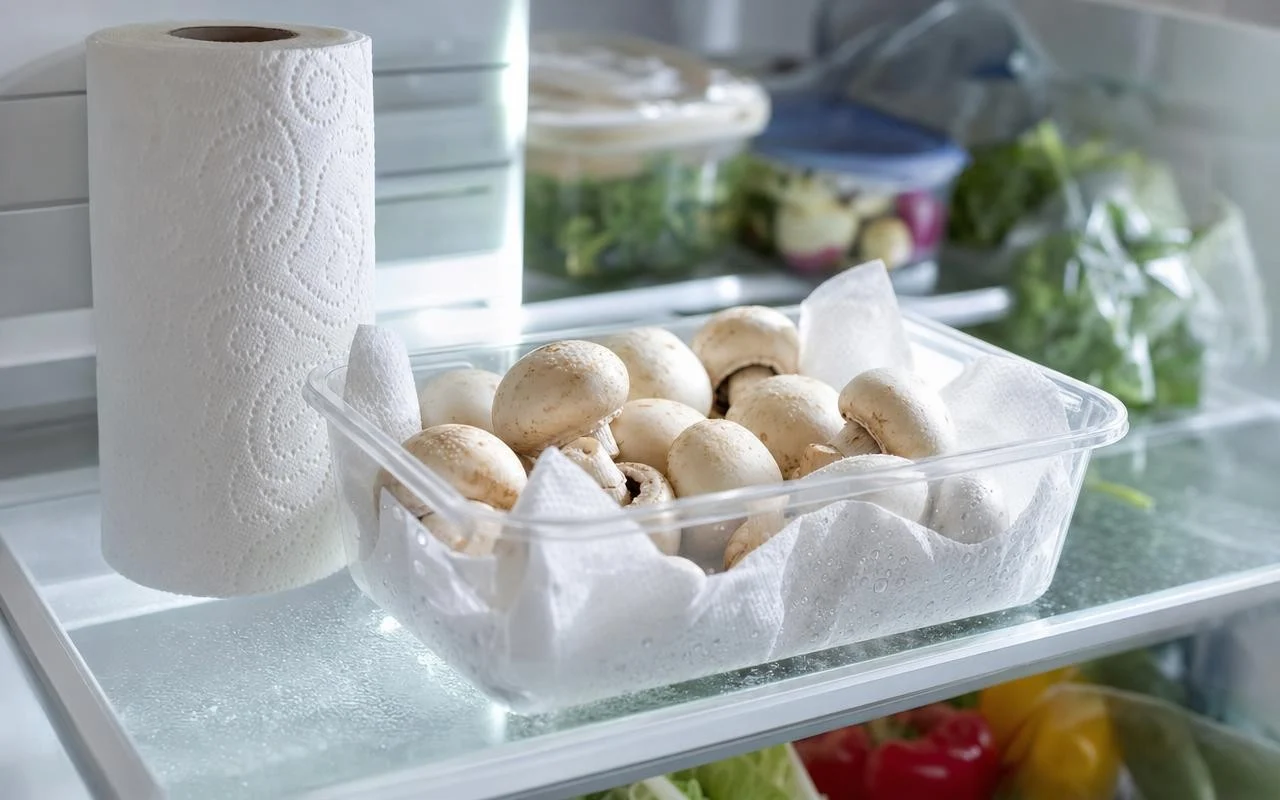
You buy a nice package of mushrooms, slide it into the refrigerator, and two days later they’re already soft all over, somewhat slimy, sometimes with a questionable odor. Many home cooks swear that a single sheet of paper towel tucked in with the mushrooms changes everything, without really understanding what’s happening inside the box.
Official bodies like Health Canada already advise keeping mushrooms in the refrigerator, in a paper bag, and consuming them quickly. The question remains how the mushroom-paper-towel conservation trick fits into this framework, and why it can work when used correctly.
Humidité, plastique et champignons visqueux : le vrai problème à régler
A mushroom is mostly water and continues to “breathe” after harvest. In a bag or a closed plastic tray, moisture condenses on the walls, drips back onto the caps, and creates that dreaded slimy film. The site La Table de Famille nicely captures this difference, estimating mushrooms last 2 to 3 days in plastic packaging, versus 5 to 7 days in breathable packaging like paper.
Health Canada also reminds us that poor packaging and storage conditions can foster certain bacteria, including those responsible for botulism, especially in hermetically sealed containers kept at too high a temperature. Even though refrigeration mitigates this risk, the underlying principle remains: avoid trapping moisture and allow at least some air to circulate, ideally in a cold zone between 0 and 4 °C as recommended by ANSES.
Que fait vraiment l’essuie-tout avec les champignons au réfrigérateur ?
The experts cited by Epicurious and the Washington Post describe the same idea: managing the balance between moisture and drying. The paper towel acts as a buffer. It absorbs the small droplets that form inside the bag or container instead of letting them stay in direct contact with the mushrooms. Paired with a container that permits a little airflow, this absorbent paper limits slimy mushrooms without them drying out too quickly.
Practically speaking, it’s enough to line the bottom of the paper bag or container with a dry sheet of paper towel, then place the mushrooms on top. Some prefer to put the towel on top, simply laid over the mushrooms—the idea is the same: to capture excess moisture. Health Canada recommends not washing the mushrooms before storing them, but rinsing them just before use and then patting them dry with a clean paper towel.
Mode d’emploi express et erreurs à éviter avec l’essuie-tout
Tests reported by AOL, drawing on Serious Eats, show that misusing the paper towel can have the opposite effect. When the paper becomes fully soaked and sticks to the bottom of the container, it creates a very humid zone where mushrooms in contact with it mold more quickly. So never let the paper towel turn into a sponge saturated with water.
To take advantage of the trick, a number of mistakes must be avoided:
- Washing the mushrooms before storing them, which adds even more moisture.
- Sealing them in a plastic bag or an entirely hermetic container.
- Leaving the moisture-laden paper towel in direct contact with the mushrooms.
- Storing in the vegetable drawer, often more humid, rather than on a cold shelf.
- Assuming they’ll keep for a full week: some sources mention only 3 days.
The durations do vary: Health Canada mentions up to 5 days for prepackaged mushrooms in the fridge, while La Table de Famille cites 5 to 7 days when stored in paper. American university sources cited by Demotivateur, such as Penn State Extension or Iowa State University, suggest between 3 days and a week depending on conditions.
In all cases, warning signs trump the calendar: a sticky or slippery texture, dark patches that spread, a strong or sour odor. In these situations, it’s best to discard the mushrooms, regardless of the presence of the paper towel. This small accessory simply enhances storage that is already sound: a paper bag or non-hermetic container, a well-cooled refrigerator, and prompt consumption.
